
Table of Contents
The bones were so small that at first glance they looked like they might belong to juveniles. But Fidel Torcida Fernández-Baldor of the Dinosaur Museum of Salas de los Infantes reckoned otherwise. Scattered across the Burgos Province site in northern Spain, the delicate fossils represented at least five individuals—all adults, all impossibly tiny for dinosaurs. “From the beginning, we knew these bones were exceptional because of their minute size,” he says. What wasn’t immediately obvious was just how exceptional. It would take years of painstaking analysis before the team realised they’d stumbled across something that would force palaeontologists to redraw branches of the dinosaur family tree stretching back seventy million years.
The animal they eventually named Foskeia pelendonum—from the ancient Greek for “light forager” and the Celtiberian Pelendones tribe that once inhabited the region—is weird in ways that matter. It isn’t just small. Plenty of dinosaurs shrank over evolutionary time, often losing complexity as they miniaturised. Foskeia did the opposite. “Miniaturization did not imply evolutionary simplicity,” says Marcos Becerra of the Universidad Nacional de Córdoba. “This skull is weird and hyper-derived.”
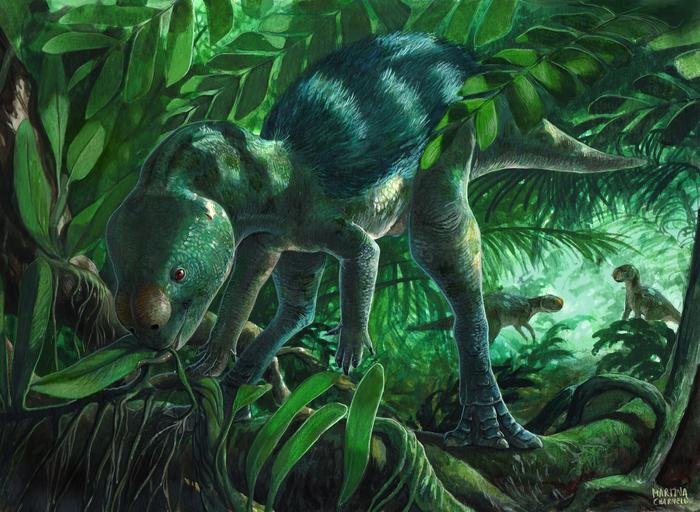
Hyper-derived is palaeontologist-speak for “evolution went absolutely bonkers here.” Under micro-CT scanning, Foskeia’s skull revealed fused premaxillae, procumbent front teeth that jutted forward, a single thread-like tooth at the front of the lower jaw, and a jaw joint positioned higher than in any related dinosaur. The overall effect is something that looks vaguely familiar (bipedal plant-eater, roughly chicken-sized) but constructed according to a completely different architectural plan. “This is not a ‘mini Iguanodon’, it is something fundamentally different,” notes Tábata Zanesco Ferreira of the Universidade Federal do Rio de Janeiro.
That fundamental difference is what makes Foskeia so valuable. Palaeontology has a massive gap problem. We’ve got decent fossil records for some periods and lineages, then… nothing. Entire chapters missing. The ornithopod dinosaurs—the group that includes famous herbivores like Iguanodon—are particularly patchy in the Early Cretaceous, especially in Europe. Finding an adult specimen of a previously unknown ornithopod from 125 million years ago is roughly equivalent to discovering a crucial page that’s been torn out of a history book for over a century. “Foskeia helps fill a 70-million-year gap,” says Thierry Tortosa of the Sainte Victoire Natural Reserve. “A small key that unlocks a vast missing chapter.”
The key works because of what Dr. Koen Stein of Vrije Universiteit Brussel found when he examined the bone microstructure. The histological analysis confirmed that at least one specimen was sexually mature despite its diminutive size, with growth patterns suggesting a metabolic rate approaching that of small mammals or birds—significantly higher than most dinosaurs. “Knowledge of growth and development is essential if we want to compare the anatomy of Foskeia with other species,” Stein explains. “Young individuals are prone to changes in anatomical features as they grow.” Without confirmation of adult status, researchers might have dismissed Foskeia’s bizarre features as juvenile characteristics that would disappear with age. Instead, they’re genuine evolutionary innovations that survived to reproductive maturity.
Those innovations tell a story about how this animal made its living. The specialised dentition and skeletal features suggest Foskeia shifted its posture as it grew, eventually relying on bursts of speed through dense Cretaceous forests. The procumbent teeth and unusual jaw mechanics hint at a very specific feeding strategy, possibly cropping low-growing vegetation with a precision that larger ornithopods simply couldn’t match. Being small opened ecological niches that bigger dinosaurs couldn’t access.
But the real bombshell came when the team ran a new phylogenetic analysis incorporating Foskeia. They placed it as sister to Muttaburrasaurus, an Australian ornithopod, within a group called Rhabdodontomorpha. That alone expanded our understanding of how widely this lineage spread. More dramatically, the analysis recovered an old, largely abandoned hypothesis about dinosaur relationships. “In our results, the plant-eating dinosaurs… form a natural group called Phytodinosauria,” the team reports in their paper. If this holds up under further testing, it would revive a classification scheme that most palaeontologists thought was settled decades ago.
Penélope Cruzado-Caballero of the Universidad de La Laguna puts it plainly: “Its anatomy is weird in precisely the kind of way that rewrites evolutionary trees.”
There’s a broader lesson here about what we miss when we focus only on the spectacular. Palaeontology has traditionally celebrated the massive, the complete, the photogenic. Titanosaurs that shake the earth. Tyrannosaurs with bone-crushing jaws. Complete skeletons that can be mounted in museum halls. Fragmentary remains of chicken-sized dinosaurs with bizarre skull anatomy? Less sexy, perhaps. Harder to fund. Easy to overlook.
The Foskeia team argues this needs to change. “These fossils prove that evolution experimented just as radically at small body sizes as at large ones,” they write. “The future of dinosaur research will depend on paying attention to the humble, the fragmentary, the small.” That 70-million-year gap they’ve helped fill? It’s almost certainly hiding more evolutionary experiments we haven’t discovered yet, buried in collections of “scrappy material” that seemed too incomplete to warrant detailed study.
Perhaps the most striking aspect of Foskeia is how it demonstrates that miniaturisation doesn’t mean simplification. If anything, shrinking opened up new possibilities. With less body mass to support, Foskeia could develop bizarre specialisations that would have been structurally impossible at larger sizes. The elevated jaw joint, the peculiar teeth, the metabolic rate approaching that of birds—these aren’t degenerate features of a lineage in decline. They’re innovations of a lineage adapting to entirely new ways of being a dinosaur.
We tend to think of dinosaur evolution as a story of getting bigger, more fearsome, more dominant. But what if we’ve been looking at it backwards? The real story, it turns out, includes countless lineages doing the opposite—getting smaller, weirder, more specialised. Evolution doesn’t have a direction. It just explores every available option. Sometimes the most important discoveries fit in the palm of your hand.
Related
Discover more from Wild Science
Subscribe to get the latest posts sent to your email.