
Table of Contents
An emergency fund has one job: to be there when the furnace dies, the car needs a transmission, or a job disappears. Where you keep that money matters almost as much as how much you save. Park it somewhere too locked up and you cannot reach it fast enough. Leave it in a checking account and it quietly loses value while inviting impulse spending. The top 7 places to keep your emergency fund balance safety, access, and a decent return. Most households do best with a mix rather than one account.
If you are starting from zero, the $25 transfer plan in this guide to building an emergency fund from scratch is a realistic place to begin.
1. A high-yield savings account
A high-yield savings account is the workhorse of most emergency funds. You get federal insurance up to $250,000 per depositor, per bank, and many online banks have paid 4% to 5% in recent years. Transfers to your checking account usually take one to two business days, which is fast enough for almost any real emergency.
Keep this account separate from the one you use for groceries and bills. A separate login and no debit card make it harder to raid the balance for a dinner out. Name it something boring: ‘Emergency Fund.’

2. A money market deposit account
A money market deposit account is a savings account with checking-like features. It is FDIC-insured at a bank, often pays a rate close to a high-yield savings account, and may come with a debit card or limited check-writing. That can help if you need cash the same day without waiting for an online transfer.
The trade-off is minimum balances and monthly fees. Some banks waive the fee only if you keep $2,500 or $10,000 in the account. Read the fine print and compare the fee-free yield against a plain high-yield savings account.
3. A no-penalty certificate of deposit
A no-penalty CD lets you withdraw your money before maturity without giving up interest, usually after the first six days. You lock in a fixed rate for 11 to 13 months, and the bank cannot cut that rate if savings rates fall. The money stays insured, and you keep a clear exit.
This works well for the slice of your fund you are unlikely to touch in the next six months but still want available. Avoid traditional CDs with early-withdrawal penalties for emergency money. A 5% rate is not much help if cashing out costs three months of interest. For more low-risk options, these safest investments that protect your hard-earned money are worth a look.
4. Short-term Treasury bills
Treasury bills are short-term government debt sold at a discount and maturing in four, eight, 13, 17, 26, or 52 weeks. They are backed by the U.S. government, and the interest is exempt from state and local income tax. That tax break can make a 4.5% T-bill worth more than a 4.5% savings account in a high-tax state.
You buy them through TreasuryDirect or a brokerage. A ladder of four-week and 13-week bills keeps some cash maturing every month, so you are never more than a few weeks from a payout. If you need money before maturity, you can sell on the secondary market, but the price can be slightly higher or lower than what you paid. Use T-bills for a second layer of your fund, not the whole thing.
5. A cash management account
A cash management account is offered by brokerages and fintech firms. It sweeps your cash into FDIC-insured partner banks, pays a competitive yield, and comes with a debit card and ATM access. If you already invest at a brokerage, it keeps your emergency cash in the same dashboard as the rest of your money.
Check the details: how many partner banks hold the cash, whether the debit card charges foreign transaction fees, and how quickly transfers settle. These accounts are not banks, so customer service and hold policies can vary. Still, they can be a solid home for money you may need within a week. Building the balance is the hard part; these ways to build wealth that take less effort than you think can help you automate the process.
6. A Roth IRA as a backstop
This one comes with a warning. A Roth IRA is not a first-choice emergency fund, but it can serve as a backup layer. You can withdraw your contributions at any time, tax-free and penalty-free, because you already paid tax on that money. Earnings have different rules, and early withdrawals of earnings can trigger taxes and a 10% penalty.
If you use this strategy, keep the emergency portion in something stable inside the Roth, such as a money market fund or short-term bond fund, not in stocks. You also face the annual contribution limit, and once you pull money out, you cannot easily replace it if you have already maxed out the year. Treat it as a deep backstop after your savings and CDs. And do not let the thrill of investing pull your emergency fund into risky assets; that investing itch can wreck a perfectly good safety net if you let it.
7. A small amount of physical cash
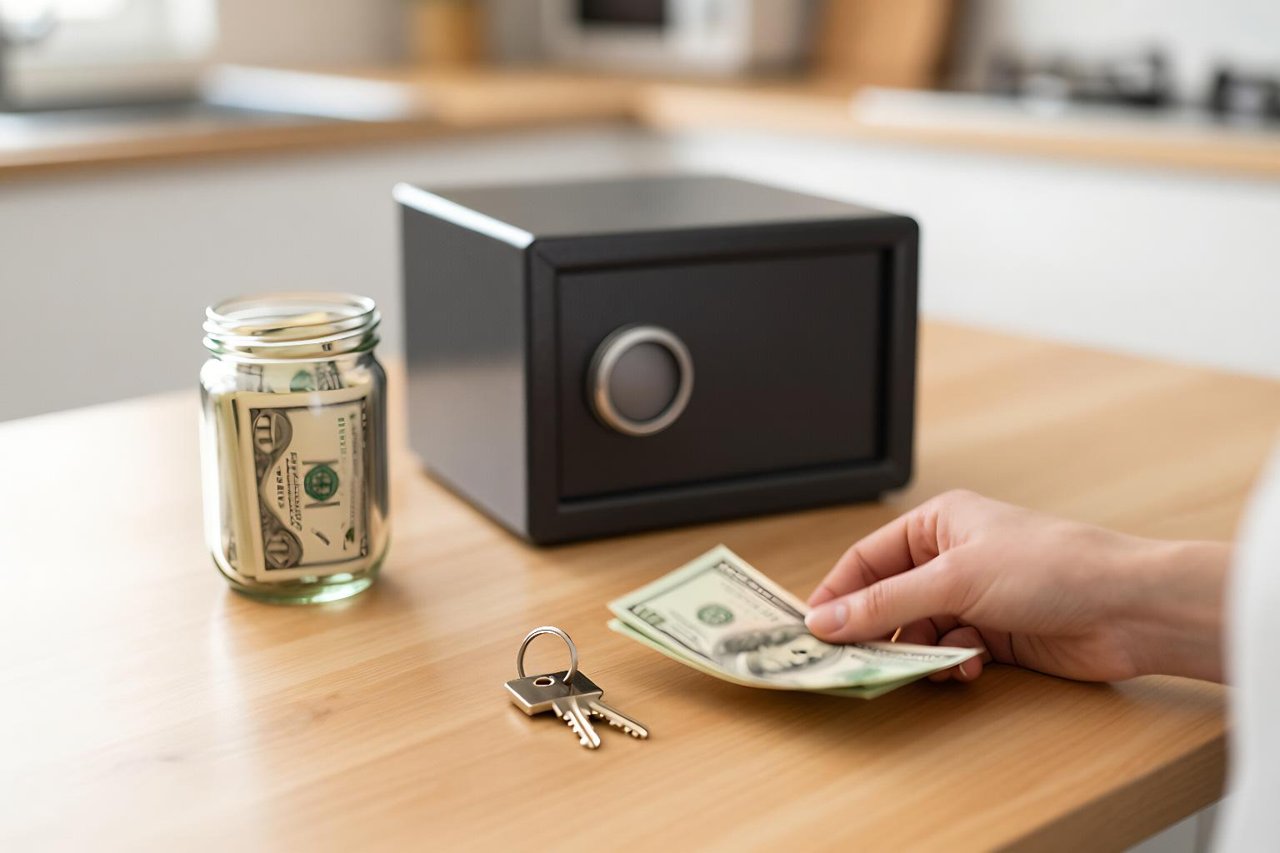
Keep $200 to $1,000 in small bills in a fireproof safe or another secure spot at home. This is not about earning interest. It is about paying for gas, groceries, or a hotel room when a storm knocks out card readers or a bank’s systems go down.
Do not turn your house into a vault. Cash can be stolen, lost in a fire, or eaten by inflation. A few hundred dollars is enough for a short disruption. For most people, the bulk of the emergency fund should stay in an insured account that you can access electronically.
How to split your emergency fund across these places
There is no perfect split, but a two-layer system works for most households:
- Layer 1: One month of expenses in a high-yield savings account or cash management account. This is your same-week money.
- Layer 2: The next two to five months in a mix of no-penalty CDs and short-term Treasury bills. These earn a bit more while staying reachable within days or weeks.
- Layer 3: $200 to $1,000 in cash at home for outages and card-system failures.
A common split is 50% in a high-yield savings account, 25% in a no-penalty CD, 20% in T-bills, and 5% in physical cash. Adjust based on your job stability, income volatility, and how quickly you could replace a paycheck. If you are barely scraping by, start smaller; even $500 can keep a small problem from becoming a debt spiral. This guide on what to do if you’re barely scraping by financially can help you find room in the budget.
Set up your two-layer system this week
Start with the account you already have. Open a high-yield savings account, nickname it, and set an automatic transfer for the day after payday. Even $25 per week adds up to $1,300 in a year. Once you reach one month of expenses, open a no-penalty CD or buy a 13-week T-bill with the next chunk. Keep the cash at home in small bills. Review the split once a year or after a major life change.
The exact accounts matter less than the structure. You want one pocket you can reach today, one pocket you can reach this month, and a small stash for the day the power goes out. Build that, and most financial surprises become annoyances instead of emergencies.


