
Table of Contents
Few forces on Earth are as dramatic or as misunderstood as volcanoes. They can level cities in hours, yet also create fertile soil that sustains civilizations. Volcanoes are not just destructive—they are constructive, building islands, mountains, and even the atmosphere itself. Understanding them means understanding the planet’s inner workings, from the core to the crust.
What Exactly Is a Volcano?
A volcano is a rupture in the Earth’s crust that allows molten rock, gas, and ash to escape from below. That molten rock, called magma when underground and lava when it reaches the surface, comes from the mantle—the layer between the crust and the core. Most volcanoes form at the boundaries of tectonic plates, where plates either pull apart or collide. But some, like the ones in Hawaii, pop up in the middle of plates over hot spots—plumes of unusually hot mantle material.
The Anatomy of an Eruption
Not all eruptions look the same. Some are gentle, oozing flows that creep across the landscape. Others are explosive blasts that send ash miles into the sky. The difference comes down to the magma’s chemistry and gas content.
Magma Viscosity: The Key Variable
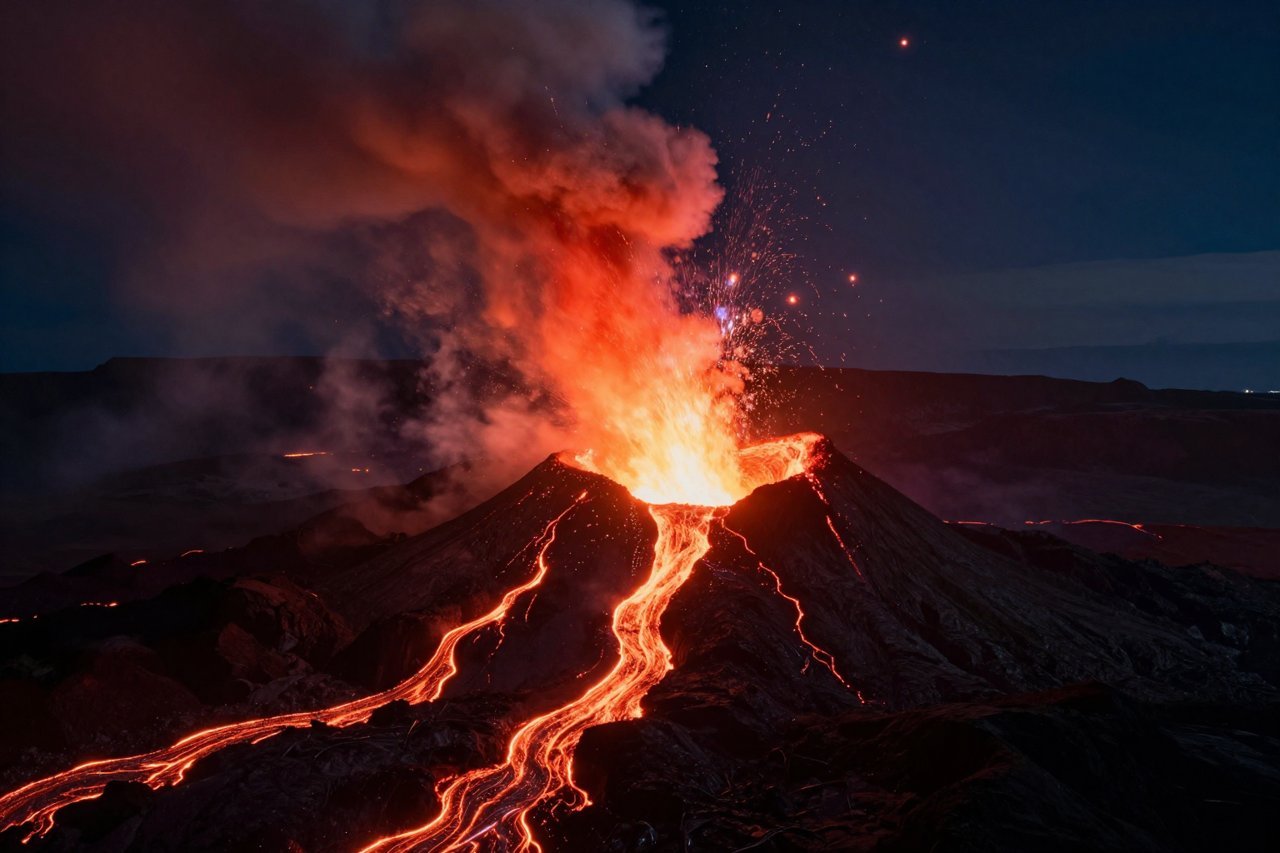
Magma with low silica content, like basalt, is runny. Gases escape easily, producing non-explosive eruptions—think of the red rivers on Hawaii’s Kīlauea. High-silica magma, like rhyolite, is thick and sticky. It traps gas until pressure builds to a breaking point, resulting in catastrophic explosions like the 1980 Mount St. Helens blast.

Types of Eruptive Styles
- Effusive eruptions: Lava flows steadily, building broad, gentle-sloped shield volcanoes (e.g., Mauna Loa).
- Explosive eruptions: Ash, pumice, and pyroclastic flows race down slopes at high speed, forming steep stratovolcanoes (e.g., Mount Fuji, Vesuvius).
- Phreatomagmatic eruptions: When magma meets water, steam explosions pulverize rock and create wide craters called maars.
The Biggest Volcanoes on Earth
Size matters when it comes to volcanoes. The largest volcano on Earth is Mauna Loa in Hawaii, rising about 9 kilometers from the seafloor. But the biggest known volcano in the solar system is Olympus Mons on Mars—two and a half times the height of Everest. On our planet, the supervolcanoes like Yellowstone pose the greatest long-term threat. They don’t erupt often, but when they do, they can alter global climate for years.
Volcanoes and the Shaping of Continents
Volcanoes are not just mountain builders; they also create new land. The Hawaiian Islands are a chain of shield volcanoes formed as the Pacific Plate moves over a hot spot. Iceland sits directly on the Mid-Atlantic Ridge, where the Eurasian and North American plates are pulling apart. This makes Iceland one of the most volcanically active places on Earth. The island grows by about 2 cm every year. If you’re fascinated by how such forces reshape our world, check out 25 Mind-Blowing Earth Facts That Will Change How You See the Planet—it includes more on plate tectonics and volcanic impacts.
Living with Volcanoes: Risks and Rewards
Despite the dangers, people have lived near volcanoes for millennia. The fertile volcanic soils are rich in nutrients, perfect for agriculture. In Indonesia, Java’s volcanoes support some of the densest farmland on Earth. The Romans grew grapes on the slopes of Vesuvius, unaware of the disaster that would bury Pompeii in A.D. 79.
Monitoring and Prediction
Today, volcanologists use a suite of tools to monitor restless volcanoes: seismometers detect tiny earthquakes as magma moves; GPS measures ground swelling; gas sensors sniff out changes in sulfur dioxide. These data can give hours to days of warning. For example, the 1991 eruption of Mount Pinatubo in the Philippines was predicted, allowing tens of thousands to evacuate. Still, many eruptions catch communities off guard, as seen in the 2018 eruption of Guatemala’s Fuego volcano.
Volcanic Hazards
Lava flows are rarely deadly because they move slowly. The real killers are pyroclastic flows—fast-moving clouds of hot gas and ash that can travel over 700 km/h. Lahars, or volcanic mudflows, can also be devastating. They occur when heavy rain or melting snow mixes with ash, rushing down valleys with the force of concrete. A massive lahar from Nevado del Ruiz in Colombia killed 23,000 people in 1985.
Volcanoes Beyond Earth
Volcanic activity isn’t limited to Earth. Jupiter’s moon Io is the most volcanically active body in the solar system, with hundreds of eruptions at any time. Venus has thousands of volcanoes, possibly still active. Mars boasts the largest volcano—Olympus Mons—and evidence of ancient eruptions. Studying these helps us understand planetary evolution. Some of the most surprising NASA discoveries that changed our understanding of the universe came from observing volcanic activity on these distant worlds.
The Role of Volcanoes in Climate
Large eruptions can cool the planet. When Mount Pinatubo erupted in 1991, it released 20 million tons of sulfur dioxide into the stratosphere. That gas formed sulfate aerosols that reflected sunlight, lowering global temperatures by about 0.5°C for two years. Smaller eruptions have less impact, but a supereruption could cause a volcanic winter, disrupting agriculture worldwide. However, volcanoes also release carbon dioxide—though humans emit far more each year than all volcanoes combined.
Famous Eruptions That Changed History
Some eruptions have left marks on human civilization. Thera (Santorini) around 1600 B.C. may have contributed to the decline of the Minoan culture. The eruption of Mount Tambora in 1815 was the largest in recorded history, causing the “Year Without a Summer” in 1816, with snow in June and failed harvests. More recently, the 2010 eruption of Eyjafjallajökull in Iceland shut down European air travel for weeks, costing billions. These events remind us how much we depend on a stable planet.
Volcanoes and the Ocean Floor
Most volcanic activity actually happens underwater, along mid-ocean ridges. These submarine volcanoes form new oceanic crust as magma wells up. The process is slow but continuous—the Atlantic Ocean widens by about 2.5 cm each year. Hydrothermal vents near these ridges host bizarre ecosystems that thrive without sunlight, relying on chemicals from the Earth’s interior. For more on how the ocean holds surprises, see Ocean Discoveries That Are Rewriting the Story of Our Planet.
The Future of Volcanology
Scientists are now drilling into active magma chambers to understand them better. The Krafla Magma Testbed in Iceland aims to directly sample magma at shallow depths. This could lead to more precise eruption forecasts and even geothermal energy from superhot rock. Meanwhile, satellite monitoring like InSAR can detect ground deformation across entire volcanic fields, offering a global watch. The ultimate goal is to turn volcanoes from unpredictable threats into understood natural processes.
Volcanoes are both creators and destroyers. They remind us that the Earth is alive, restless, and constantly reshaping itself. Whether you live near one or far away, their influence touches everything—from the air we breathe to the land we walk on.


