
Table of Contents
The last letters of Ugarit were never sent. Scribes in the Syrian port city had stacked clay tablets in a kiln to bake them when the end came around 1185 BCE, and the fire that consumed the city left that correspondence unfired and legible. One message begs the Hittite court for grain. Another reports enemy ships already at sea. Within a generation, Ugarit was gone, and so were the Hittite capital at Hattusa, the palaces of Mycenae, and most of the trade network that had held the eastern Mediterranean together for three centuries.
It’s a story told so often that it can sound simple: something bad happened, and a civilization fell over. The reality is messier and far more interesting. Why ancient civilizations collapsed is one of those questions where the honest answer is almost always “several things at once, in a particular order, with the poorest people hit first.”
Almost No Collapse Has a Single Cause
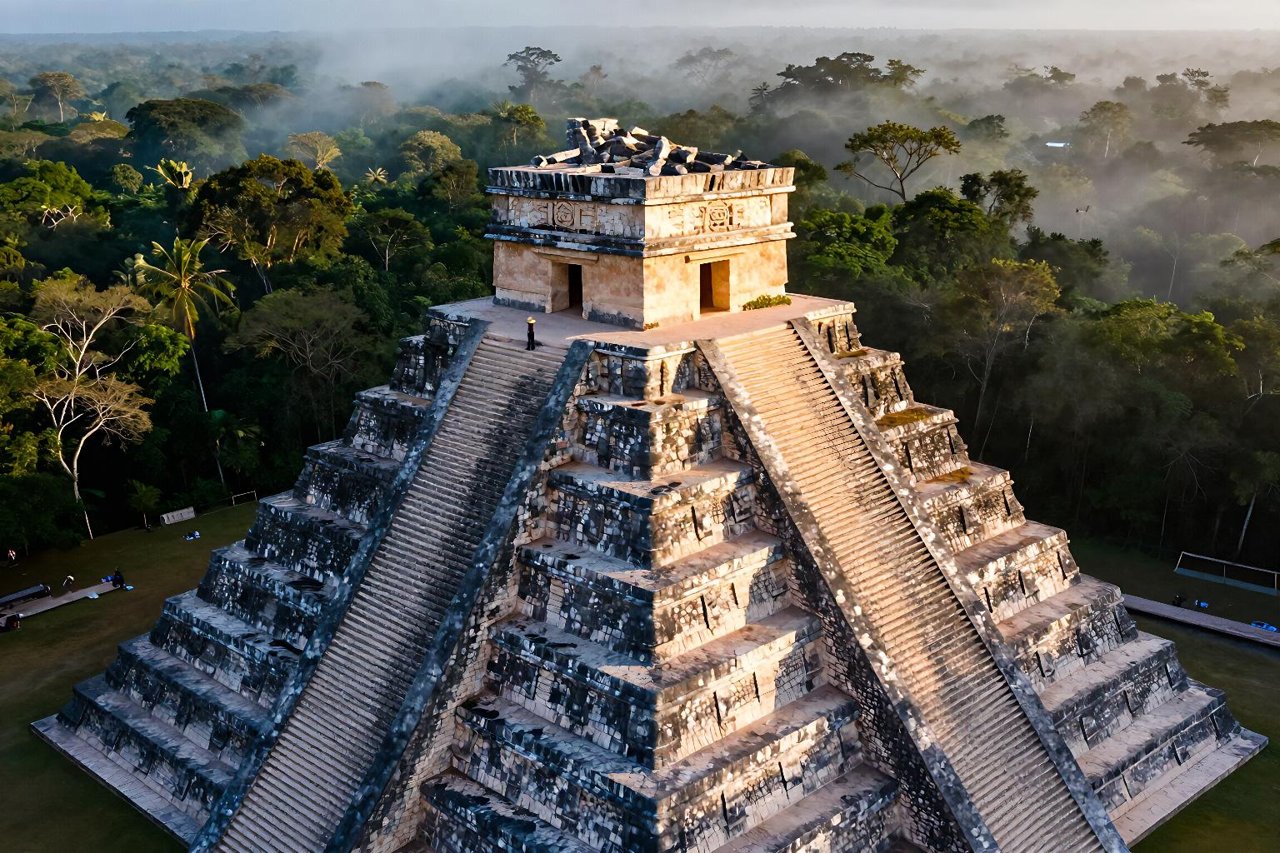
Take the Maya. For decades the popular explanation was drought, full stop. Then came the ecological version: too many people, hillsides stripped of forest, thin soils washing into rivers. Then the political reading, in which sacred kings whose legitimacy rested on delivering rain lost credibility when the rain didn’t come, and the entire ideology of divine rulership cracked along with the maize harvest.
All three are probably right. A drought in a landscape of several million people living on a narrow food surplus isn’t just a weather event. It’s a stress test applied to a political system, a farming system and a belief system simultaneously.

The Akkadians make the same point. Their empire unravelled around 2150 BCE during a drought severe enough that climatologists have named it the 4.2 kiloyear event. But Akkad had already spent a century squeezing conquered cities with tribute and garrison troops. The drought didn’t create the crisis. It removed the last bit of slack that might have absorbed it.
Climate Was Usually the Trigger, Not the Cause
Palaeoclimate records are the closest thing we have to a time machine. Speleothems from Yucatán caves, oxygen isotopes in lake mud, ice cores drilled out of Greenland: they tell a remarkably consistent story. The climate of the last five thousand years was never a stable backdrop against which human history politely unfolded. It swung, sometimes hard, sometimes for decades at a stretch.
Drought only kills societies that are already stretched
That distinction matters. Rain failed in the Mediterranean many times without ending anything. It ended the Greenland Norse because they were already marginal: a colony of a few thousand people refusing to eat fish in a land where fish were abundant, propping up their economy on walrus ivory, and then watching the European market for walrus ivory collapse in the fourteenth century. The climate was the last straw, not the first.
The Ground Beneath Them: Soil, Salt, and Water
Some of the most damaging collapses were slow, boring and entirely invisible to the people causing them. In southern Mesopotamia, thousands of years of irrigation under a baking sun raised the water table and pulled salt up into the topsoil. Wheat, which is salt-sensitive, gave way to barley. Barley yields then fell too. By the late first millennium BCE, some of the most productive land in the ancient world had been downgraded to marginal.
Greece and Italy had their own version of the problem: goats, charcoal burning and hillside ploughing stripping the soil off slopes that took millennia to build. And Angkor, the sprawling Khmer capital whose waterworks covered roughly a thousand square kilometres, depended on a hydraulic system so intricate that a run of failed monsoons in the fourteenth and fifteenth centuries could break it faster than any army.
Money, Trust, and the Cost of Running a State
Rome is the classic case, and the numbers are brutal. Under Augustus, the denarius was about 90 percent silver. By the 260s CE it was under 5 percent, a thin wash of silver over bronze. That debasement wasn’t stupidity. It was what a state does when the cost of soldiers, borders and administration outruns the tax base, and each fix makes the next one harder.
Money is really a proxy for trust. When people stop believing the coins, the contracts and eventually the institutions behind them, an empire can hold its territory and still lose the thing that made the territory worth holding. That pattern shows up again and again in the long history of why great powers break apart, from Sumer to Rome to dynasties that outlived their own tax systems.
Connected Worlds Break Faster
The Late Bronze Age is the clearest example we have of a collapse that spread through interdependence. Cyprus supplied copper. Tin came from Cornwall or Afghanistan, moving through dozens of middlemen. Mycenaean Greece, the Hittites, Egypt and the Levant were locked into a single trading system, with royal marriages and gift exchanges tying the elite together across thousands of kilometres.
That system was efficient right up until it wasn’t. Crop failures, earthquakes, raiders, displaced populations and the loss of a single link in the chain could cascade. Egypt survived the Bronze Age collapse, barely, and then spent the next century fighting off people who had once been trading partners. Connectivity is a multiplier. It makes good years better and bad years catastrophic.
The Cases That Are Still Being Argued Over
Not every collapse has a settled explanation, and some of the tidiest stories are the ones archaeologists now doubt. Easter Island’s famous ecocide narrative, popularised in the 1990s, has been challenged by researchers who argue the population never reached the numbers claimed and that rats and European contact did more damage than careless islanders. Cahokia, the great Mississippian city across the river from modern St. Louis, was abandoned by around 1350, and nobody can yet say whether floods, drought, deforestation or political breakdown was the decisive factor.
The Maya remain the most contested of all. There was no single Maya collapse. Some cities fell in the eighth century, others held on for another two hundred, and Maya communities kept farming and building long after the royal courts went quiet. The long argument over what happened to the Maya cities is a useful corrective to the idea that civilizations simply switch off.
What Actually Finishes a Civilization
Strip away the specifics and the same handful of pressures keep appearing:
- Environmental debt: eroded soil, salinised fields, deforested watersheds, depleted aquifers. The bill always arrives later than the spending.
- Climate shocks hitting a system with no stored surplus to absorb them.
- Fiscal exhaustion: states that can no longer pay for the army, the canals or the grain dole that keeps them legitimate.
- Elite overreach, where a narrow ruling class captures more of the surplus while delivering less, until the population stops cooperating.
- Loss of legitimacy, when the story a society tells about itself stops matching what people can see from the fields.
The technical achievements of these societies made them impressive, and in some cases they made them brittle. Sophisticated irrigation, monumental architecture and long-distance trade all demand constant maintenance, and the most technologically advanced ancient civilizations were often the ones most exposed when the maintenance stopped.
Collapse Is Rarely a Day. It’s a Generation That Stopped Repairing Things.
In most cases, the word “collapse” is doing too much work. The last dated monument at Tikal is from 869 CE, but people kept living in the region, farming, burying their dead, trading. What disappeared was a specific arrangement: divine kings, monumental construction, scribal schools, long-distance tribute. A thin elite layer peeled off, and millions of ordinary people simply reorganised.
That’s the part of the story that tends to get lost. Collapses are not evenly distributed. The people with land, grain stores and the ability to move survive them. The people one failed harvest from disaster do not. And the early warning signs are almost always dull: a canal nobody dredged, a salary paid in clipped coins, a temple with less plaster on the walls than the one before it.
No ancient civilization collapsed because of a single dramatic event. They collapsed because, year after year, the cost of holding everything together crept a little closer to the cost of letting it go, and someone in charge kept choosing the cheaper option.


