
Table of Contents
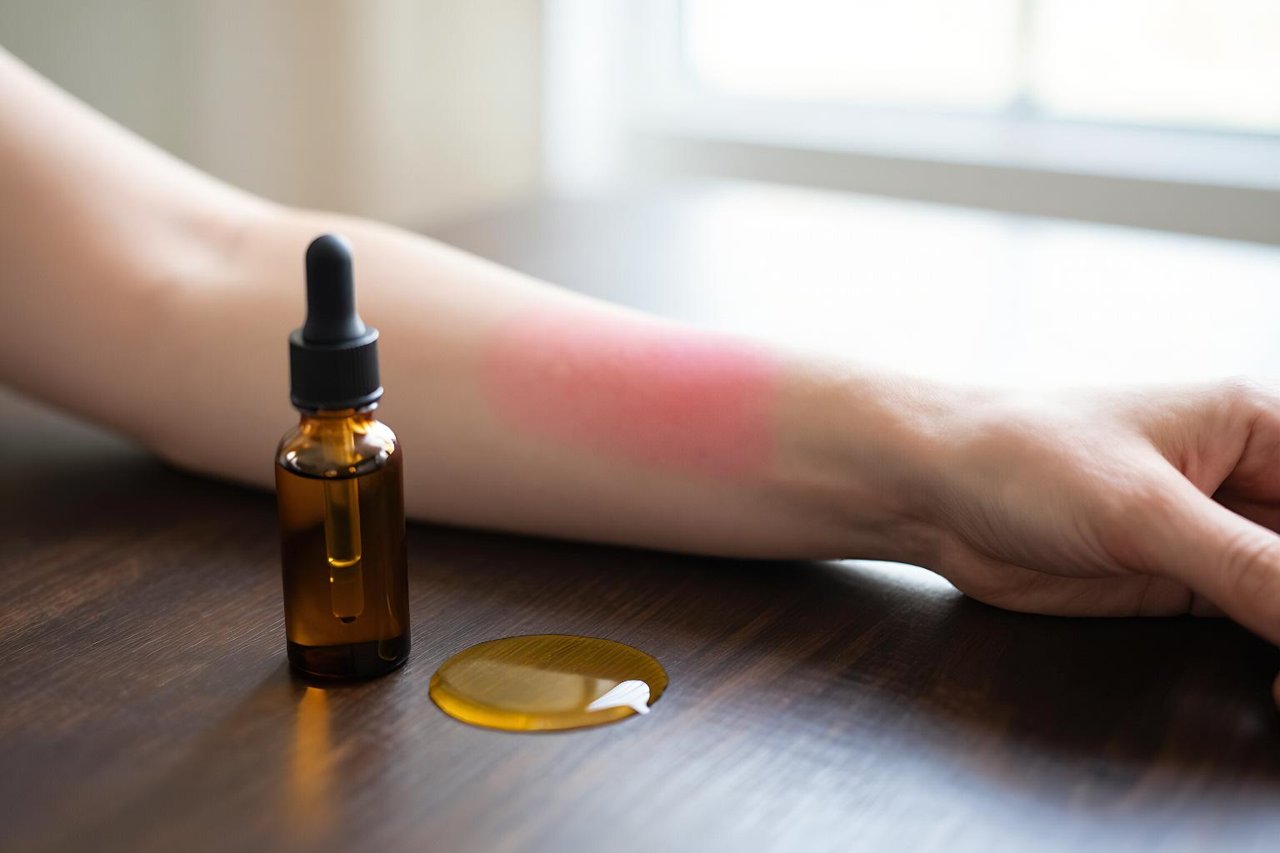
Six drops of neat lavender oil on a cotton pad, dabbed on a teenager’s temples before an exam. By morning there’s a tight red patch across her forehead, warm to the touch and itching enough to keep her awake. Her mother is baffled. It was natural. It was organic. It was supposed to help her sleep.
What happened on that forehead isn’t a mystery, and it isn’t a sign of a “toxic” body. It’s chemistry meeting skin. Essential oils are among the most concentrated plant materials you can buy at a market stall. That intensity is what makes them potent in a diffuser, and it’s also what makes them sting.
Irritation and Allergy Are Two Very Different Problems
People use “irritated” as a catch-all, but dermatologists separate two reactions that look similar and behave nothing alike.
Irritant contact dermatitis
This is direct damage. The oil is too strong for the skin’s barrier, and the proteins and lipids in the outer layer get disrupted. Anyone exposed to a high enough dose will react. Onset is fast, usually minutes to a couple of hours, and it stays inside the area that was exposed. Typical signs are stinging, redness, dryness and a crisp edge where the oil stopped. Paint 100% cinnamon bark oil on your wrist and you’ll get irritation, no prior exposure required.

Allergic contact dermatitis
This one involves the immune system. It needs a first exposure to prime the body, which often passes without a single symptom, then a second contact triggers a rash 24 to 72 hours later. It can blister, it spreads past the original site, and it can return when you use a product containing the same compound at a fraction of the strength. Once you’re sensitised to linalool, a “gentle” lavender body lotion is enough to set it off.
The Chemistry Behind the Sting
Essential oils are cocktails of terpenes, alcohols, aldehydes, ketones and phenols. Some are mild. Others are aggressively reactive.
Phenols and aldehydes such as thymol in thyme, carvacrol in oregano, eugenol in clove and cinnamaldehyde in cinnamon are the classic hot oils. They denature proteins on contact, which is why aromatherapists handle them with gloves.
Alcohols and terpenes like linalool and limonene smell lovely in a fresh bottle and become a different chemical story once they oxidise. Linalool turns into linalool hydroperoxides; limonene becomes carvone and limonene hydroperoxides. Those hydroperoxides are potent sensitisers. In patch-test studies, oxidised linalool causes reactions in a meaningful share of people who have never had trouble with fresh lavender oil.
Furocoumarins in cold-pressed citrus oils make skin temporarily photosensitive. Bergamot is the famous offender. Apply a 3% blend and spend an hour in the sun, and you can come back with a streaky, burn-like reaction that fades into brown pigmentation lasting months.
Dilution: The Number That Matters Most
Nearly every reaction I’ve seen in friends’ bathrooms traces back to one thing: no carrier oil. A drop straight from the bottle is close to 100% concentration. Skin doesn’t handle that well, and it doesn’t need to.
- 0.5-1%: face, neck, children over two, older skin, pregnancy. Roughly 3 to 6 drops per 30 ml of carrier oil.
- 1-2%: general adult body massage and daily leave-on blends. 6 to 12 drops per 30 ml.
- 3-5%: short-term use on small areas, or professional work. 18 to 30 drops per 30 ml.
Worth knowing: a 30 ml bottle of jojoba or sweet almond holds roughly 600 drops. So 1% is six drops, not the twenty that look harmless when you’re squirting from a pipette.
Oils With a Reputation for a Reason
A handful of oils account for a disproportionate number of reactions. That doesn’t make them evil, it makes them strong.
- Cinnamon bark, clove bud, oregano, thyme — high phenol content, irritant even when diluted.
- Wintergreen — mostly methyl salicylate, which absorbs quickly and can cause serious harm in small volumes.
- Lemongrass and citronella — citral is a well-documented sensitiser.
- Tea tree — usually fine when fresh, troublesome once the bottle has been open for a year.
- Peppermint — menthol near the eyes or on broken skin feels like a small emergency.
Who Reacts Most, and Where
Skin thickness varies across the body. Eyelids are around 0.5 mm; the soles of your feet are several millimetres thick. A 2% blend that feels lovely on your back will sting on your neck. Anyone with eczema, rosacea, seborrhoeic dermatitis or a recent chemical peel has a compromised barrier and reacts at concentrations other people tolerate easily. Children have thinner skin and a higher surface-area-to-weight ratio, so the same dose hits harder.
When the Bottle Itself Is the Problem
An oil that has sat open on a sunny windowsill for two years is not the oil you bought. Oxidation speeds up with heat, light and air. Citrus oils can turn within six months; resinous ones last years. If the liquid has gone cloudy, the smell has shifted from bright to sour, or the dropper is gummy, bin it.
How to Patch Test Without Fooling Yourself
- Dilute the oil exactly as you plan to use it. Testing neat oil tells you nothing useful about a 1% blend.
- Apply a 20p-sized amount to the inner forearm, then cover with a plaster or a folded square of gauze and tape.
- Leave it 24 hours, then check at 24, 48 and 72 hours. Allergic reactions are slow; a five-minute wait proves nothing.
- Phototoxic oils need a light test too. Apply, wait a day, then expose briefly to daylight and watch for burning or darkening.
- Test one oil at a time. If you test a blend of five, you learn nothing when you react.
If Your Skin Is Already Reacting
Act quickly and gently. Wipe the area with a carrier oil or full-fat milk: oils dissolve oils, while water just spreads them around. Follow with a mild, fragrance-free cleanser and lukewarm water. A cool compress takes the heat out, and an over-the-counter 1% hydrocortisone cream is reasonable for a small itchy patch for a few days. Skip acids, retinol and anything perfumed until the skin settles. Blistering, swelling, breathing trouble or a rash across a large area means a doctor, not a home remedy.
Reading the Label Like a Formulator
“Pure”, “therapeutic grade” and “aromatherapy quality” are marketing phrases, not regulated standards. What’s genuinely useful sits in the ingredient list. Under EU rules, 26 fragrance allergens must be declared by name when they exceed 0.001% in leave-on products. That’s where you’ll spot linalool, limonene, geraniol, citronellol, eugenol and cinnamal. Seeing them listed isn’t a warning of danger; it’s information that lets you dodge the one that got you.
Look for “bergapten-free” or “FCF” on citrus oils if you’ll be outdoors, and treat “parfum” or “fragrance” with suspicion if you’re already sensitised, because it can hide an undisclosed essential oil blend. Store bottles upright in dark glass, away from the radiator and the window. Write the open date on the cap. If your skin has already told you no once, believe it. A sensitised reaction is far easier to prevent than to calm down.


