
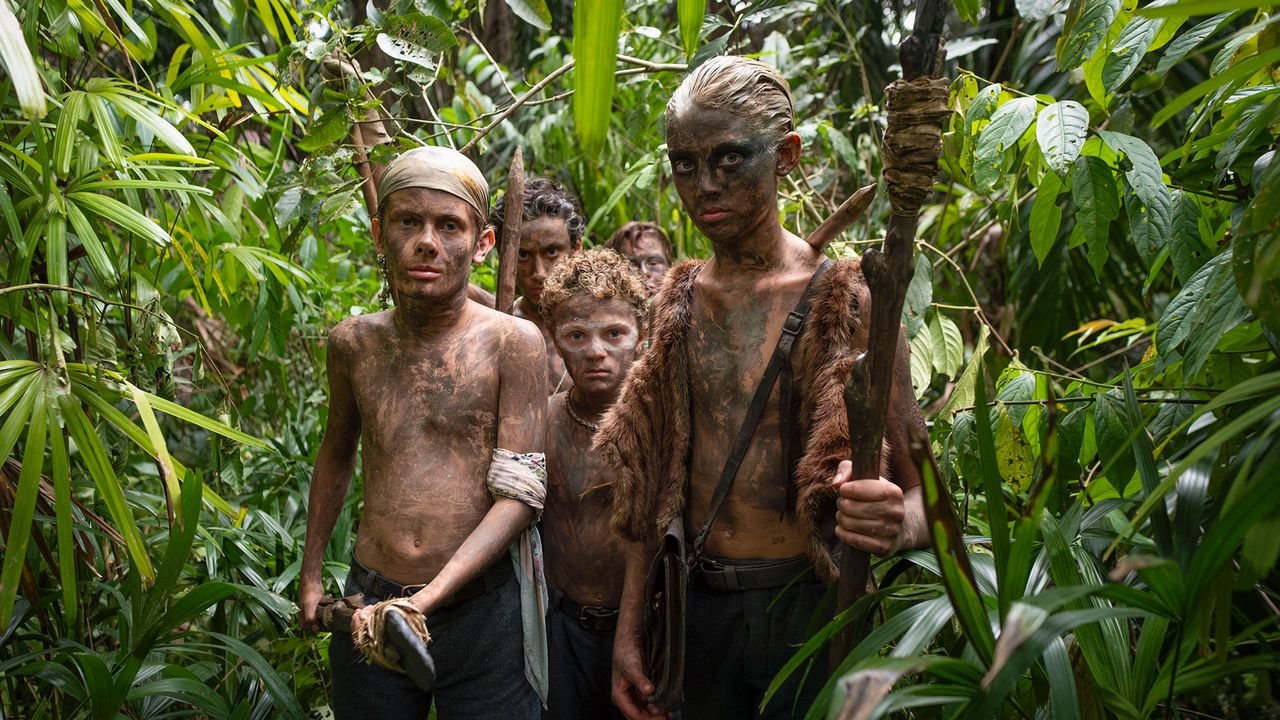
I first read Lord of the Flies not as a teenager in school, like most, but as a fully-grown adult. And I was horrified.
Not because I am sheltered or unaccustomed to the ways of the world, but because William Golding’s allegorical tale is such a visceral account of toxic masculinity that it disturbed me to my core – to the point I had to take several breaks before I could finish it.
(In fact, the only other piece of fiction that has ever had this sort of impact on me is American Psycho by Bret Easton Ellis. Take from that what you will.)
For, despite Lord of the Flies being set during the Second World War and published in the 1950s, it is still eerily relevant today – so much so that the BBC has turned the cautionary “fable” (as Golding himself put it) into a new four-part series. And who better to adapt the book than Adolescence writer, Jack Thorne?
The story, for those unfamiliar, follows a group of British schoolboys who are left stranded on a deserted island in the Pacific after their plane crashes. Not only are there no adult survivors from the wreckage, leaving the boys alone to fend for themselves, there is a notable absence of women and girls throughout.
We start off with democratically-nominated chief, Ralph – a smart, well-mannered boy who, although he isn’t perfect, certainly seeks to be fair and do right by others. Combined with the astuteness of his pal Piggy, they act as guardians for the boys and “littluns”, setting out a plan of action to be rescued.
Their authority is quickly brought into question by another boy named Jack, however, who, along with his choir group, swiftly assumes the role of hunter.
A power struggle then ensues between Jack and Ralph, with the former prioritising food-gathering over keeping the fire alight to provide a smoke signal to passing ships.

Slowly but surely, Jack and his pack edge closer and closer towards evil, represented by the sadistic presence of Roger, who’s always been there, but steadily becomes more pronounced as time progresses. Without any proper guidance and repercussions for their actions, the boys’ brutality and mob mentality lead to fatal consequences.
Given that the author, Golding, was both a schoolteacher and a lieutenant in the Royal Navy, the original story is very much an allegory for the real bloodshed of the war – of the corruption of innocence and the stolen youth of those on and off the battlefield.