

Table of Contents
[ad_1]
I live and breathe emails.
As a marketer, email outreach isn’t just another task on my to-do list. It’s a critical part of building relationships and driving results. Over the years, I’ve realized that the success of an email doesn’t end with hitting “send.” What happens afterward, when someone opens it, clicks a link, or spends time reading, holds the real insights.
Curious to find tools beyond the basics, I spent weeks experimenting with the best email tracking software. I wanted answers to specific questions: Does email tracking actually work, or is it just notification noise? Which tools go beyond open rates and give you something you can act on? Each tool I evaluated had quirks, strengths, and shortcomings, and a few genuinely changed how I think about outreach.
After researching over 30 solutions, I’ve compiled a list of the 10 best email tracking software that genuinely impressed me, including Salesforce Sales Cloud, HubSpot Sales Hub, Apollo.io, Instantly, and ZoomInfo Sales. These platforms do more than just track opens and clicks; they provide concrete insights that help fine-tune my strategy.
Whether you’re a sales pro, a freelancer managing client communication, or just someone wanting to know when their emails are being read, there’s a tool here for you. Ready to see which software deserves a spot in your tech stack?
Let me walk you through the standouts and what makes them worth your time.
Best email tracking software for 2026: My top picks
- Agentforce Sales (formerly Salesforce Sales Cloud): Best for enterprise teams with AI-driven pipeline management
AI-driven insights, customizable dashboards, integration with various platforms ($25/mo) - HubSpot Sales Hub: Best for automated follow-ups and pipeline visibility Tracks opens, clicks, and document views natively in Gmail and Outlook, triggering follow-up sequences based on recipient behavior. (Free; paid from $20/mo)
- Apollo.io: Best for outreach teams that prospect and track in one place
Pairs a verified B2B contact database with sequencing to track and follow up with prospects in one place. (Free; paid from $49/mo) - Instantly: Best for cold outreach with deliverability built in
Monitors campaign performance across unlimited sending accounts while managing inbox placement and domain reputation. (Free trial; paid from $37/mo) - ZoomInfo Sales: Best for intent-driven prospecting and engagement Combines email engagement with real-time intent signals to prioritize prospects most likely to convert. (Available on request)
- Pipedrive: Best for visual pipeline management and deal tracking Automatically links emails to deals and contacts for a single view of every conversation and pipeline stage. (Free trial; paid from $24/mo)
- Salesloft: Best for structured cadences across multiple channels
Tracks opens, clicks, and replies within cadences and connects that data to call outcomes and CRM activity. (Available on request) - Close: Best for fast-moving sales teams in a CRM-native setup
Logs every email, call, and SMS automatically so reps always know exactly where each lead stands. ($9/mo) - monday CRM: Best for visual deal management with AI-driven automation Syncs email activity into deal boards and uses AI agents to flag engaged leads and trigger next steps. (Free trial; paid from $12/mo)
- Brevo Marketing Platform: Best for multi-channel campaign management Tracks opens, clicks, and engagement across email, SMS, and WhatsApp from one dashboard. (Free; paid from $9/mo)
*These email tracking software solutions are top-rated in their category, according to the G2 Spring 2026 Grid Report. I’ve also added their monthly pricing to make comparisons easier for you.
Best email tracking software I recommend
The idea behind email tracking seems simple enough: a tool that tells you when someone opens your email, clicks a link, or interacts with your message. But I wondered if it really worked. Would it be just another notification overload, or could it genuinely change how I manage my outreach?
So, I decided to dig in and evaluate various tools to see what they were made of. Here’s what I learned: at its core, email tracking software uses tiny, invisible mechanisms, like pixel tracking or unique link identifiers, to track specific actions a recipient takes. Sounds technical, right? Thankfully, most tools made it pretty seamless for me to set up and interpret.
How did I find and evaluate the best email tracking software?
I wanted to go beyond surface-level research. Instead of relying solely on Google searches or personal recommendations, I wanted a deeper understanding of what these tools offered and how they performed. To get started, I identified some of the leading names in the industry through G2’s grid reports. I evaluated over 30 tools before narrowing the list down to these 10.
Once I had my list, I tested each tool in different capacities. From installation to daily use, I examined how intuitive the software felt and how well it integrated with my existing setup. I paid close attention to features like real-time notifications, data accuracy, and analytics depth. Tools that were easy to use and delivered reliable insights quickly rose to the top of my list.
I also tapped into user feedback at scale. I used AI to analyze hundreds of reviews on G2, which helped me spot recurring themes, both positive and negative, that I might not have encountered in my testing alone. In cases where I couldn’t personally test a tool due to limited access, I consulted a professional with hands-on experience and validated their insights using verified G2 reviews.
The screenshots featured in this article may include both those captured during testing and those obtained from the vendor’s G2 page.
The global email tracking software market is valued at USD 3.3 billion in 2026, with firms using advanced link tracking and document analytics reporting up to a 5x increase in ROI.
Choosing the right email tracking tool isn’t just about tracking opens. It’s about getting the details that matter without drowning in unnecessary noise. Let me show you how I picked the ones that made the final cut.
What do I look for in the best email tracking software?
What I loved during testing was how the best email tracking software removed the guesswork. Instead of sending a follow-up email into the void, I could see when someone opened my message or clicked a link. But some tools also bombarded me with alerts for every single open, while others buried the data behind confusing dashboards.
After all of that, I’ve realized the real value of email tracking software lies in how much it simplifies my work while giving me data that’s actually useful. To make sure you’re picking the right tool, here’s a list of key factors I found crucial during my testing.
- Tracking precision: I needed tools that didn’t just claim to track opens and clicks but actually delivered accurate, real-time data. Tools that relied on pixel tracking often stumbled when recipients used privacy-focused email clients. The standouts were the ones that combined pixel and link tracking for a complete picture of recipient behavior.
- Integration with my workflow: If a tool didn’t play nice with my Gmail or connect seamlessly with CRM, it was immediately out. I wasn’t about to upend my entire workflow for clunky integrations. The tools I kept coming back to were the ones that felt invisible, working in the background without requiring constant monitoring or extra logins.
- Customizable notifications: Some tools overwhelmed me with useless notifications. I mean, do I really need to know every single time someone re-opens the same email? The best software lets me fine-tune alerts, so I only get updates when it actually matters, like the first time someone opened an email or clicked a key link.
- Advanced analytics: Beyond basic open and click rates, I wanted insights that told a deeper story. For example, how long did someone spend reading my email? Did they forward it to someone else? Tools that tracked this level of detail helped me refine my strategy, while those stuck to surface-level metrics felt like they were holding back.
- Privacy compliance: As someone who sends emails globally, I couldn’t ignore compliance. GDPR and similar regulations are serious business, so I prioritized transparent tools about how they tracked recipients and offered opt-out features. If the software didn’t respect privacy laws, I wasn’t interested, no matter how flashy its features were.
- Scalability: This was a big one for me. Some tools worked fine for solo use, but as soon as I tried scaling for team collaboration, they buckled. Shared analytics, collaborative templates, and the ability to assign tasks were must-haves for me when thinking long-term.
- AI-powered insights: In 2026, the best tools don’t just show you who opened an email. They tell you what to do next. I prioritized tools that used AI to surface follow-up recommendations, flag high-intent leads, or optimize send times based on recipient behavior.
The list below contains genuine user reviews from the Email Tracking Software category page. To be included in this category, a solution must:
- Integrate with email platforms so that users can create, manage, send, schedule, and track inbound and outbound emails
- Enable users to schedule emails according to a diverse range of factors, such as time constraints, geographic distribution of prospects, and prospect status
- Notify users when various actions (e.g., email opened, reply sent, attachment downloaded) are performed by the recipient
- Allow users to categorize inbound and outbound email communications according to tags, lists, and sales priority
- Deliver analytics on basic and advanced email use information to understand how emails are received
*This data was pulled from G2 in 2026. Some reviews may have been edited for clarity.
1. Agentforce Sales: Best for enterprise teams with AI-driven pipeline management
When I tested Agentforce Sales (formerly Salesforce Sales Cloud) for email tracking, I knew I was stepping into a tool designed for teams that think big and work smarter. As a marketer, I often need tools that bridge the gap between strategy and execution, and Agentforce caught my attention because of its ability to connect email tracking directly to broader marketing efforts: support campaigns, nurture leads, and provide actionable insights.
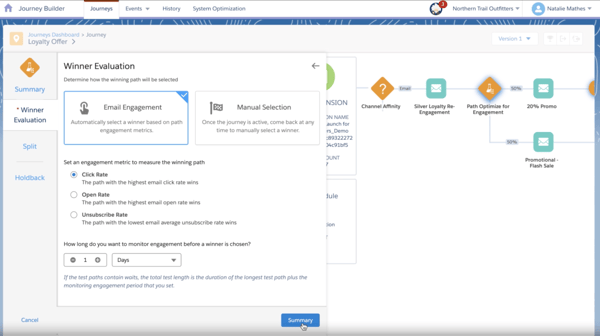
Every email I sent within the system wasn’t just tracked. It was linked to a contact’s entire history, including how they interacted with past campaigns, content downloads, or website activity. For instance, when I sent an email promoting an eBook, I could see whether the recipient opened it, clicked the download link, and interacted with other content. This level of granularity made it easier to identify which campaigns resonated with specific segments of my audience.
Another feature I found genuinely useful was the engagement scoring. Agentforce Sales doesn’t just track email opens and clicks; it aggregates these actions with other interactions to rank leads based on their overall engagement. What I appreciated was that the lead scoring goes beyond a number. It actually explains the “why” behind each score, so my team always understood what was driving a lead’s priority and could act on it with confidence.
What really stood out during my testing was the shift toward autonomous AI agents. Agentforce now deploys AI that can proactively handle lead research, draft personalized outreach emails, and manage follow-up tasks with minimal human intervention. For a busy sales team, this is a meaningful upgrade. It moves the platform from a system of record to a system of action, handling the administrative grind so reps can stay focused on closing.
One thing worth knowing is that the AI features work best when your CRM data is clean and well-maintained. If your historical records are patchy or inconsistent, the AI’s suggestions can feel off until things are tidied up. For teams willing to invest in that groundwork, though, the payoff is significant. The automation and intelligence Agentforce brings to the table is hard to find elsewhere at this scale.
For managing campaigns that tie directly to sales goals, Agentforce’s email tracking features are invaluable. It’s a tool best suited for teams that need detailed insights and are already invested in the Salesforce ecosystem.
What I like about Agentforce Sales:
- I could tie email tracking data to campaign performance and see it alongside other lead interactions (like downloads or ad clicks), which was great for analyzing content effectiveness.
- With engagement scoring, I could focus on the most active leads, helping me allocate resources to those most likely to convert.
What G2 users like about Agentforce Sales:
“What I like best about Agentforce Sales is the transition from manual CRM management to autonomous sales support. By leveraging the power of Data Cloud, the platform provides AI agents that can proactively research leads and manage outreach. This ‘Agent-first’ approach, combined with Einstein’s generative capabilities, has transformed Salesforce from a database into a proactive member of our sales team, significantly reducing administrative overhead.”
– Agentforce Sales Review, Jasjit S.
What I dislike about Agentforce Sales:
- Getting the AI to perform at its best requires clean, well-organized CRM data, which can take some upfront effort, but teams that invest in it tend to see a noticeable lift in how accurately the platform prioritizes and routes leads.
- The initial setup involves a fair bit of configuration across multiple menus, though once everything is in place, the platform handles even the most complex enterprise workflows without breaking a sweat.
What G2 users dislike about Agentforce Sales:
“The biggest challenge is the complexity of implementation, salesforce is not plug and play, it require proper planning, configuration and often a dedicated admin or consultant, the cost can be high, especially when you include licence, add ons and implementation expenses, there is also a steep learning curve, especially for new users or non technical teams, sometimes performance issues like slow loading or glitches can impact user experinece.”
– Agentforce Sales Review, Himanshu I.
2. HubSpot Sales Hub: Best for automated follow-ups and pipeline visibility
I’ve always appreciated HubSpot’s focus on creating tools that work seamlessly together, so I was curious to see how HubSpot Sales Hub performed specifically for email tracking. While it’s positioned as a sales tool, the email tracking features proved incredibly useful for refining my marketing campaigns and understanding audience behavior in greater detail.
What stood out right off the bat was the simplicity of getting started. Since I already use HubSpot for marketing automation, integrating the Sales Hub into my workflow was a breeze. The email tracking tool worked natively with Gmail and Outlook, and within minutes, I received real-time notifications about opens, clicks, and even document views.
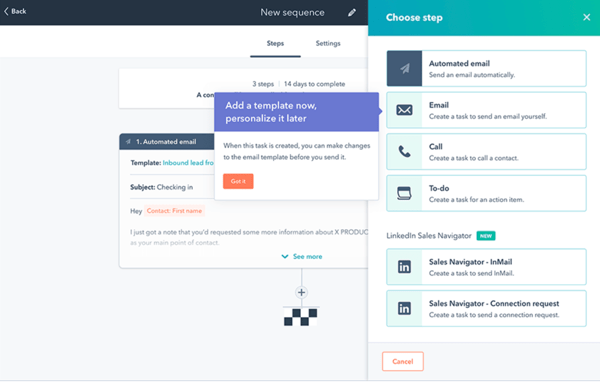
Another feature that caught my attention was the sequences tool. While technically a sales feature, I found it invaluable for nurturing leads. I could create email sequences for follow-ups that triggered automatically based on recipient behavior. For example, if someone clicked on a link in my first email but didn’t register for the webinar, a personalized follow-up would go out two days later with a gentle nudge to sign up.
Something worth calling out is how HubSpot has leaned into AI in a meaningful way in 2026. The AI note taker records and summarizes sales calls automatically, while the follow-up suggestions surface next steps based on deal context rather than generic prompts. For anyone managing a heavy pipeline, these additions quietly take a surprising amount of admin work off your plate.
Many of the advanced features, though, are locked behind higher-tier plans. Things like detailed reporting, lead scoring, and sophisticated automation require an upgrade, which can feel limiting for smaller teams or those just starting out. That said, the core tracking and pipeline features at lower tiers are genuinely capable, and most teams find they get solid value out of HubSpot long before they need to think about upgrading.
For those already using HubSpot, the Sales Hub’s email tracking is a natural extension of their toolkit. It’s ideal for those who want to blend marketing and sales efforts, especially when nurturing leads through multi-step campaigns.
What I like about HubSpot Sales Hub:
- The ability to automate follow-ups based on specific actions, like clicks or no response, helped me keep recipients engaged without manual effort.
- I could track not just email interactions but also how long recipients spent viewing attachments, which gave me information about the content that resonated.
What G2 users like about HubSpot Sales Hub:
“I wouldn’t use any other CRM—HubSpot has everything I need, and the Sales Hub is truly stellar. The pipeline management saves me a ton of time and keeps me focused on the right priorities. The automation also works really well, letting me personalize outreach while still automating follow-ups with prospects.”
– HubSpot Sales Hub Review, Anne G.
What I dislike about HubSpot Sales Hub:
- Many of the more powerful features, like detailed reporting and lead scoring, sit behind higher-tier plans, which can feel restrictive for smaller teams, though the core tracking and pipeline features at lower tiers deliver strong value on their own.
- Notification timing can occasionally feel inconsistent, though once you fine-tune the alert settings to focus on the actions that matter most, like first opens and link clicks, it becomes much easier to prioritize follow-ups without the noise.
What G2 users dislike about HubSpot Sales Hub:
“One thing that can be slightly challenging is the initial setup and learning curve, especially if you’re new to CRM tools. Some features and workflows take time to fully understand. Also, pricing can feel a bit high as you scale and need access to more advanced features. It’s a powerful tool, but smaller teams might find it less flexible from a cost perspective.”
– HubSpot Sales Hub Review, Himanshu L.
Learn how to use email automation to save time, reduce manual tasks, and improve business efficiency.
3. Apollo.io: Best for outreach teams that prospect and track in one place
As someone constantly juggling multiple campaigns, I needed a tool that could not only track email performance but also give me actionable insights for making smarter decisions. Apollo.io turned out to be more than just a tracking tool, it was like having an extra set of hands for understanding what’s resonating with recipients and what’s falling flat. G2 Data shows Apollo.io scores 90% for Email Scheduling, making it one of the strongest performers in the category for structured outreach execution.
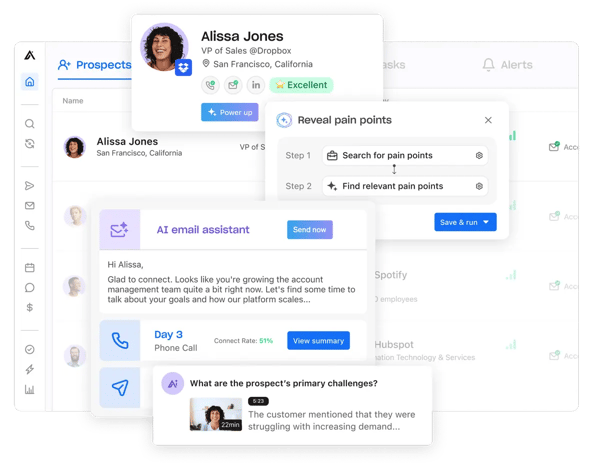
When testing Apollo.io during a cold outreach campaign for a webinar, the first thing that struck me was its timeline view of recipient engagement. Imagine sending a follow-up email and seeing exactly when your contact opened the previous one, clicked your link, and even forwarded it to someone else. That level of visibility made planning my next move feel more intentional, not just a shot in the dark.
Another highlight was how Apollo.io presented trends across all my campaigns. For example, it flagged that my emails with shorter subject lines had significantly higher open rates, a discovery I might have overlooked otherwise. It also pinpointed which links within my emails generated the most clicks, allowing me to optimize future campaigns with confidence.
What’s also worth noting is how Apollo.io has evolved in 2026. It now functions as a fully agentic GTM platform, with AI that handles account research, lead scoring, and message personalization automatically, which means less time deciding who to prioritize and more time actually reaching out.
However, data accuracy was another concern. While the database is extensive, I occasionally ran into outdated contact information, which led to bounced emails. Based on G2 reviews, this is a common frustration among users doing heavy prospecting. That said, using Apollo’s built-in verification filters before exporting goes a long way toward keeping bounce rates manageable.
For teams running data-driven outreach at scale, Apollo.io brings together prospecting, tracking, and AI-driven personalization in a way that’s hard to replicate with separate tools. If you want a platform that actively helps you decide who to reach out to, when, and with what message, this one’s worth a serious look.
What I like about Apollo.io:
- I loved seeing a full timeline of recipient activity, from opens to clicks and even forwards, all in one clean view.
- Apollo.io didn’t just show me the numbers; it identified patterns, such as which subject lines and links performed best across my campaigns.
What G2 users like about Apollo.io:
“The contact search is really goood. I can filter by industry, job title, company size and get a proper list in minutes. Before this I was wasting so much time just trying to find the right person to reach out to. Also the fact that you can set up email sequences directly inside Apollo without needing another tool is genuinely helpful. Everything is in one place and it just makes the whole outreach process a lot faster. Free plan is also decent enough to get started without paying anything upfront.”
– Apollo.io Review, Durgesh D.
What I dislike about Apollo.io:
- Data accuracy can be inconsistent, with some contacts having outdated emails or phone numbers, though running lists through Apollo’s built-in verification filters before sending helps keep bounce rates under control.
- racking standalone emails sent outside of Apollo requires a bit of extra setup, it’s a small trade-off for a platform that handles the entire outreach process, from prospecting to follow-up, in one place.
What G2 users dislike about Apollo.io:
“The data accuracy is the biggest frustration. Email bounce rates are higher than I’d like. Probably 10-15% of contacts have outdated information, which hurts deliverability if you’re not scrubbing lists before sending. A more aggressive real-time verification pass before exporting would go a long way.”
– Apollo.io Review, Adeel M.
Boost your email campaigns with proven insights. Discover 10 tips for email marketing strategy straight from G2’s own email expert.
4. Instantly: Best for cold outreach with deliverability built-in
Instantly is one of those tools that piqued my interest because it’s specifically designed for cold email outreach. As a marketer, I was curious to see how its email tracking features could help me optimize campaigns targeted at new leads and potential customers. It positions itself as a lightweight, high-performing platform, and I wanted to see if it could live up to its promise.
For one of my campaigns, a cold outreach to promote a new webinar, I tracked engagement across multiple email variations. The ability to monitor which version performed best (A/B testing is built-in) was incredibly helpful for tweaking my messaging mid-campaign.
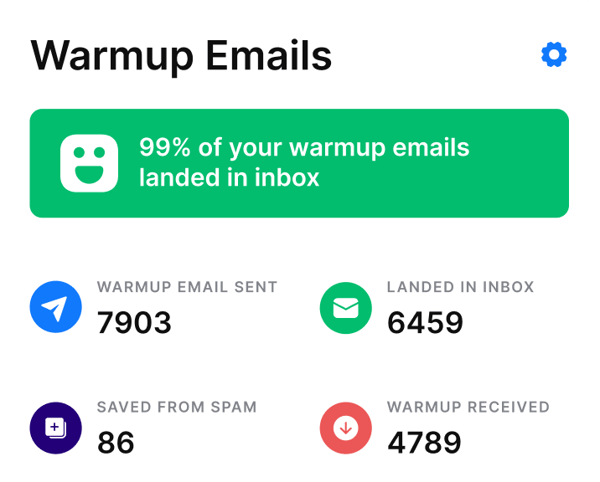
Another standout feature was Instantly’s warm-up service, which ensures your email domain builds and maintains a strong sender reputation. Deliverability is half the battle when running cold outreach campaigns, and this feature helped my emails land in inboxes rather than spam folders.
What really set Instantly apart, though, was its AI-based deliverability features. Not only could I track recipient behavior, but I could also monitor how my emails were performing from a technical standpoint, things like inbox placement and spam triggers. This gave me peace of mind that my emails were actually reaching recipients, something that often gets overlooked with standard tracking tools. It’s probably no coincidence that G2 Data shows 94% of Instantly’s users are small businesses. When you’re a lean team without a dedicated deliverability specialist, having a tool that handles the technical side automatically isn’t a nice-to-have, it’s the whole point.
Many G2 users appreciate its simplicity and ease of use, especially for teams focused on high-volume email campaigns. The insights don’t go much deeper than that, though. If I wanted to see how long recipients spent reading an email or what they did after clicking a link, I was out of luck. Based on G2 reviews, other users have mentioned wanting more advanced analytics to refine their engagement strategies, though for most cold outreach use cases, the core metrics Instantly provides are more than enough to keep campaigns moving in the right direction.
For cold email campaigns where deliverability and scale matter most, Instantly delivers exactly what it promises. It handles the technical heavy lifting so you can stay focused on what actually drives results, the message, the audience, and the follow-up.
What I like about Instantly:
- It was ideal to use Instantly for large-scale outreach campaigns due to its ability to track thousands of emails across multiple accounts in real time.
- The deliverability tracking was another standout feature, helping me ensure my emails were landing in inboxes and not spam folders.
What G2 users like about Instantly:
“I love Instantly AI for their fantastic dashboard design and awesome outreach service. I absolutely love their customer support; it’s the best I’ve ever experienced. Their software is very easy to use and totally worth the money. The initial setup was very easy, and we can now launch so many emails in just a matter of minutes. Instantly ai automated warm-up pool keeps my sender reputation healthy without any manual effort. The campaign analytics dashboard helped me pinpoint winning subject lines fast. Unexpectedly, the bounce detection feature alone saved my domain from being blacklisted — something I hadn’t even considered when signing up.”
– Instantly Review, Ashwin S.
What I dislike about Instantly:
- The analytics stay focused on the basics, opens, clicks, and replies, so if you need deeper behavioural insights like time spent on an email or post-click activity, you’ll need to supplement with another tool, though for most cold outreach teams, the core metrics are more than sufficient.
- Some of the more advanced capabilities come as add-ons, which can push the overall cost higher than expected as you scale, though the flat-fee base pricing still makes it one of the more straightforward options to budget for in this category.
What G2 users dislike about Instantly:
“Nothing much, really, maybe just the reporting part could be perfected. The analytics are good for the basics (opens, clicks, replies), but I’d love to see more granular reporting and advanced behavioral triggers for automations.”
– Instantly Review, Alla L.
5. ZoomInfo Sales: Best for intent-driven prospecting and engagement
ZoomInfo Sales has a strong reputation for helping sales teams identify and engage prospects, but as a marketer, I was curious to see how its email tracking capabilities could contribute to campaign performance. I found a tool that excels at tying email tracking directly to prospect data, giving me a fuller picture of how my outreach campaigns landed with key audiences.
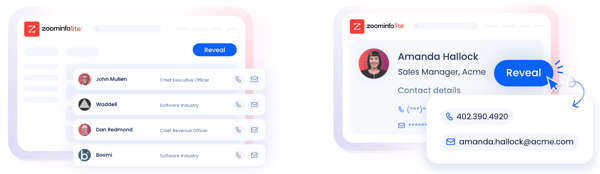
One of the standout features was how ZoomInfo’s email tracking integrates seamlessly with its extensive contact database. When I sent emails promoting a new industry report, I could not only track opens and clicks but also cross-reference this data with enriched profiles of the recipients. For instance, I could see if a lead who clicked a link had recently changed roles, received funding, or added new team members—all of which helped me refine my follow-up messaging.
Another strength of ZoomInfo’s email tracking was its focus on helping me prioritize leads. The platform assigns an “engagement score” based on email interactions and other tracked behaviors, which makes it easy to identify which leads are genuinely interested versus those who are just casually browsing. This was particularly useful for segmenting recipients in larger campaigns and tailoring my outreach to their specific level of interest.
Beyond tracking, ZoomInfo has built out its AI capabilities meaningfully. The Copilot feature acts as an AI sales assistant that pulls account summaries, surfaces intent signals, and drafts tailored outreach based on what’s happening at a prospect’s company right now. For email campaigns tied to specific buying moments, it takes a lot of the research work off your plate before you even hit send.
One thing I noticed is that ZoomInfo’s data coverage isn’t equally strong across all regions. For teams running campaigns in North America and Europe, it’s impressively robust. But for outreach targeting Latin America or parts of Canada, the contact data can be thinner or less current. Based on G2 reviews, this is a recurring theme among users operating across multiple geographies. For most teams focused on core English-speaking markets though, it rarely gets in the way.
For running data-driven campaigns and targeting new prospects, ZoomInfo Sales offers powerful email tracking features that integrate beautifully with its contact intelligence. It’s a strong fit for teams that want their email engagement data to mean more than just opens and clicks.
What I like about ZoomInfo Sales:
- Tracking email engagement alongside detailed contact profiles helped me better understand and target recipients based on their roles, industry, and behavior.
- The intent data and engagement scoring made it easy to prioritize the prospects most likely to convert, rather than treating every open as equal.
What G2 users like about ZoomInfo Sales:
“The intent and filtering features are incredibly useful and important to me, especially when it comes to revenue amounts and locations. My account manager has been really good, showing me the ropes and being available when needed. ZoomInfo Sales makes it easy to find the correct decision maker by allowing me to input multiple job titles, which is super helpful when dealing with thousands of contacts.”
– ZoomInfo Sales Review, Heidi G.
What I dislike about ZoomInfo Sales:
- Data coverage can vary significantly by region, with Latin America and parts of Canada noticeably thinner than North America or Europe. For most teams focused on core English-speaking markets, the platform rarely lets you down.
- Contact data can occasionally be outdated, with some leads having changed roles since their profile was last updated, though cross-checking key contacts before outreach keeps the impact manageable.
What G2 users dislike about ZoomInfo Sales:
“I don’t dislike anything about the tool. My main suggestion is to keep expanding the data coverage for Latin America. We also use it for searches in Europe, Asia, the Middle East, and the US, and in those regions I’ve found it to be very robust. It would be great to improve the presence of, and access to, information for countries in Latin America. Also, some of the contact information isn’t updated—there are cases where contacts no longer work at their companies or don’t hold those positions anymore. That said, I understand this isn’t easy to keep current in a world where professional mobility moves so fast.”
– ZoomInfo Sales Review, Monica R.
6. Pipedrive: Best for visual pipeline management and deal tracking
When I tested Pipedrive for email tracking, I wasn’t expecting it to feel this natural. It’s primarily known as a sales CRM, but the way it connects email activity directly to deals makes it genuinely useful for anyone who wants their tracking data to live inside their pipeline rather than in a separate tool.
The email-to-deal linking was the first thing that stood out. Every email I sent or received was automatically attached to the relevant deal and contact, so I never had to manually log a conversation or go hunting for context before a follow-up. G2 Data shows 79% of Pipedrive’s customers are small businesses, and it’s easy to see why. When you’re running a lean operation without a dedicated ops team, having a CRM that handles the admin of connecting emails to deals automatically saves more time than it sounds.
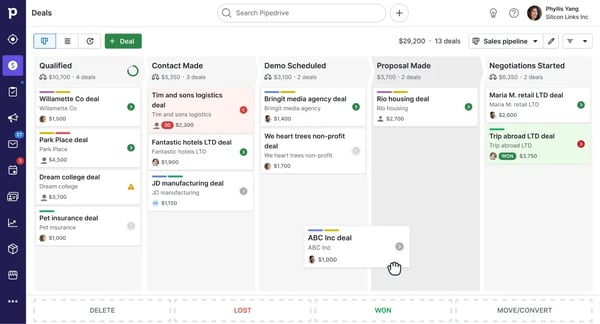
Workflow automation was another area where Pipedrive genuinely impressed me. I could set up rules that triggered follow-up reminders, moved deals between stages, or flagged leads that had gone quiet after a certain number of days. Nothing slipped through the cracks, and I didn’t have to think about it once the rules were in place.
The integrations rounded things out nicely. The connections with Slack, Trello, and Google Calendar meant that a deal won in Pipedrive could automatically kick off a project in Trello or send a notification to the right channel without any manual handoff. For teams already using these tools day to day, it feels less like an integration and more like everything just working together.
The native integrations do have their limits, though. While the API is solid for custom builds, some of the out-of-the-box connectors don’t go as deep as you’d want, and syncing with tools outside the core stack can require more configuration than expected. That said, for most small and mid-sized teams, the core integrations cover everything needed to run a smooth sales process without any extra setup.
Pipedrive is a strong fit for growing sales teams that want email tracking baked directly into their pipeline, without the complexity of a larger enterprise CRM. If you want a tool that keeps every conversation, follow-up, and deal stage in one clean view, this one delivers exactly that.
What I like about Pipedrive:
- I loved how every email automatically attached to the right deal, giving me full conversation context without any manual logging.
- I found the workflow automation genuinely reliable, follow-up reminders, deal stage triggers, and lead alerts all ran in the background without needing constant attention.
What G2 users like about Pipedrive:
“I like that Pipedrive links emails to deals and offers deal tracking. The integration with Slack and Trello is particularly useful. I appreciate how one click when a deal is won can trigger Project Set Up in Trello. The initial setup was easy, and that made getting started with Pipedrive straightforward.”
– Pipedrive Review, Steven B.
What I dislike about Pipedrive:
- The native integrations can feel limited in depth for tools outside the core stack, though the API is well-built for teams that need custom connections, and the out-of-the-box integrations cover most common workflows without any extra work.
- Advanced reporting and certain automation features are locked behind higher-tier plans, though the core pipeline visibility and follow-up automation available at the entry level are strong enough for most growing teams.
What G2 users dislike about Pipedrive:
“As easy as it is to implement Pipedrive into workflows in the sales team, it is sometimes difficult to establish good connections to other platforms and systems. It is definitely possible! The API support is great for individual solutions, but unfortunately, the native apps and integrations provided by Pipedrive often have limited capabilities here.”
– Pipedrive Review, Simon R.
7. SalesLoft: Best for structured cadences across multiple channels
SalesLoft has a reputation for being a powerhouse in the sales world, but as a marketer, I was curious to see how its email tracking features could complement marketing efforts. My main focus was how it could help with lead nurturing campaigns, content distribution, and gaining deeper insights into recipient behavior.
What immediately stood out was how SalesLoft’s email tracking integrates into its broader cadence functionality. While primarily designed for sales outreach, I found the Cadence feature incredibly useful for marketing campaigns, particularly when running multi-touch email sequences. I tested it with a series of nurture emails promoting a case study. SalesLoft tracked opens, clicks, and even reply rates for each email in the sequence, helping me identify which content resonated most with recipients.
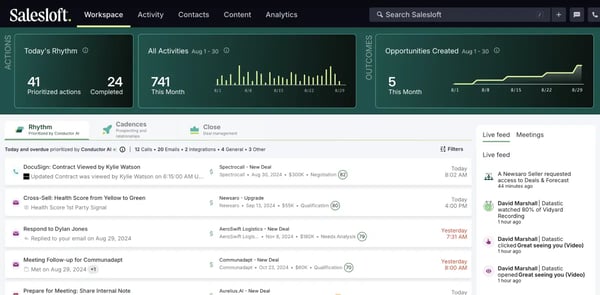
A unique feature I loved was the team template analytics. As someone who collaborates with sales teams, this allowed me to measure how well-shared email templates performed across the team. It was fascinating to see which templates led to higher engagement and adjust them to improve performance. This data type isn’t always accessible in marketing-focused tools, so it felt like a valuable addition.
The Clari merger has also added a meaningful layer to what Salesloft can do in 2026. The platform now functions as part of a predictive revenue system, with AI that surfaces pipeline risk, prioritizes daily tasks through the Rhythm feature, and helps reps understand which activities are actually moving deals forward. For teams that want their email engagement data connected to real revenue outcomes, that’s a significant upgrade from standard sequence tracking.
Reporting is one area where Salesloft still has room to grow. The analytics within the platform can feel fragmented when you need a complete picture of campaign performance, and many teams end up relying on Salesforce or an external BI tool to pull everything together. That said, the core engagement data, opens, clicks, replies, and call outcomes, is reliably captured and easy to act on day to day.
Overall, Salesloft is my go-to recommendation for teams running structured, multi-channel outreach at scale. If your sales and marketing teams are closely aligned and you need email tracking that connects directly to pipeline execution, the cadence system and Clari-powered insights make it one of the more complete options in this category.
What I like about SalesLoft:
- I found the multi-touch cadence tracking invaluable for understanding exactly which emails in a sequence were driving the most engagement and replies.
- I appreciated how Salesloft went beyond opens and clicks to capture reply context, giving me something concrete to work with before every follow-up.
What G2 users like about SalesLoft:
“It excels at driving consistent, high-volume sales execution through structured cadences that automate outreach across email, calls, and tasks, helping ensure no leads fall through the cracks. Its biggest strengths are boosting rep productivity with clear, day-to-day workflows, integrating tightly with CRMs like Salesforce, and providing real-time engagement insights (opens, replies, call data) that help teams prioritize the right prospects.”
– SalesLoft Review, Harrison P.
What I dislike about SalesLoft:
- Reporting and analytics can feel fragmented when you need a full picture of campaign performance, and getting there often means leaning on Salesforce or an external BI tool, though the day-to-day engagement data is reliably captured and easy to act on.
- The platform can feel more enterprise-oriented than some teams need, which means certain workflows require more configuration than expected, though once set up it runs consistently and keeps outreach structured across the whole team.
What G2 users dislike about SalesLoft:
“It is a very powerful tool, but at times it feels more “enterprise” than what some users really need. This orientation can end up affecting the day-to-day experience, especially when something simpler and more direct is sought.”
– SalesLoft Review, Brunella E.
8. Close: Best for fast-moving sales teams in a CRM-native setup
I’ll be honest, Close wasn’t the first tool I thought of when I started this research. It’s built so squarely around inside sales that I wasn’t sure how much it would offer from a tracking standpoint. But the more I dug into it, the more I realized that’s exactly what makes it interesting. Everything, emails, calls, SMS, and notes, lives in one place, and the tracking is built around helping you act on what you see, not just log it.
One of the standout features was the real-time tracking dashboard. I tested Close during a campaign promoting a free trial, and every time a recipient opened my email, clicked on the trial link, or replied, the activity was immediately logged and displayed.
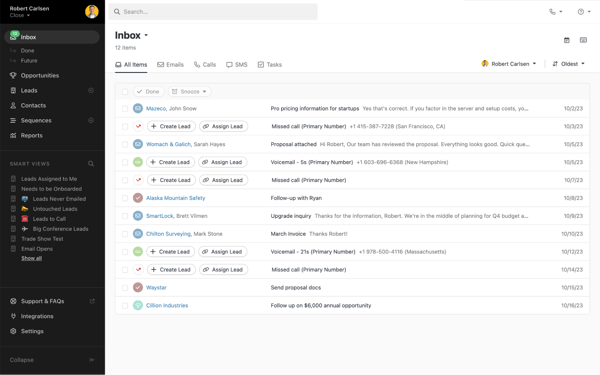
Another aspect I appreciated was the integration of email automation. Close allows you to schedule follow-ups and track their performance directly within the tool. For example, I set up an automated sequence to re-engage recipients who hadn’t clicked the initial email link, and it worked seamlessly. The system also flagged which emails were bouncing or getting no engagement, helping me clean up my email lists for future campaigns.
Close has also introduced Chloe, an AI sales teammate built directly into the platform. When a new lead comes in, Chloe reaches out instantly, and when a deal stalls, she follows up and moves it forward without waiting for a rep to act. G2 data shows 77% of Close’s users are small businesses, and Chloe feels purpose-built for exactly that reality. When you’re a lean team without the bandwidth to follow up on every lead the moment it comes in, having an AI that acts rather than just alerts makes a real difference.
The workflow automation is one area where Close keeps things relatively straightforward. For teams running standard sequences, it handles everything well, but more complex automations often require connecting a third-party tool like Zapier to fill the gaps. That said, for most inside sales teams, the built-in automation covers the day-to-day without needing anything extra.
Close is a great fit for fast-moving sales teams that want email tracking, calling, SMS, and automation all living in the same place. I’d point any lean team tired of switching between tools straight to this one.
What I like about Close:
- I loved how every email open, click, and reply surfaced instantly in the activity feed, so I always knew exactly where each lead stood without having to dig for it.
- I found the automated follow-up sequences genuinely useful for re-engaging leads that had gone quiet, and the bounce flagging kept my lists clean without any extra effort.
What G2 users like about Close:
“I think Close has probably been the best tool we’ve used so far. It handles the large amount of leads we get on a daily basis and manages calls and texts more efficiently than any platform we’ve ever used. Close solves a lot of sorting problems with leads, like identifying which are freshest, and keeps older leads in the system for follow-up. We’ve noticed a huge increase in sales since using Close because it makes it easier to communicate with leads. I find it very easy to use, and overall, it’s just a great platform without any complaints whatsoever. Also, integrating Close with Trellis has made contacting leads extremely easy compared to what we were doing before.”
– Close Review, George T.
What I dislike about Close:
- More complex workflow automations often require connecting a third-party tool like Zapier to get the job done, though for the majority of standard sales sequences the built-in automation handles things smoothly without needing extra setup.
- The mobile app experience could be more intuitive, particularly around navigation and task visibility, though the desktop experience is fast, clean, and easy to move through quickly.
What G2 users dislike about Close:
“This platform is strong for sales engagement activities, but it is also less flexible when it comes to customisation compared to other broader CRM platforms. Their reporting and analytics are also not as advanced as other enterprise platforms out there in this space. Also, for deeper marketing automation and complex workflows, this CRM might not be the perfect tool out there, since this is very sales-focused.”
– Close Review, Verified User
9. monday CRM: Best for visual deal management with AI-driven automation
monday CRM is known for its flexibility and visual project management capabilities, but I was curious to see how its email tracking features could fit into my toolkit. What I found was a system that emphasizes simplicity and customization, which worked well for organizing email campaigns while keeping tabs on recipient engagement.
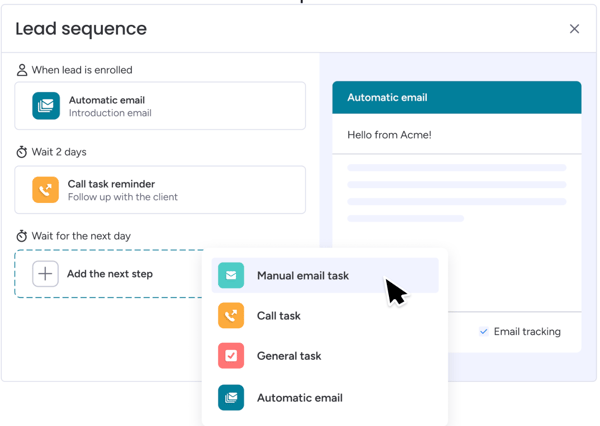
The visual pipeline was the first thing that caught my eye. Every email interaction I tracked showed up directly on the contact’s board in real time, so I could see at a glance which leads had opened my emails, clicked links, or gone quiet. The color-coded boards made it easy to prioritize follow-ups without digging through reports.
What genuinely impressed me was how far the customization goes. Unlike most CRMs that push you into a fixed structure, monday CRM lets you build pipelines, boards, and workflows around how your team actually operates. I could adapt the deal stages, contact fields, and automation rules to match my specific campaign setup without needing a developer or a long implementation process. For teams that have outgrown spreadsheets but aren’t ready for the rigidity of an enterprise CRM, that flexibility makes a real difference.
monday CRM has also made meaningful strides with AI in 2026. The AI Notetaker captures and summarizes calls automatically, then suggests next steps based on the conversation, so nothing gets missed between a call and the follow-up email. The monday campaigns feature lets marketing and sales teams plan, launch, and track branded email campaigns directly from the CRM without needing a separate email marketing tool. For teams that have historically juggled two or three platforms to manage outreach, that’s a significant simplification.
The tracking does stay focused on the core metrics, though. If you want to see how long a recipient spent reading your email or what they did after clicking a link, monday CRM won’t give you that level of detail. Based on G2 reviews, some users mention wanting deeper engagement analytics, particularly for longer campaigns. That said, for teams that care more about moving deals forward than dissecting every click, the data monday CRM does provide is clean, actionable, and easy to interpret.
monday CRM is a great pick for teams that want a visually intuitive way to track email engagement alongside their pipeline, without the setup overhead that comes with more complex platforms.
What I like about monday CRM:
- I loved how the visual boards made it immediately clear which leads were engaged and which needed a nudge, without having to run a single report.
- I appreciated how deeply customizable the platform is. I could shape the entire pipeline and workflow around how my team works rather than adapting to what the tool dictates.
What G2 users like about monday CRM:
“The combination of customizable forms, automations, and clear pipeline views makes it a strong fit for franchise lead generation. Incoming prospects are easy to track, follow-ups can be automated, and nothing falls through the cracks.”
– monday CRM Review, Sam A.
What I dislike about monday CRM:
- The engagement tracking stays focused on the essentials, opens, clicks, and replies, so teams needing deeper behavioural data like time-on-email or post-click activity may need to supplement with a dedicated analytics tool, though for most pipeline-focused workflows, the core data is more than sufficient.
- Setting up more advanced workflows and adding users can get tricky as your needs grow, though monday CRM’s no-code interface and available support resources make it considerably easier to work through than most CRM platforms at this level of flexibility.
What G2 users dislike about monday CRM:
“The reporting is decent, but if you want very deep analytics or highly advanced sales forecasting, it can feel basic compared to some other enterprise CRM. Another thing is that some advanced features are locked into higher pricing tiers, so if my team grows, the cost can rise significantly faster than expected.”
– monday CRM Review, Manish C.
10. Brevo Marketing Platform: Best for multi-channel campaign management
Brevo was the one tool on my list that made me rethink what email tracking software actually needs to be. It started from a different premise than most platforms in this category, and once I got into it, that difference became hard to ignore.
The multi-channel setup was the first thing that caught my attention. Email, SMS, and WhatsApp campaigns all live in the same dashboard, so every open, click, and reply across channels shows up in one place without any switching between platforms. For anyone running multi-touch campaigns across different audiences, that kind of consolidation saves a surprising amount of time.
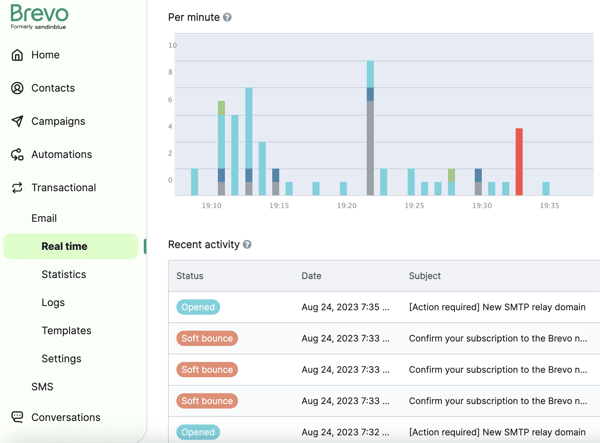
The deliverability side of things impressed me too. Brevo’s analytics dashboard gives you a clear read on open rates, click-through rates, and conversions without having to dig for the data.
The pricing is worth calling out on its own. Brevo offers a genuinely capable free plan, and the paid tiers stay affordable even as you scale. Several G2 reviewers specifically mention switching to Brevo from more expensive platforms and finding they didn’t lose any meaningful functionality in the process. For small teams, nonprofits, or marketers working with a lean budget, that accessibility makes a real difference.
The design editor is one area where Brevo shows its trade-offs. It works well for standard email layouts, but when you need something more custom or heavily branded, it can feel restrictive. Getting things exactly right sometimes means switching to HTML or working around the drag-and-drop builder’s limitations. That said, for the vast majority of campaign types, the editor does the job cleanly and without much friction.
For teams that want to track and manage campaigns across email, SMS, and WhatsApp from one platform without paying enterprise prices, Brevo Marketing Platform is one of the most practical options on this list.
What I like about Brevo Marketing Platform:
- Tracking engagement across email, SMS, and WhatsApp from one dashboard genuinely changed how I managed multi-channel campaigns. Nothing slipped between platforms.
- The deliverability analytics are clean and easy to act on. Open rates, CTR, conversions, all right there without having to go looking for them.
What G2 users like about Brevo Marketing Platform:
“Brevo nails the balance between cost, simplicity, and performance. It’s easy to use, quick to learn, and powerful enough to run serious campaigns without the bloated price tag. Everything just works—and it makes marketing feel a lot less complicated and a lot more effective.”
– Brevo Marketing Platform Review, Lisa G.
What I dislike about Brevo Marketing Platform:
- The design editor works well for standard layouts but can feel limiting when you need more custom or branded email designs, though switching to the HTML editor gives you the flexibility to build exactly what you have in mind.
- Setting up more advanced automations takes some getting used to and isn’t always as intuitive as the rest of the platform, though once the workflows are in place, they run reliably and handle complex campaign logic without needing constant oversight.
What G2 users dislike about Brevo Marketing Platform:
“One of the main drawbacks is the design editor. It works well for standard emails, but it can feel a bit limiting when you’re trying to create more custom or highly branded layouts. You sometimes have to use workarounds or switch to HTML to get things exactly how you want. Reporting is another area that could be stronger. The core metrics are there, but the dashboards aren’t as visual or flexible as some other platforms, especially if you’re trying to quickly pull insights or present performance to a team.”
– Brevo Marketing Platform Review, Ashlee H.
Frequently asked questions about email tracking software
Have more questions? Find more answers below.
1. What is the best email tracking software?
The best email tracking software depends on your specific needs. For deep CRM integration and enterprise-grade analytics, Salesforce Sales Cloud and HubSpot Sales Hub are the strongest options. For scalable outreach campaigns, Apollo.io and Instantly are excellent choices. Salesloft and Close excel in multi-touch engagement tracking, while monday CRM offers a more visual, flexible approach. Pipedrive is a great fit for teams that want email tracking built into a clean sales pipeline, and Brevo Marketing Platform is ideal for multi-channel campaigns across email, SMS, and WhatsApp.
2. Does Outlook have an email tracker?
Outlook doesn’t include a built-in email tracker, but tools like HubSpot Sales Hub and Salesloft integrate seamlessly with it. These tools allow you to track opens, clicks, and replies directly from your Outlook inbox without switching between platforms.
3. What is the best email tracking software that’s free?
HubSpot Sales Hub offers a free plan with solid email tracking features, including real-time notifications and limited automation. Brevo Marketing Platform also has a capable free plan that covers email campaign tracking, open rates, and click data without needing a paid subscription to get started.
4. What is the best email tracking software for iPhone?
HubSpot Sales Hub provides a mobile app that lets you track email opens, clicks, and replies on iPhone. Instantly is also a strong choice for managing high-volume email campaigns and monitoring performance directly from your mobile device.
5. What is the best email tracking software for large-scale campaigns?
Instantly is built for high-volume campaigns, with deliverability tracking and bulk email insights across unlimited sending accounts. Apollo.io is equally strong for managing large outreach campaigns, offering engagement timelines, sequence automation, and A/B testing for optimized results.
6. What is the best email tracking software for small teams or individuals?
For smaller teams or individual marketers, monday CRM is a solid option with its visual interface and no-code automation. Brevo Marketing Platform is another strong choice, offering a generous free plan and multi-channel tracking that covers more ground without the overhead of a larger platform.
7. Which is the best email tracking software for sales teams?
For dedicated sales teams, Close and Salesloft are the strongest options. Close combines email tracking with built-in calling, SMS, and CRM in one place, making it ideal for fast-moving inside sales teams. Salesloft is better suited for larger teams that need structured cadences, coaching tools, and Salesforce integration to run coordinated outreach at scale.
8. Which email tracking tool integrates with CRM systems?
Most tools on this list integrate with popular CRMs, but some do it better than others. Salesforce Sales Cloud, HubSpot Sales Hub, Salesloft, and Close all have native CRM integration built into their core functionality. Apollo.io and ZoomInfo Sales connect seamlessly with Salesforce and HubSpot, while Pipedrive has its own built-in CRM that automatically links emails to deals and contacts.
9. Which email tracking platform supports attachment tracking?
Salesforce Sales Cloud and HubSpot Sales Hub both support attachment tracking, letting you see how long recipients spend viewing documents and which pages they return to. Apollo.io also tracks attachment activity as part of its broader engagement timeline. If document tracking is a priority, HubSpot’s document tracking feature is one of the most detailed on this list.
10. Which email tracking tool offers the best reporting features?
For the most robust reporting, Salesforce Sales Cloud leads with fully customizable dashboards that tie email performance to pipeline and revenue data. HubSpot Sales Hub is a strong second, with clear visual reporting across email, sequences, and deal activity. ZoomInfo Sales also offers strong reporting when combined with its contact intelligence and intent data layers.
11. What are the best tools for real-time email engagement alerts?
HubSpot Sales Hub and Close both deliver real-time notifications the moment a recipient opens an email or clicks a link. Salesloft surfaces live engagement signals within its cadence dashboard, making it easy for reps to act on warm signals without leaving the platform. Apollo.io also provides a real-time engagement timeline showing opens, clicks, and forwards as they happen.
12. What are the best email tracking platforms for marketing campaigns?
For marketing-focused campaigns, Brevo Marketing Platform is the strongest option, combining email, SMS, and WhatsApp tracking with automation and campaign analytics in one place. HubSpot Sales Hub is also excellent for marketers who need email tracking integrated with nurture sequences and pipeline data. Apollo.io rounds out the list for teams running data-driven outreach at scale.
13. What are the best email tracking solutions for multi-user teams?
Salesloft is purpose-built for team-wide execution, with shared cadences, coaching features, and team-level analytics. HubSpot Sales Hub works well for collaborative teams with shared pipelines and sequence templates. monday CRM is another solid option for multi-user setups, thanks to its customizable boards and automated task assignments that keep everyone aligned.
14. What are the top platforms for combining email tracking with analytics?
ZoomInfo Sales stands out for combining email engagement data with contact intelligence and intent signals in a single view. Apollo.io offers one of the more detailed analytics layers, tracking engagement trends across campaigns alongside sequence performance. For enterprise teams, Salesforce Sales Cloud ties email analytics directly to revenue data, making it the strongest option when ROI measurement matters.
15. What are the top tools for tracking email opens and link clicks?
All 10 tools on this list track opens and clicks, but a few stand out for how they present and use that data. HubSpot Sales Hub surfaces this data in a clean activity timeline tied to each contact. Instantly tracks opens and clicks across thousands of emails in real time, making it the most scalable option for high-volume senders. Close displays this data front and center in its activity feed, making it one of the easiest to act on at a glance.
16. What are the top-rated email tracking software options for outreach teams?
For outreach-focused teams, Apollo.io, Instantly, and Salesloft are the top-rated options on G2’s Spring 2026 Grid Report. Apollo.io combines prospecting, sequencing, and engagement tracking in one platform. Instantly is purpose-built for cold outreach with deliverability and warmup built in. Salesloft brings structure and coaching to team-wide outreach cadences for more coordinated execution.
Click, open, and track like a pro
Email tracking software has come a long way from simply telling you if someone opened your email. In 2026, the best tools do far more than log a timestamp. They surface intent, connect engagement to revenue, and give you the context you need to reach out at exactly the right moment.
The data is only as useful as what you do with it. Review your insights consistently, pay attention to the patterns that emerge across campaigns, and let that shape how you write, when you send, and who you prioritize. The teams that get the most out of email tracking aren’t the ones with the most features turned on. They’re the ones who actually act on what the numbers are telling them.
The tools are ready. Now, the next step is yours. Open that trial, click “send,” and start turning email engagement into meaningful results.
Combine email tracking with a powerful CRM to unlock the full potential of your outreach. Discover the best CRM software tested and reviewed by my team.
[ad_2]
Source link


