
Table of Contents
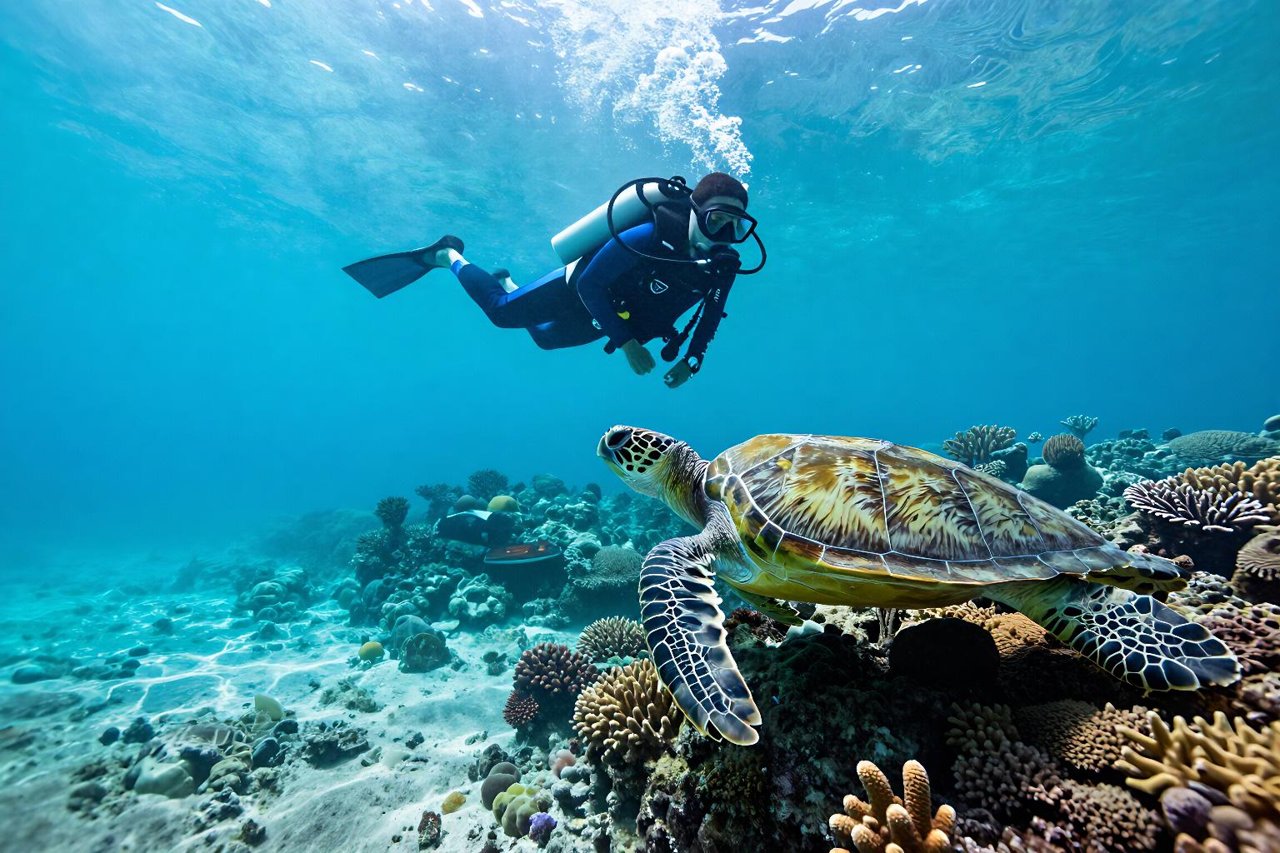
Most dive days start with a boat ride, a headcount and a briefing on a rolling deck. The really good ones start with a car park, a tank on your back and a hundred metres of sand between you and the reef. Shore diving is cheaper, more flexible and, at the right beaches, every bit as spectacular as anything a liveaboard will show you. What follows is a shortlist of coastlines worth building a whole trip around, from Caribbean walls you can swim to from the beach to a 1942 shipwreck you can literally walk into.
What Makes a Beach Genuinely Good for Diving
Plenty of beautiful beaches are terrible dive sites. Turquoise shallows that stay at three metres, surf breaks that churn the sand, or a reef that only starts at 40 metres where only technical divers can reach it. The beaches that earn a repeat visit usually have most of the following:
- An easy shore entry with sand rather than slippery rock, and no current running along the beach
- Consistent visibility in the 20 to 40 metre range for most of the year
- Something to see within recreational limits, roughly 5 to 30 metres, so a single tank is enough
- A fill station, rental gear and a dive shop within walking distance of the water
- Calm conditions on the majority of days, or a sheltered side of the island to fall back on when the wind picks up
Water temperature matters too, but mostly for your luggage. Anything above 26°C means a shorty or a rash guard, and anything below 20°C means you should be honest with yourself about how much neoprene you own.
Cozumel, Mexico: Drift Diving Along the Mesoamerican Reef
Cozumel’s west coast is one of the few places where a genuinely world-class reef sits within a five-minute boat ride of a beach you can swim from. The island’s reputation rests on drift diving, and the drift here is gentle enough for newly certified divers on the shallower sites such as Columbia Shallows, while Santa Rosa Wall drops away into overhangs and swim-throughs at around 25 metres. Palancar Reef, split into gardens, caves and a deeper section, is the one everybody photographs.

Visibility regularly hits 30 to 40 metres. Expect toadfish, splendid toadfish if you know where to look, nurse sharks resting under ledges, and hawksbill turtles on almost every dive. Chankanaab Park is the classic first-timer site, with a sandy entry and a maximum depth of about 12 metres. If you want a day out of the water, there are plenty of other things to do in Cozumel between dives, from the San Gervasio ruins to the east coast’s empty beaches.
Bonaire: The Shore Diving Capital of the Caribbean
Nowhere else on earth makes shore diving this easy. Bonaire has more than 60 marked dive sites along its leeward coast, each one signposted with a yellow stone at the roadside. You drive up, kit up at the back of the pickup, walk in and go. There is almost no current, the water sits at a bath-like 27 to 29°C, and the reef starts in waist-deep water.
The standouts are the Salt Pier, where pilings furred with orange cup coral attract dense schools of fish, and Thousand Steps, which despite the name involves about 67 stairs down to a double reef. Bari Reef, right off the beach at Den Laman, has recorded over 300 species of fish. Klein Bonaire, a flat uninhabited islet a short water-taxi ride away, is a turtle nursery with a shallow reef flat that suits snorkellers as well as divers.
Tulamben and Amed, Bali: A Wreck You Can Wade To
The USAT Liberty is the reason divers fly to east Bali. This 120-metre American cargo ship was torpedoed by a Japanese submarine in 1942, beached at Tulamben for repairs, and then pushed into the sea by the eruption of Mount Agung in 1963. It now lies in 5 to 30 metres of water about 30 metres from the shoreline, so you enter over rounded black pebbles and the bow appears within a minute.
Further south, Amed’s coves offer muck diving, nudibranchs, pygmy seahorses and a second smaller wreck at Jemeluk Bay. The black volcanic sand cuts visibility to 15 to 25 metres on some days, which is a fair trade for the macro life. If you are combining diving with a longer stay, the best beaches in Bali for swimming and surfing give you a sense of what the rest of the island’s coastline is like above the surface.
The Red Sea, Egypt: Dahab’s Blue Hole and Ras Mohammed
Dahab is built around shore diving. The Blue Hole is a 100-metre-deep sinkhole with a shallow saddle at six metres where snorkellers and open-water divers drift along a coral ledge, and the Canyon is a series of sandy corridors cutting into the reef at about 30 metres. The Lighthouse site in the middle of town is a seagrass patch full of turtles and lionfish, entry straight off the beach.
Further south, Ras Mohammed National Park delivers walls, a wrecked cargo ship at Shark Reef and hard coral coverage that is unusually intact for a heavily dived area. Water temperatures run from 22°C in February to 29°C in August, and visibility of 30 metres is normal.
Koh Tao, Thailand: Where Half the World Learns to Dive
Koh Tao issues more open-water certifications than almost anywhere else, and that volume keeps prices low and standards high. The diving is genuinely good rather than just cheap. Chumphon Pinnacle, a granite outcrop at 14 to 36 metres, attracts whale sharks between roughly March and May. Sail Rock, an hour away, has a vertical chimney swim-through at 18 metres. Closer to shore, Japanese Gardens and Twins are gentle coral sites ideal for a check-out dive.
Expect 29°C water year-round, decent 15 to 25 metre visibility for most of the year, and a beach entry at Sairee that puts you in the water within minutes of most guesthouses.
Gozo, Malta: Limestone Arches and Wartime Wrecks
The Mediterranean is underrated as a dive region, and Gozo is its best-kept secret. The Blue Hole on the west coast is a natural chimney dropping from a shallow plateau to around 35 metres, connected to the open sea through an arch that frames blue light in a way that photographs badly and looks incredible in person. The Inland Sea, a lagoon linked to the ocean by a 60-metre tunnel, is one of the strangest entries in Europe.
Add the Um El Faroud, a 115-metre Libyan tanker scuttled in 1998 and now sitting upright at 36 metres, and you have a week’s diving. Visibility often exceeds 30 metres, though a 5mm wetsuit is sensible from November to April.
The Aegean: Greece and South-West Turkey
Warmer and shallower than Malta, the Aegean suits divers who like caves, swim-throughs and the odd amphora. Visibility regularly reaches 30 metres on calm days, and the volcanic sites around Milos and Santorini sit beside the easier reef diving of the Cyclades. On the Turkish side, Marmaris and Bodrum run daily boat trips to caverns and shallow wrecks that work well for recently certified divers, and the water stays swimmable from May to October. If you are planning a wider trip, these places to visit in Greece, islands and mainland, pair neatly with a week of diving, and there are things to do in Marmaris for the surface intervals.
Isle Royale, Michigan: Freshwater Wreck Diving in Lake Superior
Not every great dive beach is tropical. Lake Superior holds some of the best-preserved shipwrecks in the world because cold fresh water does not support the shipworms that devour timber in salt water. Around Isle Royale National Park there are a dozen or more diveable wrecks, including the Glenlyon, which sank in 1924 and sits in 3 to 18 metres, and the America, a passenger steamer in about 25 metres.
Visibility of 15 to 25 metres is normal, and you can see a wooden deck intact after a century. The catch is temperature: 4 to 10°C below the thermocline, so a drysuit or a well-fitted 7mm is essential. There is nowhere to fill tanks on the island, so you arrive self-sufficient. The Upper Peninsula of Michigan has plenty more above the waterline when the dive day is done.
Timing, Training and the Practical Bits
Wind direction decides more dive days than anything else. On islands with a prevailing trade wind, pick a base on the sheltered coast and you will dive every day while others sit it out. Ask a local shop which side of the island works in which month before you book accommodation.
Bring your certification card and logbook, and get nitrox certified if you plan to do multiple dives a day on deeper sites. Dive insurance is worth the small annual premium, particularly for liveaboard or remote trips. If cost is the deciding factor, several of the destinations above sit on the cheaper end of the spectrum, and this list of tropical getaways on a budget is a good starting point for pairing a dive trip with a low-cost flight.
One last habit worth building: dive the same beach twice. The first dive you spend orienting yourself and following whoever is in front. The second, you know where the reef turns, where the sand channel runs, and where that turtle was resting. That is usually when the trip stops being a checklist and starts being a holiday.


