
Table of Contents
Street food can feel like a trial by fire. The menu might be a photograph, the sauce might be unlabeled, and the line might move so fast you get nervous. But if you know a few tricks, those same stalls become your favourite memories. In this guide, I’ve broken down the 7 best street foods in the world and the exact steps to find, order, and eat each one. No restaurant table, no umbrella drink, just the food that locals actually queue for.
If you’re looking for a quick roundup, our culinary tour in seven bites covers the classics. But this guide goes deeper: the small details that make a good eater into a street food pro.
1. Pad Thai in Bangkok: Wok Skills Over Everything
Pad Thai is a national dish, but there’s a world of difference between a tourist version and a local version. The best is made over a fierce flame, with a wok that’s smoking hot. The noodles are stir-fried with dried shrimp, tofu, egg, and a sauce that balances sweet, sour, and savoury. Watch how the vendor swirls the noodles in a continuous motion.
Order the right protein
Say “pad thai kung” for shrimp, “pad thai gai” for chicken, or “pad thai nuea” for beef. Most stalls make a good version with tofu and shrimp as standard. If you want a fried egg on top, ask for “kai kem”.

The fork-and-spoon ritual
In Thailand, you don’t use chopsticks for pad thai. You use a fork in your left hand and a spoon in your right. Push a small portion of noodles onto the spoon, then pop it into your mouth. Add the dried chillies and ground peanuts to taste. Squeeze the lime wedge over the whole plate first, and mix in the raw bean sprouts so they stay crunchy.
2. Tacos al Pastor in Mexico City: Follow the Spit
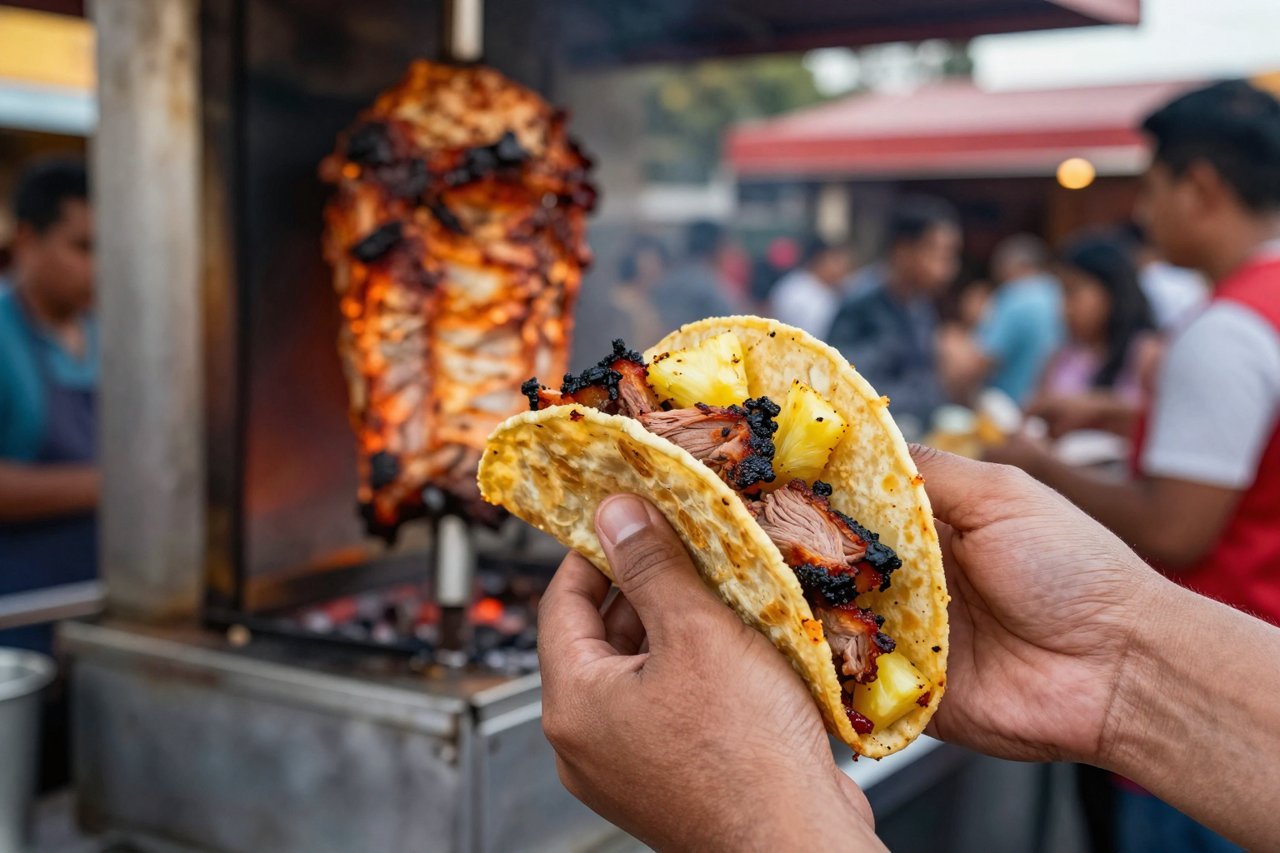
Al pastor is the taco of choice for many Mexicans. The pork is marinated in achiote and pineapple, stacked on a vertical spit called a trompo, and slow-roasted. A good trompo has crisp, slightly charred edges. You’ll see the meat being shaved off with a knife, not carved with a machine like some gyros.
Spot the flame
A real al pastor vendor will have a small flame at the base of the spit to catch drips and crisp the fat. If the meat is just being sliced from a cold mass, move on. Once you find a good one, order “tres al pastor” (three tacos) and ask for a little pineapple on top.
No cheese, no need
Street tacos come with onion, cilantro, and salsa. Usually, there are two salsas: a red one, which can be spicy, and a green one, which is tangy. A squeeze of lime and a pinch of salt are all you need. Some places give you radishes on the side. Eat with your hands, and don’t be shy about the juice running down your arm. If you’re planning a trip to Mexico’s Yucatan coast, you’ll find that same dedication to street tacos everywhere; our Cozumel guide has a few spots worth seeking out.
3. Döner Kebab in Istanbul: A Knife-Cut Masterclass
Döner literally means “turning” in Turkish. The real stuff is made from layers of meat stacked with fat, seasoned with a savoury mix of spices, and cooked on a vertical skewer. When you order, watch how the vendor cuts: a smooth, sweeping motion with a long knife, and the shavings should be thin and slightly crispy.
Say this at the counter
“Döner ekmek” is your sandwich in a half loaf of bread. “Dürüm” is it wrapped in a thin lavash. You can specify “sade” for plain (just meat and onions), “acılı” for spicy sauce, or “sossuz” for no sauce at all. In Istanbul, it’s totally normal to eat standing at the counter.
The flavour balance
A proper döner is not overloaded with sauce. The meat, lightly charred, should shine. Chopped sumac onions and pickled peppers add acidity. Some shops include a few french fries inside the bread; that’s a variation, not the rule. If you find yourself in western Turkey, the döner culture shifts slightly, especially around the Aegean. For a food-focused trip, our Izmir guide points to neighbourhoods with great wandering and street snacks.
4. Bánh Mì in Saigon: The Ultimate Fast Breakfast
Bánh mì is the Vietnamese riff on a French baguette. What makes it legendary is the contrast: a crispy crackling crust, a soft airy crumb, and a filling that layers savoury, sour, fresh, and hot. You’ll find it everywhere, but the best carts have queues of office workers around 7am.
How to order if you barely speak Vietnamese
Point and say “bánh mì thịt” (meat) and then choose your add-ons. “Ốp la” is a fried egg, “chả” is a pork roll, and “pâté” is the liver pâté that gives it its distinctive richness. Most stalls will ask if you want it not spicy (“không cay”) or with chili (“cay”). Reply with “cay nhẹ” for a mild heat.
The classic combo
A good bánh mì has at least three kinds of pork: a slice of pork roll, some shredded steamed pork, and a smear of pâté. The sandwich should be packed with pickled carrots and daikon, fresh cucumber, cilantro, and a generous pinch of chili. It’s messy, but the bread should be slightly compressed when you bite it.
5. Pizza al Taglio in Rome: A Slice of Tourist-Free Rome
Roman street pizza is a revelation. It’s baked in large rectangular trays, often in a wood-fired oven, and sold by weight. You can get a piece the length of your forearm for a couple of euros. The most common types are margherita, with a thin crust and a few wispy pools of mozzarella, and pizza bianca, just olive oil and salt.
How to get the best piece
Walk up to the counter and say “una fetta di margherita, per favore” (a slice of margherita). If you want more, say “ancora un po'” to ask for a slightly bigger piece. The server will cut it, weigh it, and then you pay. Don’t overthink it.
Eat it on the go
In Rome, pizza al taglio is a snack, not a sit-down dinner. Fold it in half, lengthwise, and walk. The crust should be crisp but chewy, with slightly blistered edges. A light drizzle of olive oil on the top is a good sign. If it’s oily enough to soak through the paper, it’s likely not the best.
6. Pani Puri in Mumbai: The One-Bite Explosion
Pani puri is more of an experience than a food. The vendor gives you a crisp, hollow sphere filled with a mix of boiled potato, chickpeas, and a spoonful of spiced water. The trick is to pop it in your mouth whole and bite it smart enough that the liquid bursts over your tongue without running down your chin.
Ordering one plate
Sit at the stall or stand at the counter, and say “ek plate pani puri.” Usually, you’ll get six to eight pieces. Ask for “sweet” (meetha), “spicy” (teekha), or “mixed.” Many first-timers prefer “less water” (kam paani) until they get the hang of it.
The bite technique
Take the entire puri from the tray, place it in your mouth, and close your lips. Give a single, quick bite. Don’t slurp, don’t chew slowly: just bite and enjoy. The combination of crunchy shell, soft filling, and the tangy, slightly spicy water is magic. It should take about five seconds per puri.
7. Jerk Chicken in Jamaica: Smoke, Fire, and Festival
Jerk is a cooking style, not just a marinade. The meat is coated in a blend of scotch bonnet peppers, allspice, thyme, and scallion, then cooked over a wood fire, typically pimento wood. The smoke from the wood is a huge part of the flavour. You’ll see old steel drums converted into makeshift smokers at roadside stalls.
Ordering by the quarter
Ask for a “quarter bird” or “half bird” depending on your appetite. If you want the full experience, ask for “festival” (a fried dumpling) and “bammy” (cassava bread) on the side. And when they ask if you want it spicy, remember that Jamaican “medium” is often hotter than anything you’ve had before.
How to eat it
Jerk chicken is best eaten with your hands. Tear pieces off the bone and dip them into the sauce or sprinkle a bit of the house pepper vinegar. Don’t be polite about the bones; there’s real flavour in the char. A squeeze of lime over the top cuts the heat.
The Universal Street Food Rules That Actually Work
By now, you might notice a pattern. Every great street food vendor shares a few traits, and the eating experience follows the same logic. Here are the rules that carry over no matter which city you’re in:
- Go where the locals queue. If there’s a line, even a long one, that’s a good sign. Short lines mean the food may have been sitting around.
- Watch the turnover. If the cook is constantly making new batches, the ingredients are fresh. If the wok is cold or the grill is empty, move on.
- Carry small notes. Vendors rarely have change for a $50 note. You’ll collect a lot of street food coins this way.
- Try one thing at a time. Order a single portion, watch how it’s made, and decide if you want more. This is how you learn without gambling your appetite.
- Trust your nose and your eyes. If a stall smells good and the preparation area looks clean, it usually is. Your gut reaction matters.
And finally, the most useful advice: don’t overthink it. The first time you order, you might fumble. That’s fine. Locals have been doing this for decades; they don’t expect everyone to be perfect. But if you show a little curiosity and respect, you’ll get better food and a friendlier welcome.
Take a bus to a local market, or wander past a busy corner. You’ll find that the world’s best street foods aren’t that far away. And if you ever find yourself on the Turkish coast, you’ll want to check out the food stops we mention in our Marmaris guide; they’re perfect for testing your new skills.


