
[ad_1]
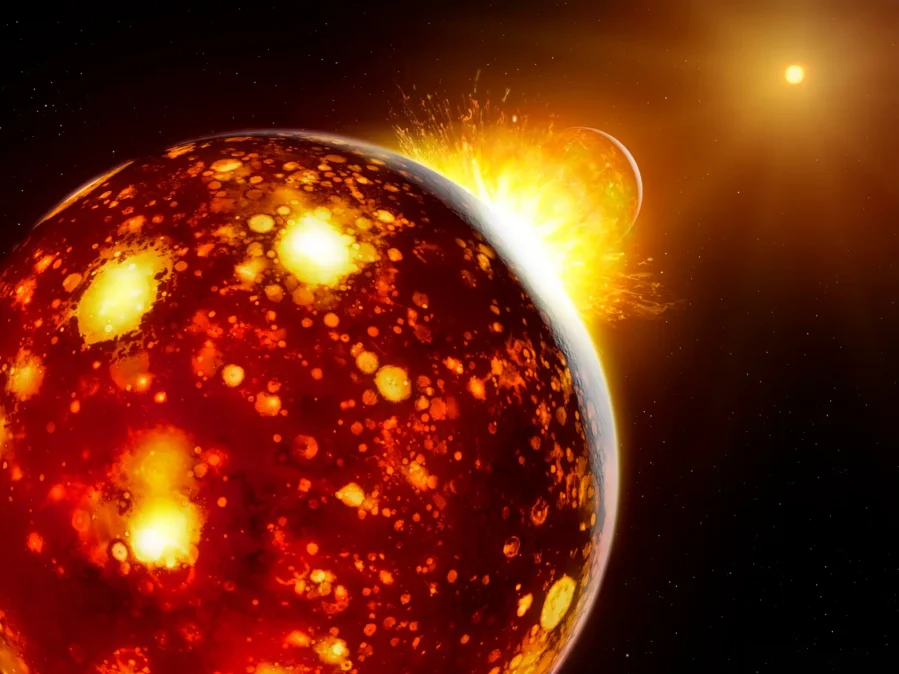
Four and a half billion years ago, a neighboring world slammed into the young Earth and changed everything. Now, precise chemical sleuthing suggests that this lost planet, Theia, did not come from some distant corner of the Solar System but from right beside us, likely even closer to the Sun than Earth.
In a new experimental study published in Science on November 20, 2025, researchers led by the Max Planck Institute for Solar System Research and the University of Chicago used high precision measurements of metal isotopes in rocks from Earth, the Moon, and meteorites to reconstruct Theia’s origin. By combining iron, chromium, molybdenum, and zirconium isotope data with detailed mass balance models under different giant impact scenarios, they conclude that the Moon forming impactor was built almost entirely from inner Solar System material and probably formed slightly closer to the Sun than Earth did.
The team set out to answer a deceptively simple question that has eluded planetary scientists for decades: what kind of body hit the proto Earth so hard that it produced the Moon, and where in the nascent Solar System did it grow up? Direct evidence is impossible because Theia was destroyed in the collision, but its chemical fingerprints are still preserved in the modern Earth Moon system. The new work approaches the problem as a planetary forensics case, starting from today’s compositions and working backward to what Theia and the early Earth must have looked like.
Isotopes, slightly different versions of the same element that differ in neutron number and mass, are central to that reconstruction. In the early Solar System, isotopes of iron, chromium, zirconium, and other metals were not distributed uniformly. Material that formed near the Sun carries a subtly different isotopic mix than material that formed farther out. Because those isotope ratios are preserved when planets accrete, a planet’s isotopic composition effectively records its building zone.
The researchers first measured the ratios of iron isotopes in 15 terrestrial rocks, six Apollo lunar samples, and 20 undifferentiated noncarbonaceous meteorites representing inner Solar System reservoirs such as enstatite and ordinary chondrites. Using multicollector mass spectrometry, they showed that Earth’s mantle and the Moon’s mantle are indistinguishable in mass independent iron isotope composition, extending a pattern already seen for elements like chromium, calcium, titanium, zirconium, and tungsten.
That striking similarity between Earth and Moon is a known puzzle. Many giant impact simulations predict that the Moon should be made largely of Theia’s material, which would normally leave a measurable isotopic difference between Earth and Moon if Theia formed elsewhere. Alternatives include scenarios in which the Moon is mostly derived from Earth’s mantle, or in which violent mixing during and after the collision homogenized the two bodies. On its own, the iron data cannot tell those models apart.
To move beyond that stalemate, the team treated the problem as a mass balance exercise. They asked which combinations of proto Earth composition, Theia composition, and impactor size could produce the observed isotopic signatures of modern Earth’s mantle and the Moon’s mantle. Crucially, they did this not just for iron, but simultaneously for elements that behaved differently during Earth’s formation, particularly in relation to core formation.
Reading Theia’s Chemical Signature
“The composition of a body archives its entire history of formation, including its place of origin.”
That principle, as co author Thorsten Kleine of the Max Planck Institute for Solar System Research puts it, guided the team’s reverse engineering strategy. Elements that prefer metallic cores, such as iron and molybdenum, mostly disappeared into Earth’s core early on. The iron and molybdenum that remain in the mantle therefore record only the later stages of Earth’s growth, including contributions from Theia and from material added after the Moon formed. In contrast, more rock loving elements such as zirconium stayed in the mantle throughout the entire accretion history and record an earlier, more complete blend of building blocks.
By combining these different elemental clocks and running mass balance calculations across a range of impact scenarios, from a relatively small impactor to a canonical Mars sized one and an even larger half Earth impactor, the team could test which histories are compatible with the data. They compared candidate compositions to those of noncarbonaceous meteorites, which are thought to represent inner Solar System material, and carbonaceous meteorites, which sample outer Solar System reservoirs.
One robust outcome is that Earth’s mantle composition for several elements lies at one end of the range defined by noncarbonaceous meteorites and cannot be reproduced by simply mixing known meteorite groups. That implies that at least one important ingredient in the Earth Theia system is not represented in any meteorite yet recovered. The question then becomes whether that unsampled component belonged primarily to proto Earth, to Theia, or to both.
When the authors assumed that proto Earth looked like various classes of outer Solar System carbonaceous meteorites, the implied Theia composition had to be extremely exotic, far outside known meteorite ranges, especially for zirconium and molybdenum isotopes. Those scenarios require Theia to sit well off established isotope correlation lines for inner Solar System bodies. In contrast, when they assumed that proto Earth resembled inner Solar System noncarbonaceous meteorites, the calculated Theia composition needed to be much less extreme, although still not identical to any known meteorite group.
A Neighbor From The Inner Solar System
“The most convincing scenario is that most of the building blocks of Earth and Theia originated in the inner Solar System. Earth and Theia are likely to have been neighbors.”
That is how lead author Timo Hopp of the Max Planck Institute for Solar System Research summarizes the picture that emerges from the calculations. In the favored solution, both proto Earth and Theia are built predominantly from noncarbonaceous material associated with the inner Solar System. The missing, “exotic” component is still required, but its properties are moderate rather than extreme. In this scenario, Theia appears slightly more enriched in material produced by the so called s process of neutron capture, a pattern that previous work has suggested increases toward smaller heliocentric distances in the inner Solar System.
If that interpretation is correct, then Theia most likely formed somewhat closer to the Sun than Earth, perhaps in the innermost regions of the noncarbonaceous domain, before migrating into an orbit that ultimately intersected Earth’s. The team’s models also allow a small contribution from outer Solar System, carbonaceous like material to Earth’s mantle, for example via a late veneer of meteorites accreted after core formation, without disrupting the inner Solar System origin of Theia.
The work carries important implications for how scientists think about planet formation and the Moon forming impact. It strengthens the case that the Earth Moon system is largely an inner Solar System product, rather than the outcome of a collision between bodies that formed in widely separated regions of the protoplanetary disk. It also narrows the range of acceptable giant impact models by tying them to a multi element isotopic fingerprint rather than a single element or pair.
The authors emphasize, however, that their reconstruction is not unique and depends on several key assumptions. The exact mass of Theia, the details of how its core interacted with Earth’s during the impact, and the degree of mixing and homogenization between Theia and proto Earth all affect how much of each element Theia could have delivered to Earth’s mantle. The analysis also relies on extrapolating isotopic trends defined by the limited set of meteorites available for study and on the idea that those trends reflect simple two component mixing within the inner Solar System.
Even with those caveats, the combination of iron, chromium, molybdenum, and zirconium isotopes gives a much more tightly constrained portrait of the Moon forming impactor than was previously possible. Instead of a mysterious wanderer from the outer Solar System, Theia now looks like a close relative that grew up in the same inner neighborhood as Earth, built from similar but not identical raw materials, before their violent encounter produced the Earth Moon system we inhabit today.
Science: 10.1126/science.ado0623
If our reporting has informed or inspired you, please consider making a donation. Every contribution, no matter the size, empowers us to continue delivering accurate, engaging, and trustworthy science and medical news. Independent journalism requires time, effort, and resources—your support ensures we can keep uncovering the stories that matter most to you.
Join us in making knowledge accessible and impactful. Thank you for standing with us!
[ad_2]
Source link


