
[ad_1]

I’ve long had an issue with sourcing buttons for my bespoke suits, which is that the dusty, unpolished horn I fell in love with when I first had suits made on Savile Row isn’t available in other parts of the world.
The buttons, I knew, were made in Italy, and yet the Italian tailors couldn’t source them. The Asian tailors in Hong Kong or Korea couldn’t get them either. So I ended up buying sets myself, at retail, and giving them to the tailors when I saw them.
Trying to find out what was going on here sent me down a rabbit hole of button manufacturing, sourcing, and market dynamics. Fortunately, unlike similar rabbit holes I’ve gone down in the past, these days I have friends in the industry that I can ask and get connections to the people involved.


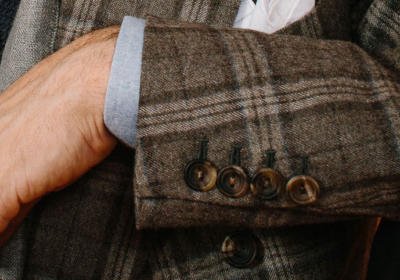
Water buffalo horn, which is the horn we know and love from bespoke, comes from India (top image). There’s also ox horn, which some tailors and ready-to-wear brands use and simply describe as ‘horn’, but that’s not as hard and sometimes less subtle in colour. When you see buttons with a simple pattern of stronger yellow against black or dark brown, that’s usually ox (above).
The raw material is sold in auction markets in India, but is a nigh-on monopoly. This makes it expensive, and more expensive recently because of the way India is changing – more meat is being consumed, and as a result more water buffalo killed at a younger age.
Horn for buttons is usually better from older animals, when the horn has had time to grow and harden. If the animals are killed younger, there’s less available and that affects the price (depending on the colour, it’s gone up by two to three times since Covid). Horn suffers from being a byproduct of another industry, as quite a few other menswear materials do.
That’s one reason good buttons have become more expensive – and one more that good clothes as a whole have. But it’s not why I can’t get my dusty buttons outside the UK.

That’s down to the supply chain. Horn comes from India to the various places buttons are manufactured, usually as blank disks (above). These are cut, shaped and finished in different ways to achieve various looks.
Most high-end horn is made in Italy still – there are about a dozen manufacturers, few elsewhere in Europe and only one still in the UK (Courtney & Co, which is small). Those manufacturers make hundreds or thousands of buttons at a time. One of the best in Italy, Padano, can make about a million a week for example and has a minimum of a thousand per colour, size and shape.
So they can’t easily supply tailors, who might need a dozen or so for a suit. They supply ready-to-wear brands directly, and supply merchants who in turn sell to tailors. The two major merchants in the UK are Bernstein & Banleys and Richard James Weldon – since James Grove (a manufacturer as well as a merchant) went bust in 2012.
The agency business for buttons is similar to the one for cloth: you spend a lot of money buying stock of the material, and then have to gradually sell it to the end consumer, a little bit at a time. The capital investment and stock risk makes it a naturally conservative business.
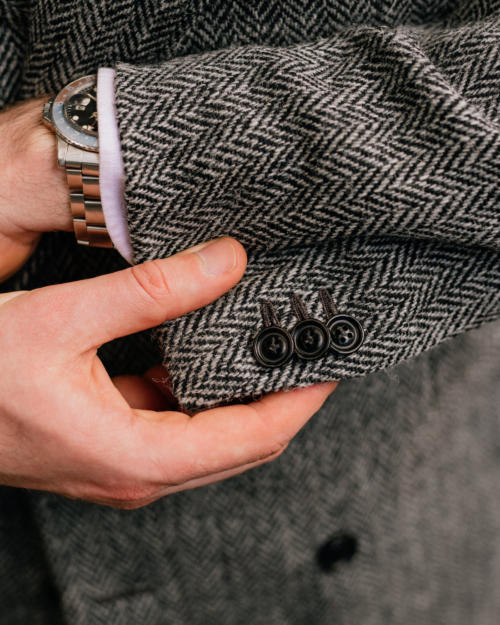
UK merchants can survive because they get lots of regular orders from the UK tailors. They also sell trimmings – linings, canvas, thread and so on. But in Italy, not many people want the unpolished horn used on Savile Row. They use corozo (a nut, only sourced from Ecuador) and polished or semi-polished horn (above).
As discussed in the past, there is an interesting dynamic here that Italians like their bespoke to look like ready-to-wear in some respects, possibly because RTW is more desirable; so they like similar buttons. English bespoke customers have historically wanted the opposite – to not look like ready-to-wear – and so like different buttons too.
Either way, the problem for me is that the demand for unpolished horn is not big enough in Italy for there to be an Italian merchant willing to buying thousands of them and sell them to tailors. Even though the buttons themselves are made there. There are some buttons that come close, but they’re usually slightly polished and not in the normal ‘Grove’ shape.

One last, final wrinkle. The most beautiful buffalo-horn buttons, at least to my eye, are the ones sometimes referred to as ‘Tiger’s Eye’ (above) – Bernstein colours 7 and 7½.
These are more of a mid-brown, and so used more on my tweed jackets and lighter coloured coats. They’re particularly beautiful because they have so many colours swirling through them – honey and chocolate, patches of very dark brown and often a stab of chalky white.
These more variegated buttons only come from close to the tip of the horn, and make up about 5% of supply. This makes them about twice as expensive as the rest, and twice as hard for a supplier to buy in bulk – particularly given they won’t be used as much as darker buttons.
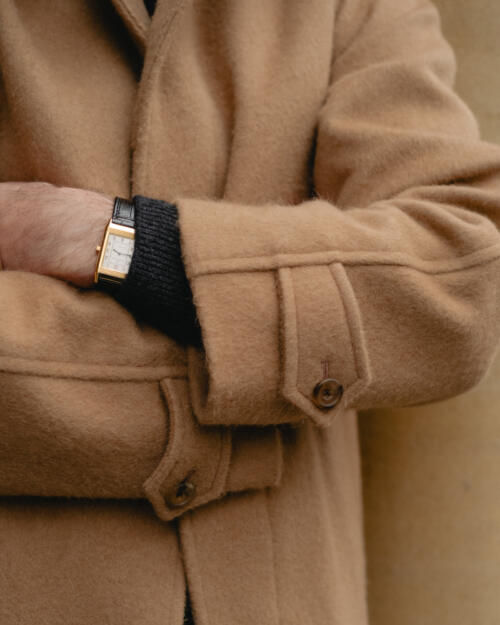
These are the buttons we used on our recent camel coat in the Donegal pre-order programme (below), and it made a surprising difference to the cost. But given the cloth was already the best camel available, it seemed worth it.
So where does this leave me? In search of a button supplier in Italy or Asia. I may try to connect suppliers with merchants in different countries, just in case it’s lack of information that has been the problem, rather that the local market.
And I might start working with Courtney & Co (above) to get my own button supply, given their minimums are lower. That may also help with the merchants, and at the very least, I’ll buy a couple of jars of buttons to keep in the showroom, so there’s a ready supply for my suits and any tailors that come through.
As we all know, these little things make all the difference.

[ad_2]
Source link


