
[ad_1]
For the first time, meteorologists have glimpsed the tiny bursts of ultraviolet light emitted by trees during thunderstorms.
Scientists have long suspected the existence of this invisible phenomenon, thought to be the result of a passing storm’s charge inducing an electric current within trees below.
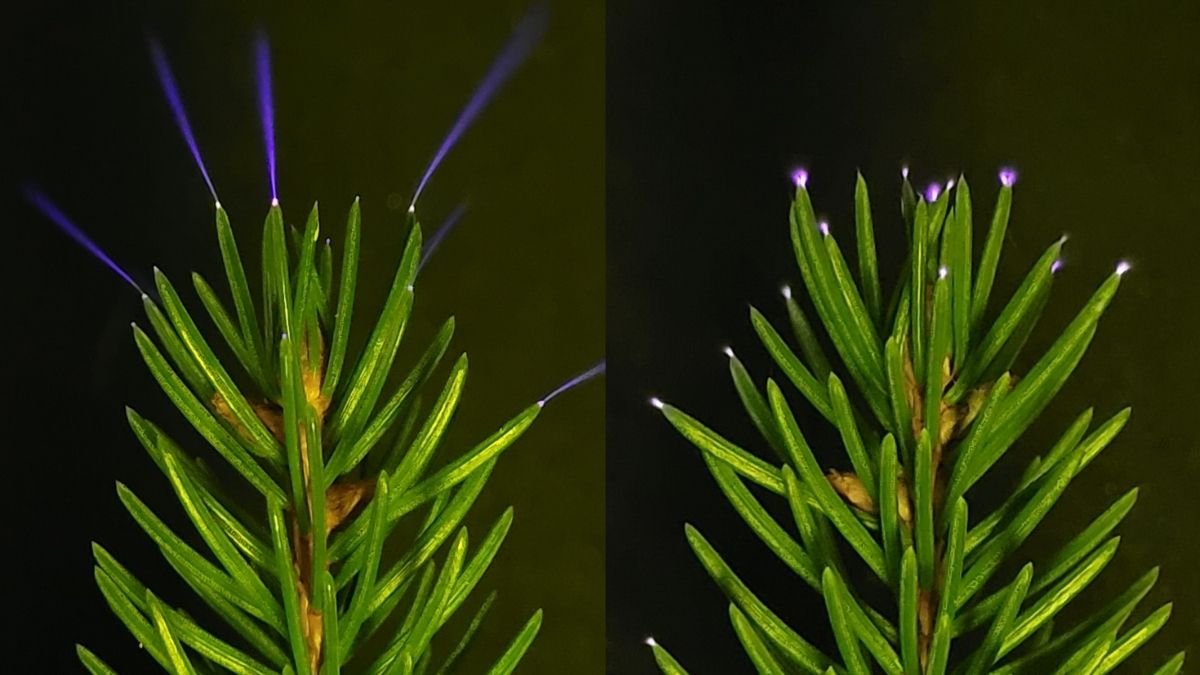
Referred to as a corona, the glow produced by a build-up of charge in leaf tips had previously been recreated in a lab and inferred from strange changes in the electrical fields of forests during storms.
But knowing we really had to see it to believe it, a team led by Pennsylvania State University meteorologist Patrick McFarland went storm-chasing to get the hard evidence.
“These things actually happen; we’ve seen them; we know they exist now,” says McFarland.
Thunderstorms are structures of enormous electrical turbulence. Towering cumulonimbus clouds contain frenzies of ice and dust particles that redistribute charges like a giant battery.
Once the difference between these charges grows sufficiently strong, celestial currents can crackle far above our heads or between the clouds and the ground as lightning.
But this electrical exchange between earth and sky isn’t always so dramatic. Sometimes an imbalance of charge can creep up the nearest tree, whose moisture-laden trunks and branches make a nice path to follow. Prevented from progressing by a layer of insulating air, the charge builds at the tree’s leaves, where it faintly radiates a corona of ultraviolet light.

McFarland and team glimpsed the first corona by simulating the phenomenon in the lab. They placed small spruce and maple trees in plastic pots beneath charged metal plates to mimic charged storm clouds passing overhead. Then, they switched off the lights.
“In the laboratory, if you turn off all the lights, close the door, and block the windows, you can just barely see the coronae. They look like a blue glow,” McFarland explains.
Then, the team tracked down these nearly-invisible sparks in the wild by mounting a 2013 Toyota Sienna with a weather station, an electric field detector, a laser rangefinder, and a roof-mounted periscope to direct light into an ultraviolet camera.
The resulting video doesn’t look like much at first: sweetgum leaves (Liquidambar styraciflua) blowing in the wind of a storm raging across North Carolina.
But the team’s equipment was sensitive enough to clusters of ultraviolet signals across the branches, with 41 distinct bursts of light, lasting from 0.1 to 3 seconds.
They behaved sporadically, “hopping from leaf to leaf and sometimes repeating on the same leaf,” the researchers explain. This matches what had previously been seen in lab experiments simulating the storm’s effects.
Similar effects were seen in loblolly pine trees (Pinus taeda), as well as in sweetgums, all along the US east coast.
With superhuman vision, McFarland says, “I believe you’d see this swath of glow on the top of every tree under the thunderstorm.”
“It’d probably look like a pretty cool light show, as if thousands of UV-flashing fireflies descended on the treetops.”
Each of these coronae emitted about 100 billion photons at a wavelength of around 260 nanometers for each frame of the video.
“Similar results across four additional storm intercepts from Florida to Pennsylvania give rise to a vision of swaths of scintillating corona glow as thunderstorms pass over forests,” McFarland and team write.
“Such widespread coronae have implications for the removal of hydrocarbons emitted by trees, subtle tree leaf damage, and limited thunderstorm electrification.
What effect this relatively large electrical current could be having on trees all around the world is unclear.
Related: Forest’s Strange Response to an Eclipse May Have a More Mundane Explanation
For instance, repeated exposure to these electrical surges could kill a tree’s upper branches, similar to when a tree forms an upward lightning leader in a cloud-to-ground ‘strike’.
“The impacts these coronae have on atmospheric chemistry, forest ecology, health, and evolution, and thunderstorm electrification must be re-evaluated and understood, especially as thunderstorms, and therefore coronae, increase in a warming climate,” the team concludes.
The research was published in Geophysical Research Letters.
[ad_2]
Source link


