

[ad_1]
March is MS Awareness Month.
As told to Shannon Shelton Miller
In 2016, I discovered the world of aerial arts. A friend posted on social media about the class, and when I arrived, I found myself in the corner of a typical gym. But there were beautiful silks in that corner, and I was obsessed with the artistry from the beginning.
Four years later, I was under significant stress after moving out of state and working at a difficult job. I woke up one day in the spring and couldn’t feel anything from my belly button down. I was so Type A and such a workhorse that I still got up, opened my laptop and went to work. I didn’t tell anyone what I was feeling and just thought I must have slept in an odd position.
Throughout the week, however, the numbness continued to spread, moving from my legs up the left side of my body to my face. I was also having vertigo and it was affecting my vision. I knew something was wrong.
I called my primary doctor, but this was all happening during Covid, so my appointment was virtual. She listened to me and even spoke to a colleague who had studied neurology and suggested I get an MRI. Looking back, I feel so lucky I ended up with that provider — she and her colleague were fresh out of school and I think that’s why they were willing to listen and dig deeper.
The wait for the MRI appointment was three months due to the Covid backlog. It felt like an eternity, and my symptoms continued to progress. One day I found myself getting dizzy and I couldn’t dress myself without falling over. My fiancé helped me put clothes on and rushed me to the emergency room.
At the ER, I urged them to give me an MRI, but an older male doctor responded with “Sometimes women get dizzy.” He flipped through notes about my case and, seemingly out of the blue, added “If you think it’s MS, you don’t have textbook symptoms” — and sent me home.
When I heard him mention MS, it was the first time I realized this could be serious. At the time, I didn’t know what MS was and my mind went to the worst-case scenario. I thought my dreams of aerial and teaching were gone. I even thought I was going to die soon. I told my fiancé he didn’t have to stay with me through this since we weren’t married. If he wanted out, I understood.
We ended up getting married later that week instead. I didn’t know why I was trying to push him away. I guess I was scared, but he wanted to be there for me as my rock and my support system, which he has been from the start. It didn’t hurt that his health insurance was better than mine, and we had a feeling that whatever I was experiencing, my treatment would be expensive.
Once I had the MRI, I was diagnosed with relapsing-remitting MS. The MRI uncovered numerous lesions in my brain and spinal cord. I’ve since had neurologists all over the country look at my case, and they’ve all agreed on the diagnosis.
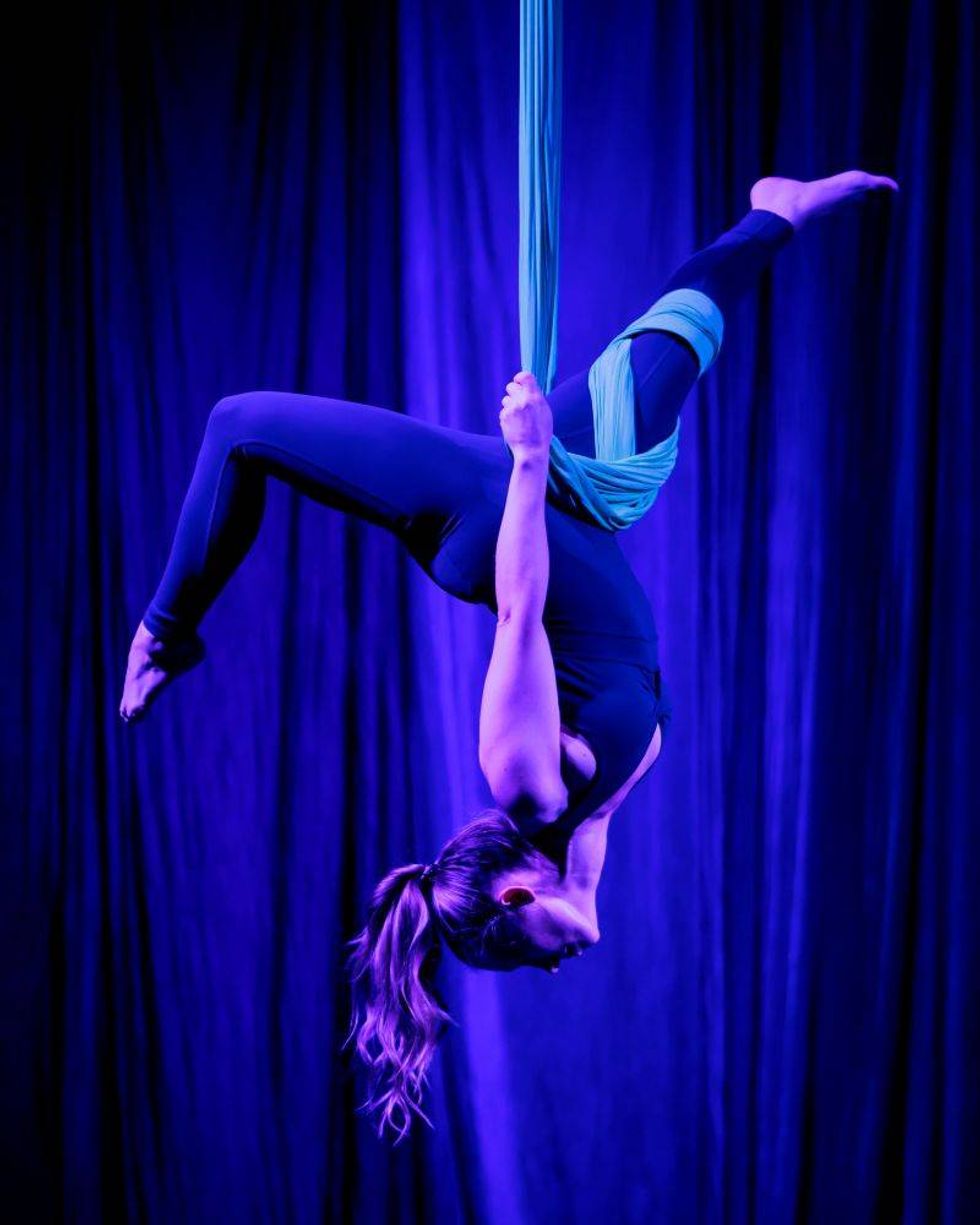 2025 (Photo/David Tuman)
In order to continue aerial arts, my body has built neural pathways around the damage, which is why I take longer to process information sometimes — a message from my brain to my foot has to travel longer around the damaged spots.
I’m now 35, and although I’ve been relapse-free for five years, my balance is definitely affected. I had two falls this past year, but it took five years before I experienced that. I know everyone’s journey with MS is different, but I had such a sudden, aggressive onset of symptoms that I was put on a high-efficacy, strong disease-modifying therapy from the beginning, which helped me recover from that initial relapse.
I’m thrilled I’m still able to do aerial, but I’ve learned to make adjustments and communicate when something is wrong. If I’m dizzy, I won’t get up in the air for safety reasons. I’ll stay low with a rigged silk and do more yoga or stretching versus dance and flow. When I’m teaching a class, I’m very open with my students and the studio where I teach, Aeriform Studio. It’s a very supportive and welcoming environment.
When it comes to aerial, people often tell me they wish they could do what I’m doing. I think the photographs people have taken make me look really cool, and some days I can do really impressive things. Other days I can’t, and this year, I’m trying to share more of my recovery and those slower days versus the pictures and videos of my art that don’t reflect my day-to-day life.
For me, MS is an invisible disease, but I live with its effects every day. Before my diagnosis, I didn’t do a great job with communication, which is ironic considering I have a master’s degree in communications. I’ve learned that I have to communicate my needs, which can include asking my husband to walk the dogs in the morning because I’m feeling dizzy, or getting a parking accommodation at my full-time job.
Living with MS has forced me to slow down and listen to my body. In my advocacy work today with MS organizations, I always tell people you know your body best. If something is off, talk to your healthcare provider. If they’re not listening, see a different healthcare provider.
Your health is the most important thing. Keep going until you find someone who will listen. Advocating for yourself can be absolutely exhausting — but it’s worth it.
Have your own Real Women, Real Stories you want to share? Let us know.
Our Real Women, Real Stories are the authentic experiences of real-life women. The views, opinions and experiences shared in these stories are not endorsed by HealthyWomen and do not necessarily reflect the official policy or position of HealthyWomen.
From Your Site Articles
Related Articles Around the Web
[ad_2]
Source link


