
[ad_1]
Key Points
- The U.S. Army requested $460.9 million for M-SHORAD in FY27, nearly doubling the $296 million allocated in FY26, split across three development efforts.
- The funding covers Next Generation Short Range Interceptor development at $215 million, directed energy upgrades at $95 million, and light force integration at $108 million.
The U.S. Army is nearly doubling its investment in its primary short-range air defense system for fiscal year 2027, requesting $461 million for the Maneuver Short-Range Air Defense program, known as M-SHORAD, up from $296 million the previous year, as the service races to rebuild air defense capabilities it dismantled two decades ago and now urgently needs to protect troops from drones, helicopters, and other aerial threats on a modern battlefield.
Breaking Defense first reported the budget figures, which reveal an Army treating short-range air defense not as a niche capability but as one of its most pressing modernization priorities.
The story of why the Army needs to spend this much money starts with a decision made in the early 2000s that looked reasonable at the time and turned out to be catastrophically wrong. After the Cold War ended and the United States spent a decade fighting counterinsurgency campaigns in Iraq and Afghanistan where enemy air threats were essentially nonexistent, the Army divested most of its short-range air defense units to free up personnel for missions considered more immediately relevant. By the mid-2000s, the service had cut its short-range air defense capacity down to two active-component battalions and a handful of National Guard units, betting that the threat environment did not justify maintaining a robust capability to shoot down aircraft and missiles over the heads of ground forces. The war in Ukraine, where both sides have fired thousands of drones of every size and type with devastating effect against armored vehicles, logistics convoys, and fixed positions, demonstrated exactly how wrong that bet was.
– ADVERTISEMENT – CONTINUE READING BELOW –
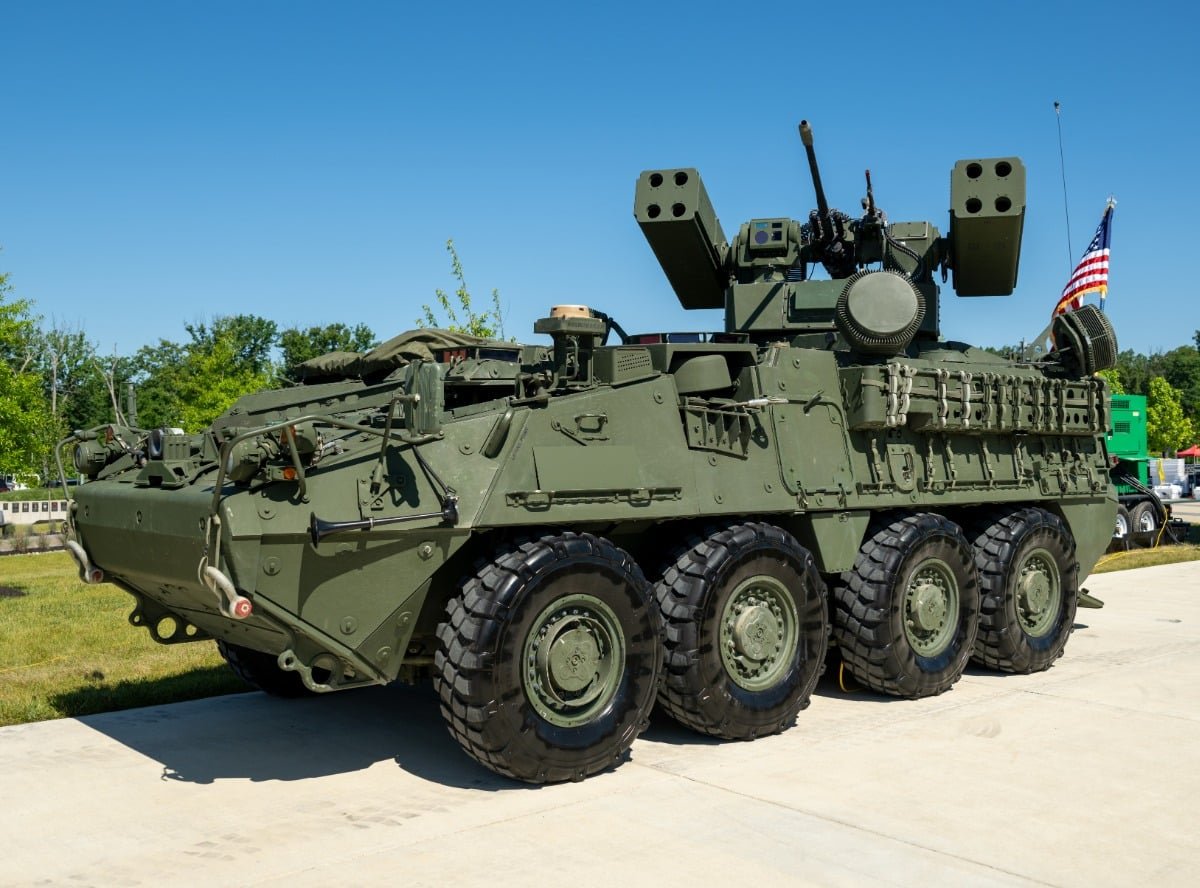
The system mounts on a modified Stryker armored vehicle, the eight-wheeled armored personnel carrier that forms the backbone of several Army brigade combat teams, giving air defense capability organic mobility with the ground forces it protects rather than requiring separate, slower-moving air defense units to keep pace. The base version, formally designated the SGT Stout in honor of Medal of Honor recipient Sgt. Mitchell Stout, killed in Vietnam, carries a combination of weapons that addresses threats across different ranges and flight profiles: FIM-92 Stinger surface-to-air missiles with a range of approximately 4.8 km (3 miles), AGM-114L Longbow Hellfire missiles originally designed for anti-armor work but adaptable to air targets, an XM914 30mm automatic cannon for close-range engagements, and an M240 7.62mm machine gun. That layered armament reflects the diversity of the threat: no single weapon covers every scenario, so the system carries several.
The $461 million the Army is requesting for fiscal year 2027 splits across three distinct efforts that together represent the full scope of where M-SHORAD is going. The largest single chunk, $215 million, funds the replacement of the Stinger missile with a new interceptor called the Next Generation Short Range Interceptor, being developed jointly by Lockheed Martin and Raytheon Technologies. The Stinger entered service in the 1980s and its single-mode infrared seeker, 4,800-meter (2.98-mile) maximum range, and 3-kilogram (6.6 lb) warhead were adequate for the threats of that era but increasingly insufficient against modern drones that can maneuver aggressively, present small radar and heat signatures, and operate in swarms that require engaging multiple targets simultaneously. NGSRI is designed to address those limitations with multi-mode seekers and extended range, though a Government Accountability Office report published in June 2025 found seven immature critical technologies in the program that could push its 2028 production target to the right.
The second spending line, $95 million, funds upgrades to the directed energy variant of M-SHORAD, a version that replaces kinetic interceptors with a 50-kilowatt laser as its primary weapon. Raytheon received a $123 million contract in 2021 to develop that laser system, and the Army received its first two prototypes in 2023, conducting live-fire tests at Yuma Proving Ground in Arizona where the system shot down Group 1 through Group 3 unmanned aircraft. The appeal of a laser for this mission is economic: a laser beam costs essentially nothing per shot compared to a missile that costs thousands of dollars and represents a round in a finite magazine. Against the kind of drone saturation attacks that Ukraine has experienced, a laser that can engage target after target without reloading offers a fundamentally different cost curve than any kinetic system. The $95 million in FY27 focuses specifically on upgrading the directed energy variant to also address counter-rotary wing threats and incoming rockets, artillery, and mortars, expanding its mission set beyond drone engagement.
The third line item, $108 million, funds the newest and most ambitious expansion of the M-SHORAD concept, a version optimized for lighter forces that cannot move with heavy Stryker vehicles. Brig. Gen. Frank Lozano, program executive officer for missiles and space, explained the gap this effort addresses when he told DefenseScoop in 2024 that earlier M-SHORAD increments are “not optimized” for light divisions such as the 101st Airborne Division. A paratrooper unit that deploys by air cannot bring Stryker-mounted air defense systems on a combat jump, which means the soldiers most likely to find themselves inserted into a contested environment without heavy support are also the soldiers with the least organic air defense capability. The solution the Army is developing involves a modular pallet or sled system that can be loaded into virtually any vehicle, from a Joint Light Tactical Vehicle to a standard pickup truck. Col. Marc Pelini described the concept at an October 2025 event, saying: “So think of like a pallet or a sled that I could put in the back of any vehicle — whether it’s an ISV, a Humvee, a JLTV, or even a technical vehicle like a Toyota truck — and I can have that self-contained capability that allows the maneuver commander to have a menu of options.”
The Army’s initial operational capability target for that fourth increment is fiscal year 2029, a timeline that the overall program’s pace will need to support even as the GAO has flagged technology maturity concerns in the interceptor development.
What the $461 million request makes visible is an Army that has fully internalized the lesson Ukraine has been teaching since 2022: air defense is not a specialist function that can be stripped from ground forces and rebuilt on demand. It is an organic capability that must move with every unit from the heaviest armored brigade to the lightest airborne formation, layered from directed energy at close range through kinetic interceptors at medium range, and capable of defeating threats from commercial quadcopters to attack helicopters. The Army spent twenty years learning that lesson the hard way. It is now spending the money to make sure it does not have to learn it again.
[ad_2]
Source link


