
Table of Contents
[ad_1]
In Meghalaya, rain is part of everyday life. The hills stay wrapped in mist, forests glow in deep shades of green, and water runs through the landscape in streams, springs, and waterfalls.
During the monsoon, the state feels especially alive — lush, cool, and full of movement. But even in a place known for heavy rainfall, farmers have long had to think carefully about how to bring water to their crops when they need it most.
It is from this need that one of Meghalaya’s most fascinating traditional farming systems emerged: bamboo drip irrigation.
A solution shaped by the hills
Meghalaya’s landscape is beautiful, but it is not always easy to farm in. Much of the state is hilly, with steep slopes and uneven ground. When it rains, water often runs downhill quickly instead of staying in the soil. In the drier months, farmers can struggle to keep crops watered.
To solve this, communities in the Khasi and Jaintia hills developed a smart way to guide water from natural springs and streams to their fields.
/filters:format(webp)/english-betterindia/media/media_files/2026/06/29/bamboo-drip-irrigation-2026-06-29-15-23-14.png)
The method is believed to be over 200 years old and uses something that is found in abundance across the region: bamboo.
How the bamboo drip irrigation system works
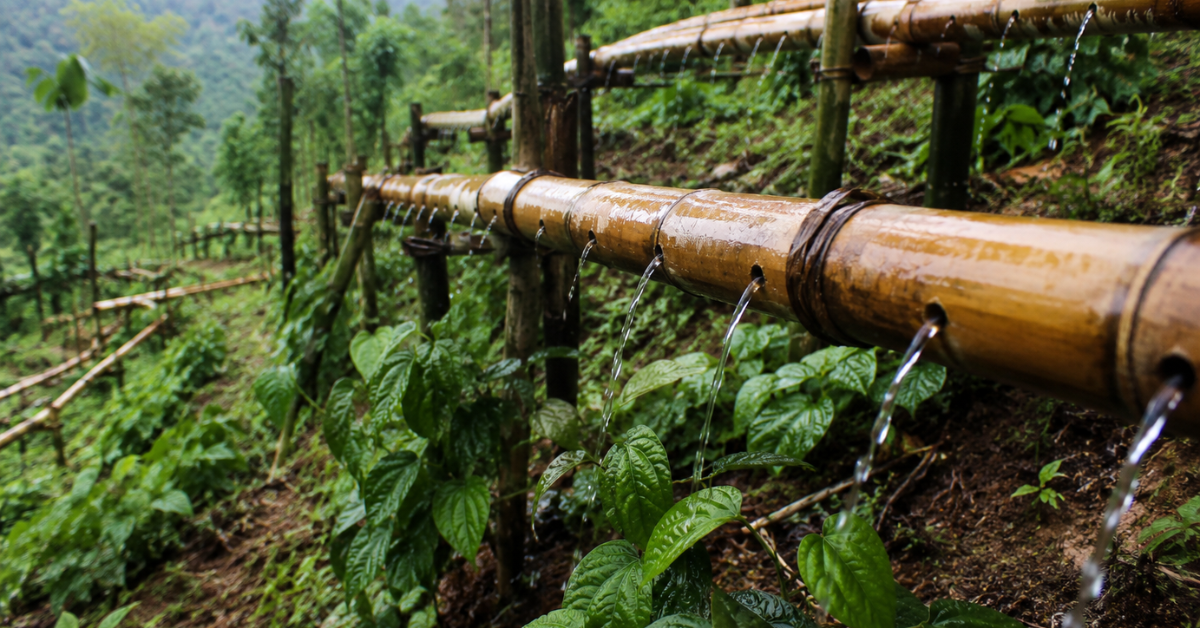
The system begins at a spring or stream located higher up the hill. Farmers collect the water there and channel it into bamboo pipes.
These are made by cutting and hollowing out bamboo and removing the natural partitions inside, so that water can flow through them easily.
The larger bamboo pieces act as the main channels, carrying water downhill over long distances, sometimes several hundred metres. These then connect to smaller bamboo pipes, which branch out across the plantation.
As the water moves through this network, the flow is gradually slowed and directed towards individual plants.
By the time it reaches the crop, the water is no longer flowing in a strong stream. Instead, it drips out slowly near the roots. According to documented accounts of the system, about 18 to 20 litres of water entering the bamboo network per minute can eventually be reduced to just 20 to 80 drops per minute at the plant site.
In effect, the system turns flowing spring water into a precise drip irrigation mechanism — without pumps, electricity, or modern machinery.
/filters:format(webp)/english-betterindia/media/media_files/2026/06/29/bamboo-drip-irrigation-2026-06-29-15-25-05.png)
The bamboo channels are usually placed on raised supports made from forked sticks. This keeps them above the ground and allows farmers to work in the fields below.
Small holes are made in the bamboo to control how much water reaches each plant, and the flow can be adjusted depending on the crop and the season.
Why does it work so well
Bamboo drip irrigation is especially useful in Meghalaya because it works with the landscape rather than against it.
The state’s slopes make it difficult to build and maintain conventional irrigation channels, but bamboo is light, flexible, and easy to shape. Since the system uses gravity, it does not need electricity or fuel to move water.
It is also highly water-efficient. Instead of flooding the soil, it sends small amounts of water directly to the roots of plants. This reduces waste and helps crops get moisture in a steady, controlled way.
Traditionally, the system has been used for crops such as betel leaf and black pepper, which need regular watering but do not do well in waterlogged soil.
Another major advantage is that bamboo is locally available, inexpensive, and biodegradable. If a section gets damaged, it can be replaced easily without expensive materials or equipment. In that sense, the system is both practical and sustainable.
More than irrigation, it is a knowledge system
What makes Meghalaya’s bamboo drip irrigation truly remarkable is not just that it works, but what it says about the communities that created it.
This is a system built through observation, experience and a deep understanding of the local environment. It shows how farmers learned to make the most of their natural resources without over-exploiting them.
/filters:format(webp)/english-betterindia/media/media_files/2026/06/29/bamboo-drip-irrigation-2026-06-29-15-26-45.png)
Photograph: (Rainwater Harvesting)
At a time when conversations around farming often focus on high-tech solutions, Meghalaya’s bamboo drip irrigation offers a unique lesson in innovation. It shows that innovation does not always have to come from machines or modern infrastructure. Sometimes, it comes from knowing the land closely enough to work with it.
This centuries-old practice is more than a traditional irrigation method. It is a powerful example of sustainable design, one that uses local materials, saves water, avoids energy use, and continues to serve as a reminder that some of the smartest solutions have existed for generations.
Sources:
‘Efficient Water Use in Meghalaya with Bamboo Drip Irrigation’ by Agriculture Institute, Published on 23 July 2025.
‘Bamboo Drip Irrigation Of The Northeastern Hills’ by Rainwater Harvesting.org
[ad_2]
Source link


