
Table of Contents
You don’t need another list of miracle foods that promise to melt fat overnight. You need foods that make eating fewer calories easier without leaving you hungry, hangry, or counting down the minutes until the next meal.
The most effective foods for weight loss share a few traits: they’re high in protein, high in fiber, high in water content, or some combination of all three. They fill you up, slow digestion, and keep blood sugar steady. If you’re looking for a full strategy beyond just the foods themselves, our real-science weight loss diet guide lays out the bigger picture.
Why Some Foods Are Better for Weight Loss Than Others
It’s not about clean eating or demonising carbs. It’s about calorie density and satiety. Calorie density is how many calories sit inside a given weight of food. A gram of broccoli has about 0.34 calories, while a gram of chocolate has around 5.4. Same weight, vastly different energy load.
Satiety is how full a food keeps you per calorie. Boiled potatoes, eggs, and beans score very high. Croissants, chips, and sugary cereal score low. When you build meals around foods with high satiety and low calorie density, you naturally eat fewer calories without white-knuckle willpower.

Here’s a quick list of the foods that deliver the most satiety and nutrition for the fewest calories:
- Eggs
- Greek yogurt and cottage cheese
- Chicken breast and turkey
- Lentils, beans, and chickpeas
- Broccoli, cauliflower, and leafy greens
- Berries and apples
- Oats and quinoa
- Avocado and nuts (in measured amounts)
Protein-Rich Foods: The Satiety Champions
Protein is the most filling macronutrient. It also has the highest thermic effect, meaning your body burns about 20-30% of the calories from protein just digesting it, compared with 5-10% for carbs and 0-3% for fat. That’s a real, measurable advantage.
Eggs at Breakfast
Start the day with two or three eggs, and you’re looking at 12 to 18 grams of protein before your day gets going. In one study, people who ate eggs for breakfast consumed significantly fewer calories at lunch compared to those who had a bagel of the same calorie count. If you’re bored of plain scrambled eggs, our breakfast recipe for weight loss shows you how to keep it interesting with veggies and herbs.
Greek Yogurt and Cottage Cheese
Plain Greek yogurt packs about 17 grams of protein per 170-gram serving, and it’s thick enough to feel like a treat. Cottage cheese is similar, with lower sugar and a mild flavour that works in savoury or sweet dishes. Choose full-fat versions if you want, because the fat helps with satiety just be mindful of portions. The protein-to-calorie ratio here is exceptional, and you don’t need to add sweetened fruit cups or flavoured versions that sneak in sugar.
Lean Meats and Fish
A 150-gram portion of chicken breast gives you around 45 grams of protein for roughly 250 calories. Salmon is higher in calories because of omega-3 fats, but it’s also deeply satisfying. Tinned tuna, sardines, and mackerel are cheap, convenient, and packed with protein. These foods are hard to overeat because they trigger fullness hormones like PYY and GLP-1.
Vegetables and Fruits: Volume Without the Calories
Vegetables are the only food group where you can eat until you’re full and still lose weight. Broccoli, cauliflower, spinach, mushrooms, peppers, and zucchini are mostly water and fibre. A massive stir-fry with 400 grams of mixed veg might clock in at under 150 calories. The chewing and stomach stretch send your brain a strong “I’m full” signal.
The Berry Advantage
Berries are lower in sugar than most fruit and surprisingly high in fibre. A cup of raspberries has about 8 grams of fibre and only 64 calories. Apples and pears are also excellent because their high pectin content slows stomach emptying. Keep the skin on, since that’s where most of the fibre lives.
If you’re also paying attention to micronutrients, some of these leafy greens are great sources of iron. Our list of iron-rich foods can help you pair spinach, lentils, and other plant proteins more effectively.
Whole Grains and Legumes: Fiber That Works
Carbs aren’t the enemy. The right kinds of carbs are actually some of the best foods for weight loss because they come packaged with fibre, protein, and resistant starch. Oats, quinoa, buckwheat, and barley all digest slowly. They keep blood sugar flat and prevent that 3 p.m. energy crash that sends you hunting for biscuits.
Legumes Are the Unsung Heroes
Lentils and beans have an unusually high protein-to-fibre combo. A cup of cooked lentils gives you about 18 grams of protein and 15 grams of fibre for 230 calories. That’s a powerhouse satiety score. People who regularly eat beans tend to have lower body weights and smaller waistlines, and they don’t even count calories.
If you prefer a lower-carb approach, swapping some rice or bread for cauliflower rice or lettuce wraps is a simple, effective trick. You’ll still get the veggie volume, just with fewer carbs. For more detail on how to structure that kind of eating, check out our complete low carb diet guide.
Smart Fats: Calorie-Dense but Worth It
Fat has 9 calories per gram, so it’s easy to overdo it. But tiny amounts of the right fats make meals far more satisfying. Avocado, extra-virgin olive oil, nuts, and seeds all bring antioxidants and healthy fats that support hormone function and nutrient absorption.
Nuts: A Handful Is the Rule
Almonds, walnuts, and pistachios are famously healthy, but they’re also famously easy to eat in quantity. A single handful (about 30 grams) of almonds is around 170 calories. If you pour them into a bowl while watching TV, you can easily eat 500 calories in minutes. Use a small container, pre-portion them, and pair them with fruit. The fat plus fibre combo keeps you full for hours.
Avocado on Everything
Half an avocado with eggs or sourdough adds creamy richness and about 7 grams of fibre. It also makes vegetables taste better, which means you’re likely to eat more of them. Just weigh it or measure it. Nobody ever regained weight from eating avocado; it was the three servings of guacamole that did them in.
How to Put These Foods on Your Plate
Forget complicated macros. Start with a visual template. Fill half your plate with non-starchy vegetables. Use one quarter for protein (meat, fish, eggs, tofu, or legumes). Use the final quarter for a smart carb (brown rice, quinoa, oats, or a starchy vegetable like sweet potato). Add a thumb-sized portion of healthy fat, and you’re done.
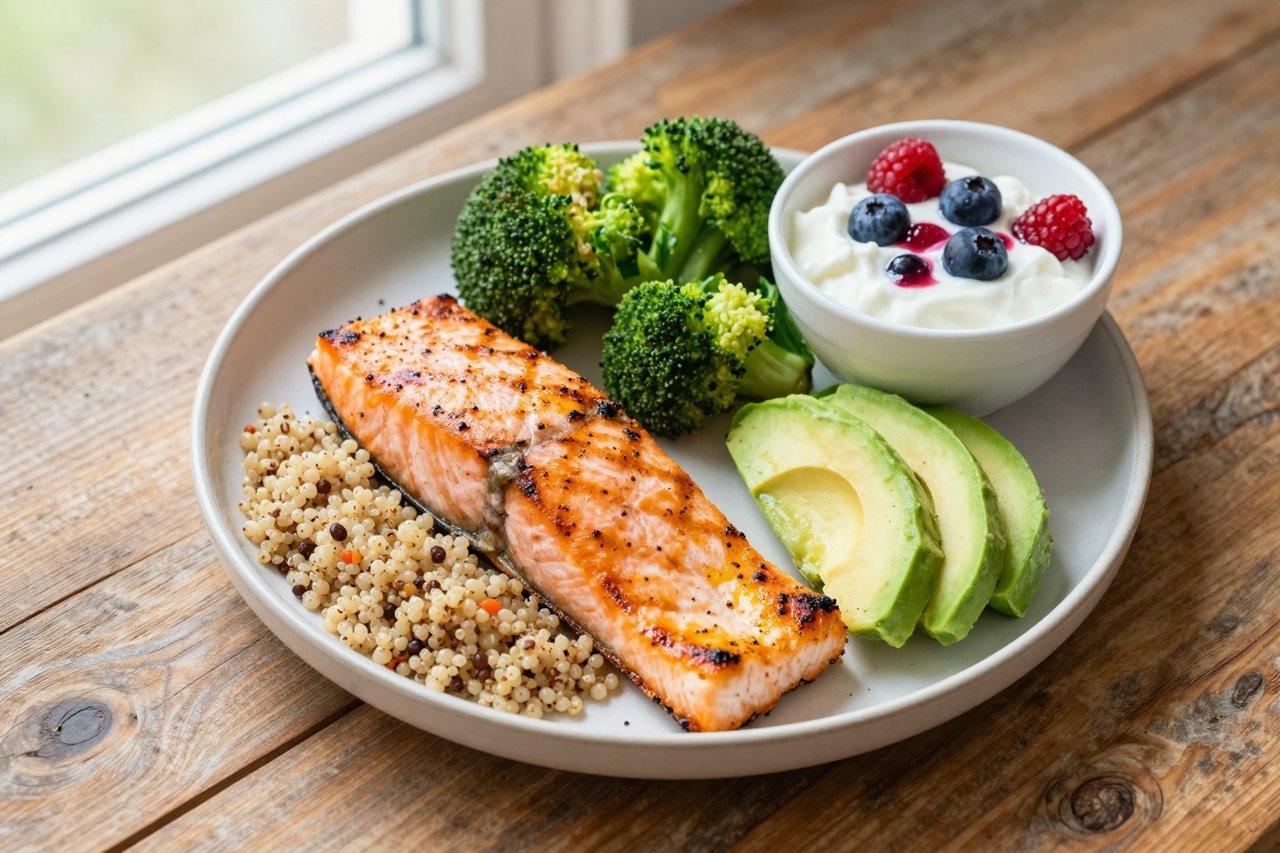
This template works because it’s flexible. You can eat breakfast, lunch, and dinner without ever counting a single calorie. A breakfast might be Greek yogurt with berries and a spoonful of granola. Lunch could be a big salad with grilled chicken and olive oil. Dinner might be baked salmon, roasted broccoli, and a small portion of quinoa. The template also makes it easier to try long-term weight loss strategies that don’t rely on willpower or restrictive rules.
If you’ve read all this and still feel overwhelmed, just pick one meal to improve this week. Swap your usual breakfast for eggs, or throw a handful of spinach into your lunch. Small changes compound faster than you’d think. And for the mindset side of things, our guide on science-backed weight loss that actually lasts explains why food is only half the equation. Consistency, sleep, and realistic expectations do the rest.
The best foods for weight loss don’t require a chef, a budget, or a subscription. They’re things you can find in any supermarket. They fill you up, they keep your blood sugar steady, and they make the whole process feel a whole lot less like suffering. Start with the plate template above, and let the foods do some of the heavy lifting.


