
Table of Contents
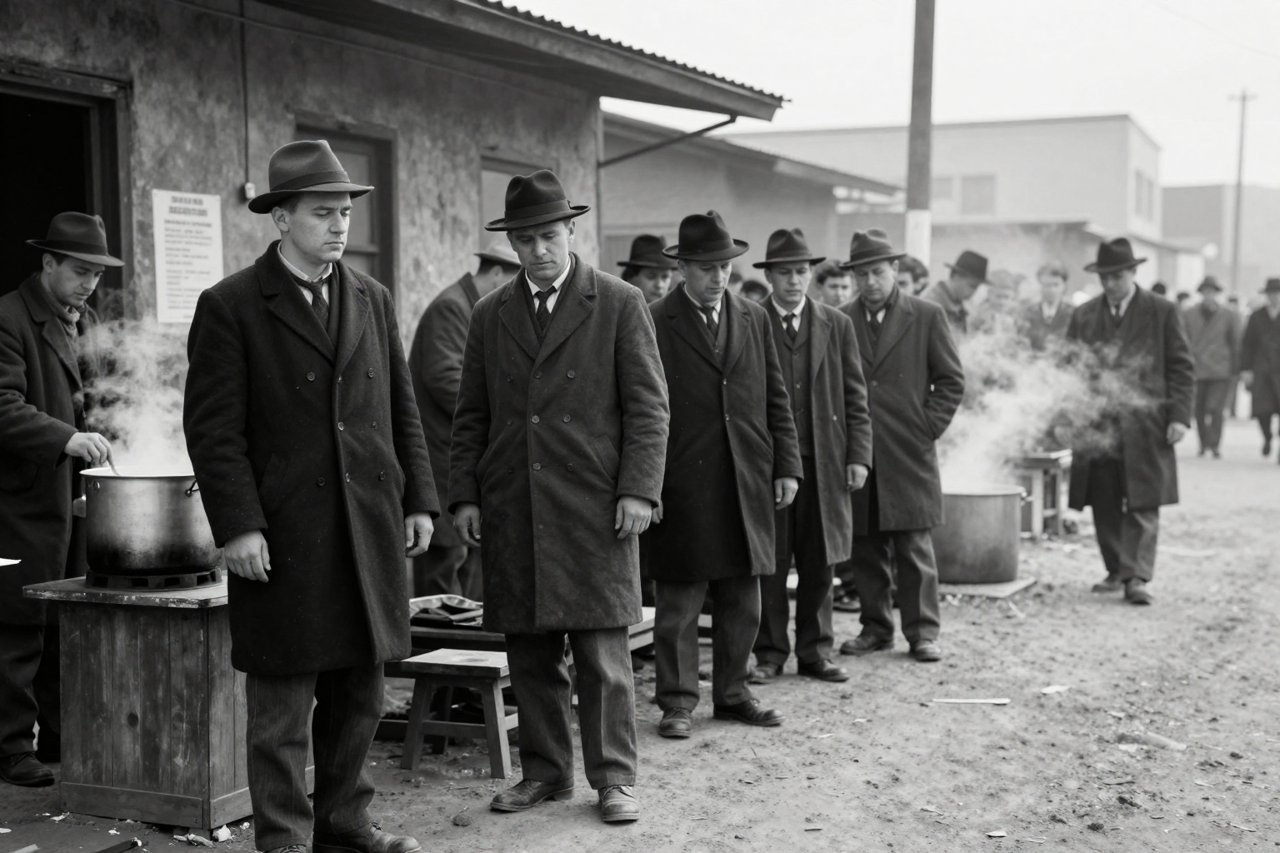
In the winter of 1932, a line of unemployed men stretched for three blocks outside a New York City soup kitchen. They stood in overcoats that no longer fit, faces blank with hunger. Similar scenes played out in Chicago, Detroit, and a thousand smaller towns. The Great Depression was not a statistic; it was the sound of empty stomachs and the silence of shuttered factories.
The Crash That Didn’t Start It
Most history books point to October 29, 1929 as the opening act. On that day, the New York Stock Exchange lost more than $10 billion in market value—almost twice the amount of money in circulation in the entire United States. But the Great Depression had been brewing for years. The 1920s were a decade of wild speculation, easy credit, and staggering inequality.
The Overheated Twenties
The “Roaring Twenties” were real for a slice of America. Henry Ford paid his workers enough to buy the cars they built, but most manual laborers saw little of the boom. In 1929, the top 1% of Americans held more than a third of the nation’s wealth. Farm incomes had been falling since 1925. When the stock market crashed, these imbalances turned a financial correction into a systemic collapse.
A Broken Banking System
Banks operated with little federal oversight. Many had invested depositors’ savings in speculative stocks or made risky loans. When the crash came, panic spread like a fire. Nationwide, depositors rushed to withdraw money, forcing banks to call in loans and sell assets at fire-sale prices. More than 9,000 banks failed by 1933. People who had never touched a stock lost everything they had saved.

The Human Toll of the Great Depression
Unemployment hit roughly 25% by 1933—and in some cities it was far worse. Cleveland, Ohio, saw unemployment above 50%. Families packed into makeshift shantytowns called Hoovervilles. Bread lines stretched for blocks, and soup kitchens served thin stew to men who had once held skilled jobs. Children went hungry; teachers sometimes fed their students out of their own pockets.
The Great Depression was not evenly felt. Women faced discrimination in relief programs and paid work. African Americans often received less relief than white Americans. Mexican Americans were pressured to leave the country. Yet the shared experience of scarcity created a deep, lasting culture of frugality that would mark an entire generation.
- Unemployment peaked at nearly 25% nationwide, and over 60% in some industrial cities.
- More than 9,000 banks failed during the first half of the 1930s.
- Industrial production fell by nearly 47% between 1929 and 1932.
- Over 2 million people became homeless, living in shacks, boxes, or railway cars.
The Dust Bowl: Nature’s Body Blow
Rural areas faced a separate catastrophe. A decade-long drought, combined with deep plowing of the Great Plains, turned thick topsoil into powder. Huge black blizzards rolled across Oklahoma, Texas, and Kansas, suffocating livestock and stripping the land. Some 3.5 million people eventually left their farms, many headed west to California. But the promised orchard work often did not exist, and families found themselves itinerant laborers, moving from crop to crop.
Washington’s Response: From Hoover to the New Deal
Herbert Hoover, a man of great intelligence and humanitarian instinct, was slow to grasp the scale of the crisis. His belief in voluntary cooperation and balanced budgets limited his actions. He did sign the Reconstruction Finance Corporation, but it lent money to banks, not to the hungry. In 1932, Hoover ordered the military to clear what remained of the Bonus Army—thousands of World War I veterans demanding early payment of their promised bonuses. The public was horrified.
Franklin D. Roosevelt took office in March 1933 and moved with astonishing speed. The New Deal was not a single program but a flurry of experiments. The Civilian Conservation Corps put young men to work in forests; the Works Progress Administration employed artists, writers, and construction workers; the Social Security Act created a permanent safety net for the elderly; the Tennessee Valley Authority brought electricity to the rural South. These measures did not end the Depression, but they changed the relationship between Americans and their government. Roosevelt’s first hundred days also transformed the presidency itself, turning the White House into the permanent center of domestic policy. If you want to see how that transformation has played out over nine decades, a study of the presidents of the United States shows a clear before-and-after picture.
The Great Depression as a Global Earthquake
The United States was not alone. Wall Street’s crash sent shockwaves around the world. Countries that relied on American loans, like Germany, saw their economies collapse and their politics turn extreme. Britain abandoned the gold standard in 1931, followed months later by Japan. International trade shrank by more than half as nations raised tariffs in a dumb race to the bottom. In Germany, the crisis helped the Nazi Party gain its first mass following. In Spain and parts of Eastern Europe, it radicalized ordinary people and eroded faith in democracy.
The Great Depression is often cited as one of the historical events that shaped our world, and with good reason: its political consequences are still unfolding in debates over tariffs and global cooperation.
The Road to Recovery and the Second World War
The Depression lingered stubbornly. Unemployment was still above 17% in 1939. The New Deal helped, but it did not fully revive the economy. A premature cut in federal spending in 1937 brought on a sharp recession within the Depression, evidence that the crisis was not simply a matter of confidence. It took a colossal shock—the Second World War—to fully mobilise the American economy. Factories that once made washing machines now built tanks, aircraft, and cargo ships. The war eliminated unemployment, and the Great Depression began to fade from everyday memory. In any account of World War II as the six years that redrew the world, the economic mobilization is as crucial as any battle.
The Generation Forged in Fire
The people who came of age during the Great Depression never forgot it. They saved string, patched clothes, and distrusted banks. Many never fully trusted the stock market again. They also developed habits of mutual support and improvisation. When the Second World War came, the same generation enlisted in huge numbers. Their discipline and willingness to sacrifice were shaped by years of scarcity. Historians now call them the Greatest Generation, and the characteristics that earned that name—thrift, duty, resilience—were the direct lessons of the 1930s, not a sudden gift of heroism.
What the Great Depression Changed Forever
The most lasting legacy is the assumption that government has a responsibility to protect the economy. The Glass-Steagall Act separated commercial and investment banking. Deposit insurance gave ordinary savers confidence. The Securities and Exchange Commission began policing the stock market. These reforms did not make crises impossible, but they built guardrails that held for decades.
Equally important is the way the Great Depression reshaped economic thinking. The idea that “the market corrects itself” lost its absolute authority. The crisis demonstrated that deep downturns can last a decade without active intervention. The history of the United States, viewed through the lens of the Great Depression, becomes a debate about how large a safety net to build, and how much risk to allow in the name of growth. That debate continues to this day, in every economic policy decision. But the Depression taught the world a simple, uncomfortable truth: doing nothing is a choice with terrible consequences.


