
Table of Contents
Ask most people to envision a medieval castle and they’ll summon the same image: a stone giant with spiked battlements, a drawbridge poised over a glassy moat, and a flag snapping in the wind. The reality is more interesting and considerably less glamorous. Medieval castles were not fairy-tale palaces. They were fortified homes, military bases, and political statements, all rolled into walls that could be three metres thick.
The story of these fortresses is entwined with the story of the Middle Ages itself. To see why they emerged, we have to look at the violent and dynamic world that produced them.
Why Castles Appeared: From Viking Raids to Feudal Power
The first castles were not built by kings with grand blueprints. They were pulled from mud, timber, and fear. In the 9th and 10th centuries, Western Europe faced brutal raids from seaborne Vikings and mounted Hungarian archers. Local lords needed a quick way to protect their people and their property. The answer was the motte-and-bailey castle: a raised earthen mound, or motte, topped with a wooden tower, connected to an enclosed courtyard known as the bailey. These structures could be raised in days using forced peasant labour, and they completely altered the nature of local warfare.
The Viking threat deserves more credit than it usually gets for shaping European defence. To understand how those raids reshaped politics and society, explore the real Viking history beyond the horned helmets and pillage. But castles weren’t only about defence. They were tools of control. A lord could ride out from his stronghold to enforce taxes, crush rebellions, and overawe the peasants who worked his fields. With no standing army and no police, the castle was the ultimate symbol of local power. For a broader look at the forces that shaped this era, start with our overview of medieval history.

Anatomy of a Castle: Not Just a Big Wall
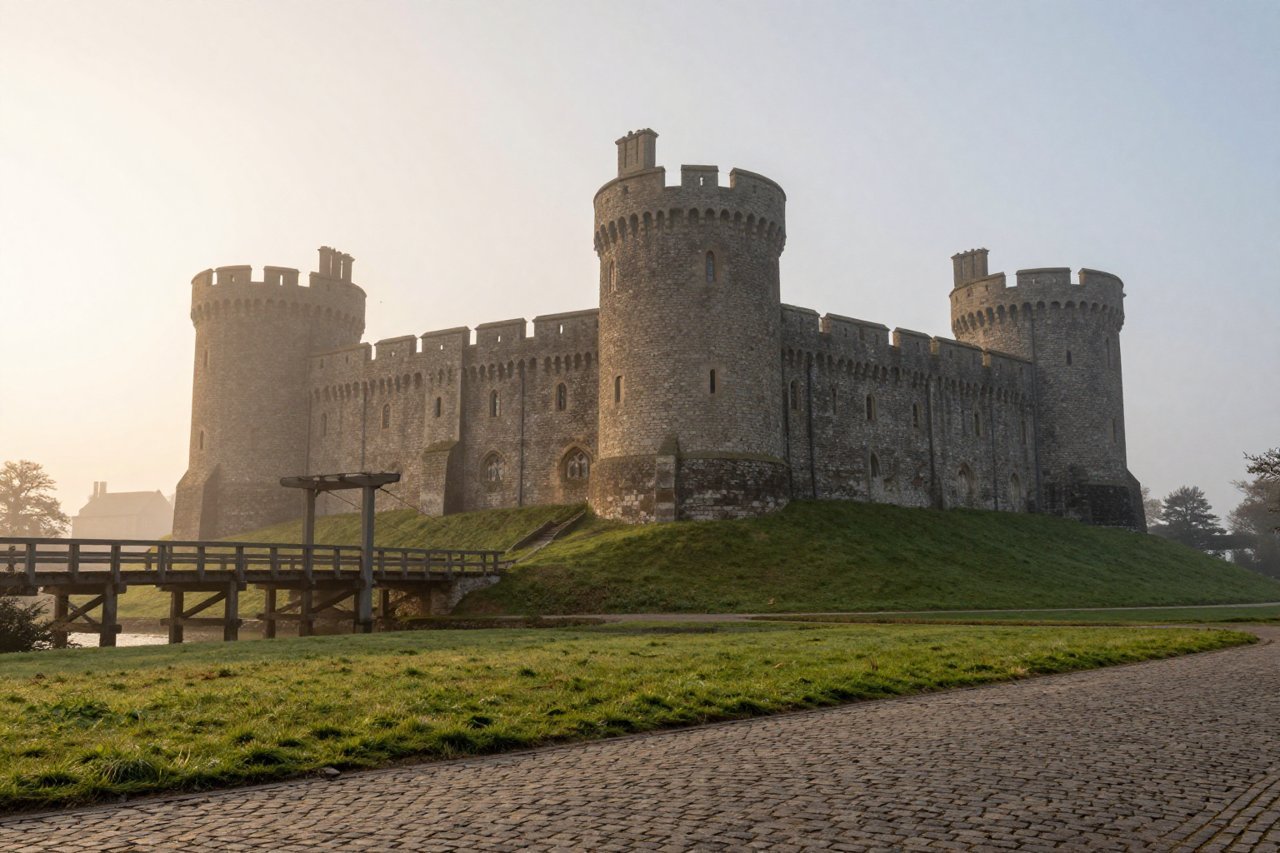
Medieval castles came in dozens of shapes, but the best-engineered ones shared the same basic anatomy. Each feature had a job, and over the centuries masons refined these into deadly efficient systems. Here’s what to look for when you visit one:
- Curtain walls – The high outer wall that connected towers. Some were over three metres thick, with the base of Caerphilly Castle reaching nearly seven metres.
- Gatehouse and barbican – The gate was the weakest point, so defenders built a fortified entrance with multiple portcullises and murder holes above to pour boiling oil or rocks through.
- Towers – Round towers were introduced because they resisted undermining attacks better than square ones. They also gave archers a wider field of fire.
- Arrow slits – Narrow openings that let defenders shoot out while staying shielded. Inside, they flared outward to give archers a wider angle of aim.
- Moat – Not always filled with water. A dry ditch was often more effective because it prevented tunnelling and made scaling ladders cumbersome.
These features worked together to create a layered defence. A single attacker might have to cross a moat, dodge arrows from two walls, survive a hail of projectiles through a murder hole, and then fight through a succession of iron gates. And that was just to reach the courtyard.
Life Inside a Castle: Cold, Smelly, and Surprisingly Noisy
Living in a medieval castle was nothing like the luxurious idyll of novels. Most great halls were draughty, smoky, and filled with the scent of rushes, animals, and unwashed bodies. Tapestries helped trap heat, but they also harboured fleas. Privacy was a rarity. Even the lord’s family often slept in a shared solar, while servants dozed on the floor of the hall. The noise was constant: blacksmiths banging in the ward, dogs barking, knights clanking in the yard. A castle was more like a busy industrial site than a silent stone monument.
But castles were also centres of government and culture. The lord heard disputes, collected rents, and hosted feasts that demonstrated his wealth. It was a hard, structured life, but one that defined the medieval world. The daily rhythm of prayers, work, and seasonal festivals was largely shaped by the Church, and you can trace that influence in the history of Christianity as it spread across Europe and beyond.
Sieges: The Brutal Reality of Castle Warfare
The castle’s true test came when an army surrounded it. Sieges were slow, filthy, and usually decided by hunger rather than heroism. Attackers would try to undermine walls, batter them with trebuchets, or simply camp outside and starve the defenders to surrender. Inside, defenders poured boiling oil, pitch, and quicklime through murder holes, while archers picked off anyone who got too close. Disease often killed more people than enemy action, on both sides.
The Crusades pushed siege warfare to a new level. When European armies encountered the advanced fortifications of the Byzantine and Islamic worlds, they brought those ideas back home. Crusader castles in the Holy Land, like the massive Krak des Chevaliers, became the gold standard of concentric defence, with two rings of walls and an inner keep that could hold out for years. The impact of these campaigns stretched far beyond the battlefield. You can read more about that in our detailed history of the Crusades.
The Evolution from Timber to Stone and Beyond
Early wooden castles burned easily and rotted within a generation. By the 11th century, stone became the preferred material, but the change was slow and expensive. A stone keep could take a decade to raise and cost more than most lords earned in a lifetime. Richard the Lionheart’s Château Gaillard in Normandy was built in only two years, but it was the exception that proved the rule. By the 13th century, engineers had perfected the concentric castle, with an inner ward that could hold out even if the outer wall fell. This was the peak of medieval military architecture.
Then came gunpowder. Cannon fire, first used in the fourteenth century, could batter down even the thickest curtain walls. Builders responded by lowering walls, thickening them, and adding gunports, but the romantic castle of the Middle Ages had lost its military purpose. By the time the Renaissance took hold, these great fortresses were being converted into residences, prisons, or quarries. The humanist ideas and changing patterns of war that defined the new era are explored in our article on the Renaissance, but the old stone piles never lost their grip on the imagination.
Why Medieval Castles Still Capture Our Imagination
The last genuinely medieval castles were built in the 15th century, yet we haven’t stopped searching for the perfect castle. Every year, millions of visitors climb the spiral stairs of the Tower of London, walk the walls of Carcassonne, or pose in front of Neuschwanstein. That last one is actually a 19th-century fantasy, but it shows how much we project onto the idea of a castle. Real castles offer something more authentic: the chance to stand where history happened, to feel the cool thickness of a wall, and to imagine the lives of the people who built and defended them.
When you visit a medieval castle, look past the battlements and ticket booths. Run your fingers over the masons’ marks, find the arrow slits worn smooth by generations of hands, and think about the families who called this place home. The stones hold stories if you take the time to listen. And behind those stories lies the whole sprawling, contradictory, utterly fascinating medieval world that gave them birth.


