
Table of Contents
CoQ10 is one of the most commonly bought supplements in the world, and also one of the easiest to take poorly. It is fat-soluble. It needs time to build up in tissue. And its effects rarely appear within forty-eight hours. So when someone says, “That supplement did nothing for me,” my first question isn’t about the brand. It’s about the protocol.
Real CoQ10 benefits need you to hit a few key variables at once: form, dose, timing, nutrient partners, and a trial period long enough to register changes. This is a practical five-step plan to make that happen, or at least to know exactly when to drop it and move on.
Step 1: Choose Between Ubiquinone and Ubiquinol
Labels list CoQ10 in one of two forms. Ubiquinone is the oxidised form. Ubiquinol is the reduced, active antioxidant form that works directly inside your mitochondria. Your body can convert ubiquinone, but that conversion isn’t free or instant.
If you are under about fifty and generally healthy, a good ubiquinone product is often enough. If you are older, you take a statin, or you already tried ubiquinone for three months and noticed nothing, ubiquinol is the smarter starting point. It costs more, but a bioavailable product beats a cheaper one that doesn’t move the needle.

For the cellular science in plain language, this full CoQ10 benefits breakdown shows why mitochondria rely on it during ATP production.
Step 2: Pick a Dose Based on Your Goal
There is no official recommended daily allowance for CoQ10. Clinical trial doses range from 100 mg to 300 mg a day. For statin-related muscle symptoms, researchers often use 200 mg of ubiquinol daily. For heart health studies, 200 mg daily combined with selenium is common. For general energy maintenance, many start at a smaller dose around 100 mg.
Quick dosing reference
- General energy support: 100 mg daily with a fat-containing meal.
- Cardiovascular support (under a clinician’s care): 200 mg CoQ10 daily.
- Statin-related muscle discomfort: 200–300 mg ubiquinol daily, ideally split into two doses and monitored by a doctor.
If you’re comparing capsules, inspect the actual amounts per serving and any absorption claims. Our list of four best CoQ10 supplements for heart health and energy support is a good place to start if you want options that pass those checks.
Step 3: Give It Fat and a Steady Schedule
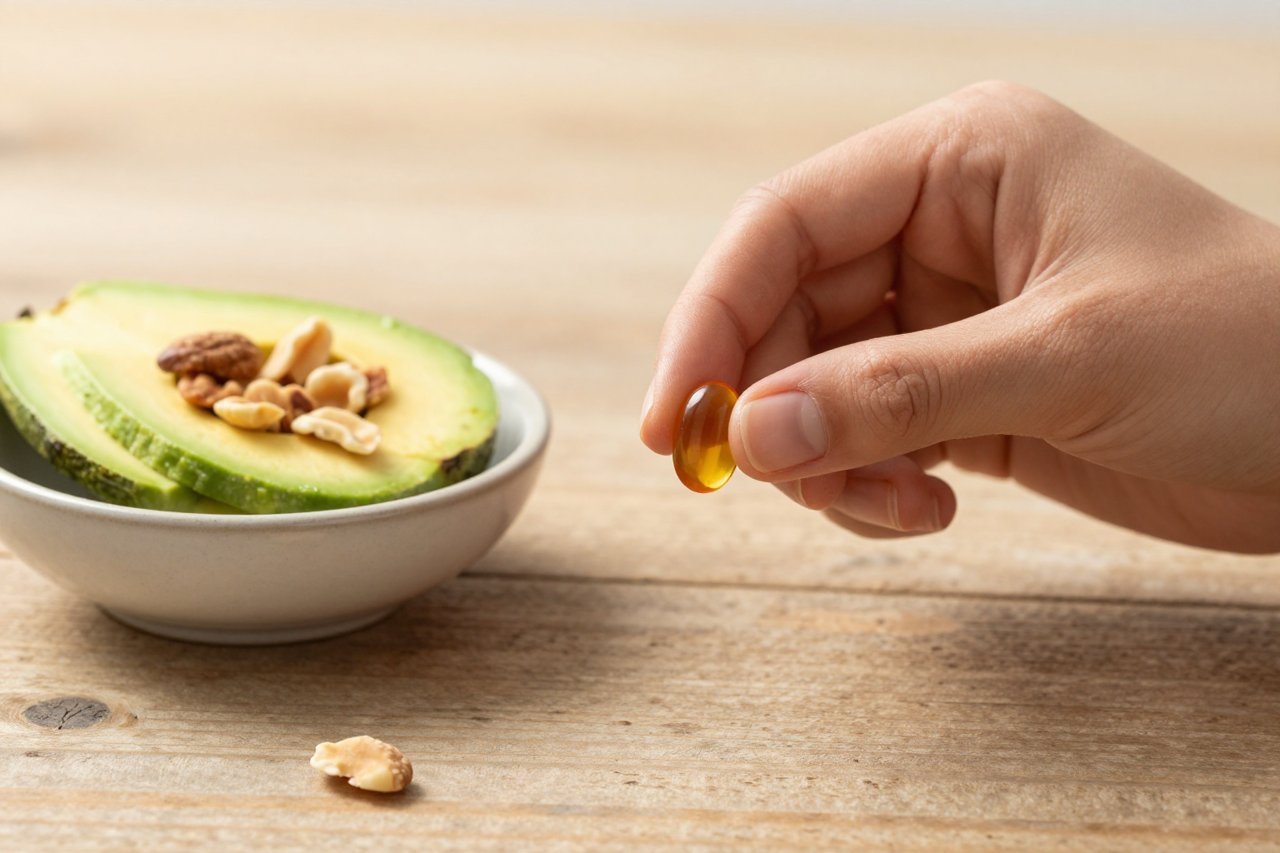
CoQ10’s chemical structure is long and hydrophobic. If you wash your capsule down with black coffee and eat a dry rice cake, don’t expect much to reach your bloodstream. You need a meal containing some fat. Think eggs cooked in butter, full-fat Greek yoghurt with almonds, or a salmon salad. This goes double for ubiquinone.
Softgels are often more reliably absorbed than dry capsules, and a supplement containing oil already gives the molecule something to dissolve in. Take your daily dose with your largest meal, or split the dose across two meals if you are using 200 mg or more.
If you’re taking a statin at night and CoQ10 in the evening, your pill routine can get crowded. Try CoQ10 with breakfast and the statin at dinner. That separation also helps you stay consistent because the CoQ10 is tied to an anchor meal, not to an empty stomach.
Step 4: Bring the Co-Factors That Help It Work
CoQ10 doesn’t function in an empty cellular room. It works alongside B-vitamins and trace minerals, and it relies on selenium for the proteins that protect mitochondria from oxidative damage. In one of the best-known Nordic trials on heart health, participants took 200 mg of CoQ10 along with 200 mcg of selenium for several years. The trial wasn’t just testing a single compound.
That doesn’t mean you need to fill your cabinet with six extra bottles. But it does mean you should check if a basic multivitamin is already covering the team. Our straightforward take on multivitamin benefits will help you decide whether a daily multi is the right foundation for your situation.
Step 5: Run a Six-Week Experiment and Let the Data Speak
CoQ10 is not caffeine. It won’t hit you in 20 minutes. Many trials that measure coenzyme Q10 levels see increases over weeks. So the fastest way to wrongly conclude that it does nothing is to quit after a week.
Before you start, set up a simple baseline. Rate your afternoon energy from zero to ten. Write down how you feel after your usual exercise or walk. If you’re taking it for heart health, record your morning blood pressure for a few days as directed. Then recreate those measurements at the end of week three and week six.
Here is a realistic example. A 58-year-old on a statin rated her 2 p.m. crash as six out of ten. She took 200 mg of ubiquinol with breakfast, and set a three-day average of her weekend hike recovery. She didn’t feel a sudden spark. In week three, her afternoon score moved down to four. By week six, the same hike no longer left her needing to rest for forty minutes. That’s the pattern that matches CoQ10’s gradual, mitochondrial-level role.
If your numbers haven’t moved after six weeks, don’t toss the bottle just yet. Try switching from ubiquinone to ubiquinol, change the dose under guidance, or make sure you’re taking it with enough fat. At the ten- to twelve-week mark, if there’s still no change, the next step is to stop supplementing or reassess why you started.
CoQ10 is one part of an energy puzzle. To see where it fits alongside caffeine, creatine, and B-complex, this practical, evidence-based guide to energy supplements sorts the strategies that actually work from the expensive ones that don’t.
Run a consistent six-week trial and make decisions from real numbers. If you see an improvement, you’ll know exactly what is working. If you don’t, at least you’ll have the information to change the dose, form, or timing. That’s how a supplement earns its place on your shelf.


