
Table of Contents
Most people meet coconut oil in the kitchen long before they think about putting it on their head. It’s the jar that turns solid in a cold room, melts the second it hits your palm, and smells faintly of the beach. Then a friend swears it fixed her dry ends, and you’re standing in the bathroom with a spoonful, wondering how much is too much and whether your hair will be greasy for a week.
This guide assumes you know nothing. It covers what coconut oil actually is, what it does to hair (in plain English), which jar to buy, how to use it the very first time, and how to judge after a month whether it deserves a permanent spot in your rotation.
Why coconut oil acts differently from other oils
Roughly half of coconut oil is lauric acid, a fatty acid with a short, straight molecular chain. That shape matters. Oils like olive, sunflower and castor are built from larger, more branched molecules that mostly sit on the outside of the hair shaft, coating it. Coconut oil’s molecules are small and linear enough to slip between the overlapping scales of the cuticle and reach the cortex, the inner layer.
That penetration is why coconut oil can do something most oils can’t: reduce how much protein your hair loses when it gets wet. A widely cited 2003 study by Rele and Mohile found that hair pre-treated with coconut oil lost significantly less protein during washing than untreated hair, or hair treated with mineral or sunflower oil. Less protein loss means less of the slow thinning and snapping that builds up from repeated washing.

Virgin coconut oil melts at around 24°C (76°F), which is also why a small amount goes further than you expect once it’s warming in your hands.
What it can and can’t do
Setting expectations early saves a lot of disappointment later.
- Can: reduce protein loss during washing, helping hair hold together over time.
- Can: lower friction, so strands slide past each other instead of snagging and snapping when you comb.
- Can: temporarily soften rough, dry ends by filling gaps in the cuticle.
- Can: loosen flaky buildup for some scalps, though it makes others noticeably worse.
- Can’t: repair split ends. Nothing seals a split back together. You trim it.
- Can’t: make hair grow faster. It supports the hair you already have.
- Can’t: replace your conditioner or a protein treatment.
If growth is your real goal, oil is a supporting player at best. Scalp health, diet and consistency do most of the work, and even the best hair growth serum won’t do much if you keep making these 8 mistakes.
Which jar to buy
Walk down the oil aisle and you’ll see three things labelled coconut oil. They are not interchangeable.
Virgin (or extra virgin)
Unrefined and cold-pressed, with a strong coconut smell and most of its natural antioxidants intact. This is the one you want for treatments.
Refined
Bleached and deodorised. Lighter scent, longer shelf life, slightly fewer beneficial compounds. A sensible choice if the smell puts you off.
Fractionated
Split into liquid medium-chain triglycerides so it never solidifies. Because the long-chain fats have been removed, it doesn’t penetrate the way virgin oil does. Treat it as a lightweight carrier for sprays and serums rather than a deep treatment. There’s a full breakdown of refined, virgin, or fractionated coconut oil and the best way to use each if you want the detail.
For a first purchase, a small jar of virgin coconut oil is plenty. Organic is nice if the price isn’t silly.
How to apply it the first time
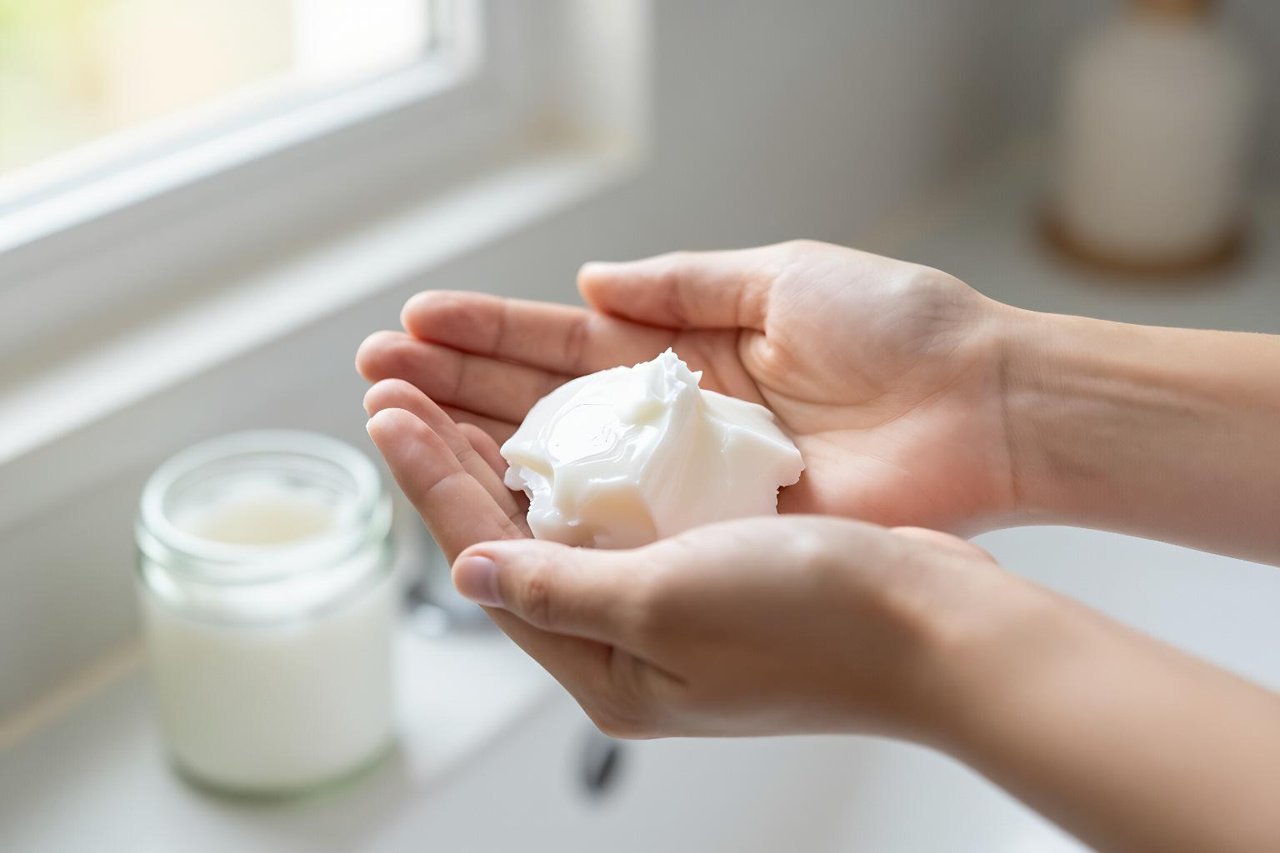
For shoulder-length hair you need half a teaspoon to a teaspoon. No more. Anything past that becomes a washing-out problem.
Warm the oil between your palms until it’s fully liquid, then start at the ends and work upward, stopping about two inches from your roots. Ends are older, drier and need it most. Roots are usually the oiliest part of your head already.
Leave it for at least 30 minutes. Longer is better: two hours, or overnight under a shower cap with a towel over your pillow. Then shampoo. Expect to need two rounds, and a sulphate shampoo genuinely helps here. Gentle formulas often leave a film behind. Condition as normal afterwards.
One warning that catches a lot of beginners: if you have dandruff or a flaky, itchy scalp, don’t massage coconut oil into it. The yeast behind most dandruff, Malassezia, feeds on fatty acids, so coconut oil can make the flaking worse rather than better. Keep it on the lengths.
How often you should do it
Fine or thin hair
Once a week at most, and go light. Fine hair shows grease fast, so a pre-wash treatment is usually enough. For a lighter touch between washes, a homemade coconut oil hair spray made with fractionated oil beats a heavy scoop from the jar.
Medium to thick hair
Once or twice a week, and you can be more generous with the amount.
Curly, coily or high-porosity hair
Two to three times a week, and many people use it as a sealing layer over leave-in conditioner. High-porosity hair soaks oil up and loses moisture quickly, so it rarely looks greasy.
Five mistakes that make beginners quit
Most people who decide coconut oil “doesn’t work” made one of these.
- Using a tablespoon when a teaspoon was plenty.
- Slathering the scalp, then wondering why the roots looked flat for three days.
- Leaving it in as a styling product on fine hair.
- Rinsing once with a gentle shampoo and giving up when it stayed greasy.
- Expecting one treatment to undo six months of heat damage.
There’s a longer list in this piece on the mistakes, myths and pitfalls that trip everyone up, including a few myths that keep circulating on social media.
Fitting it into an actual routine
You don’t need a twelve-step programme. Treat coconut oil as one move on wash day: oil before you shampoo, wash it out, style as usual. That’s the whole habit for the first month. Once it sticks, it’s easy to build on, and a step-by-step coconut oil routine adds scalp massage and a light mid-week refresh if you want more.
What to expect in the first four weeks
Week one, expect softness that fades by your next wash, plus a greasy mistake or two while you calibrate the amount. By week three or four, if it suits your hair, the change shows up in smaller ways: fewer little broken hairs in the sink, less snapping when you comb out tangles, and ends that feel smoother without looking coated.
If nothing has changed by then, check your oil type, your amount and how thoroughly you’re rinsing before you blame the coconut. And if your hair feels dry and crunchy after a treatment instead of soft, that usually points to too much protein elsewhere in your routine, or hair that needs moisture more than oil. Either way, you’ll know within a month, and you’ll know it from a small jar rather than a lifetime supply.


