
Table of Contents
The Isle of Man TT has run almost every year since 1907. On the 37.73-mile Snaefell Mountain Course, riders reach close to 200 mph on public roads lined with stone walls, lamp posts and spectators standing at the kerb. More than 260 competitors have died there. Six people were killed at the 2022 event alone.
That sits at the sharpest end of the scale. Ask ten people to name the most dangerous sports, though, and you’ll get ten different answers, usually football, boxing, or whatever gruesome injury they happened to see last weekend. The truthful answer depends entirely on what you’re measuring: deaths, catastrophic injuries, or how often someone leaves in an ambulance.
What “dangerous” actually means
There is no single ranking, and anyone who claims otherwise is selling something. Fatality rates per participant push small, extreme activities to the top. Injury rates per 1,000 hours of play push mainstream ones up. Raw death counts favour whatever the most people do, which is why cycling kills far more people each year than cave diving ever will.
The fairest metric is probably deaths or serious injuries per hour of participation. That test reshuffles the list considerably, and it’s the one worth keeping in mind as you read on. A weekend skydiver with 200 jumps has a very different risk profile from a wingsuit pilot doing 300 jumps a season.

BASE jumping and wingsuit flying: the shortest error chains
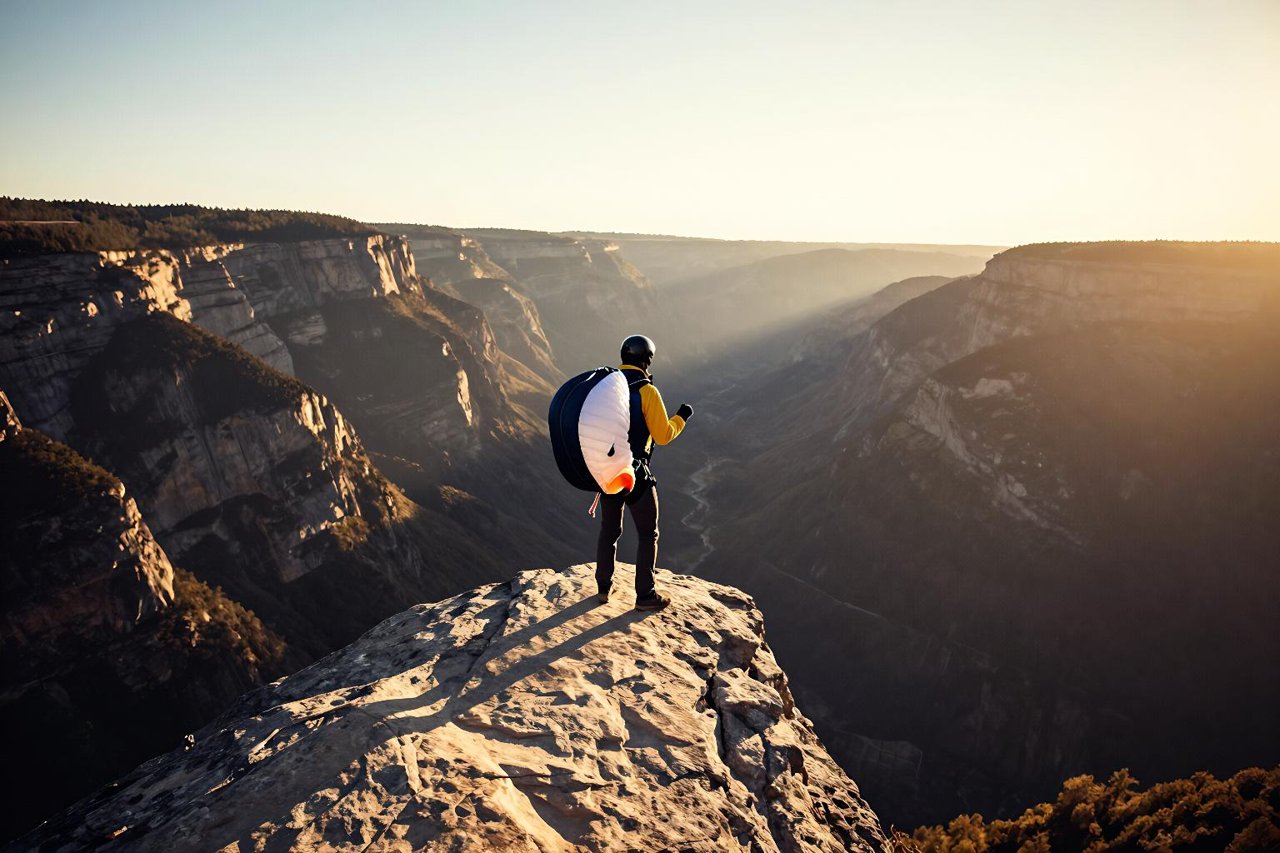
BASE stands for building, antenna, span, earth. Jumpers launch from fixed objects at heights as low as 150 metres, with a single canopy and no reserve. One widely cited analysis of jumping records put the fatality rate at roughly one death per 2,300 jumps. Other estimates for wingsuit flying run as high as one per 500.
What makes these sports so lethal isn’t recklessness. It’s geometry. A skydiver has around 60 seconds to solve a problem and a backup parachute if the first attempt fails. A BASE jumper has five seconds and nothing else. There is no second option, no re-rack, no do-over.
Why experience doesn’t protect you
Counter-intuitively, a large share of fatalities are highly experienced jumpers. Familiarity breeds shortcuts, and in a discipline where the margin is measured in metres of altitude, a shortcut is fatal. The learning curve kills beginners; complacency kills veterans.
Cave diving: the sport where panic kills
Cave divers swim into overhead environments where a direct ascent to the surface is impossible. If something goes wrong, you cannot simply go up. You follow a guideline back through the dark, often through restrictions barely wider than your shoulders, to the exit you came in through.
Cave divers make up a tiny fraction of all divers but account for a disproportionate share of diving fatalities. The standard safety protocol, the rule of thirds, reserves a third of your gas for the swim in, a third for the way out, and a third for the emergency that will, sooner or later, happen. Silt kicked up by a fin can reduce visibility to nothing in seconds. When that happens, the guideline is the only thing between you and a very quiet ending.
High-altitude mountaineering
More than 330 people have died on Everest since 1922, and while the death rate for paying clients has fallen to around 1% in good years, the mountain has a way of collecting people during the descent, when fatigue, low oxygen and summit fever combine.
Everest is not the deadliest peak. Annapurna has historically killed roughly one climber for every three or four who reached the top. K2’s ratio has hovered around one in four. Falls, serac collapses, avalanches, and the cerebral and pulmonary oedema that comes from spending too long above 7,000 metres all take their share.
Motorcycle road racing
The TT is the most famous example, but the whole discipline of real-road racing carries similar odds. The North West 200, the Ulster Grand Prix and the Macau Grand Prix have all lost riders. Unlike circuit racing, there is no run-off area. A mistake puts you into a wall, a hedge, or a house.
The riders know this. They keep coming back because the sport offers something a closed circuit cannot. It’s worth saying plainly that no amount of skill makes a stone wall forgiving.
Horse racing: falls at 40 mph with half a tonne on top
Jump racing is the brutal version. A jockey falls from roughly three metres at speed, then a horse weighing 500 kilos may land on them or roll over them. Spinal injuries, punctured lungs and traumatic brain injuries are occupational hazards. In Britain and Ireland, the sport averages several fatalities a season, and hundreds of riders retire with damage that never fully heals.
Big-wave surfing
The death toll is small enough that you can name most of the big-wave surfers who have drowned. The injury list is another matter. A wipeout at Nazaré or Mavericks can hold a surfer underwater for two or three waves in a row, and the impact zone is full of moving water equivalent to a building collapsing.
The sports that injure far more people than they kill
If you measure harm by volume rather than by fatality rate, the picture flips completely. These are the activities that fill emergency departments every weekend:
- Cycling. Around 1,000 riders die on US roads each year, and hundreds of thousands are treated for injuries. Add mountain biking and the numbers climb further.
- American football and rugby. Concussion, spinal trauma and long-term neurodegenerative disease. Repetitive head impacts are the story here, not single catastrophic hits.
- Cheerleading. It accounts for roughly two-thirds of catastrophic injuries among female high school and college athletes in the US, mostly from falls onto hard surfaces during pyramids and tumbling. Research funding has lagged badly, and as reporting on how language shapes women’s health research has shown, even the vocabulary used around female athletes’ injuries affects what gets studied.
- Horse riding. Far more dangerous per hour than most people assume, and most of the injuries happen in ordinary recreational riding, not competition.
- Gymnastics. Wrist, ankle and spine injuries from repetitive loading at a young age.
Winter sports deserve their own category
Skiing and snowboarding combine speed, hard surfaces, cold and terrain that changes daily. Tree wells, avalanches and collisions cause a steady stream of deaths each season, and the injury rate per 1,000 visits is several times higher than most team sports. Helmets have helped enormously with head trauma, but they don’t protect your knees or your spine, which is why knowing how to stay safe during winter sports matters more than any single piece of equipment.
The risk you can’t engineer away
Gear has genuinely changed the odds. Airbag vests for riders, avalanche float packs, better helmets, GPS beacons and avalanche forecasts available on a phone have all reduced the body count in disciplines that once killed routinely. Some of the more interesting recent innovations in sports and outdoors gear are aimed squarely at surviving bad days rather than performing on good ones.
But there’s a ceiling to what equipment can do. Human factors dominate almost every fatality report: a decision made at 4pm when you should have turned around at noon, a jump taken in wind that was gusting ten knots above the limit, a dive pushed past the gas plan because the cave was beautiful and the exit was close.
The useful question isn’t which sport is most dangerous. It’s which risks you’re actually willing to prepare for. Cave divers train for years and die rarely. Confident novices on a rented jet ski die every summer. The sport sets the stakes; the preparation sets the odds.


