
Table of Contents
Megalithic structures are the big, blunt evidence that prehistoric people could organise labour on a monumental scale. The word comes from Greek: megas, large, and lithos, stone. The phrase megalithic structures explained in one sentence would be this: big stones set with skill by farming communities who had no metal tools. The oldest examples go back more than 6,000 years. They turn up from the Orkney Islands to Malta, from Brittany to Korea.
The label covers tombs, standing stones, circles, alignments and walls. It describes a construction technique, not a single culture or religion.
What counts as a megalithic structure?
A megalithic structure uses large stones as structural elements: uprights, lintels, capstones, walls or kerbs. Many were tombs. Others were ceremonial rings, processional lines or defensive walls. A rock-cut tomb or an earthwork can be monumental without being megalithic in the strict sense.
- Menhir: a single upright stone. The Grand Menhir Brisé at Locmariaquer in Brittany once stood about 20 metres tall and weighed around 280 tonnes before it fell and broke.
- Dolmen: a chamber of upright slabs capped by a flat stone. Poulnabrone in County Clare is a famous Irish example.
- Passage grave: a stone-lined corridor leading to a burial chamber under a mound. Newgrange in Ireland and Maes Howe in Orkney are classic sites.
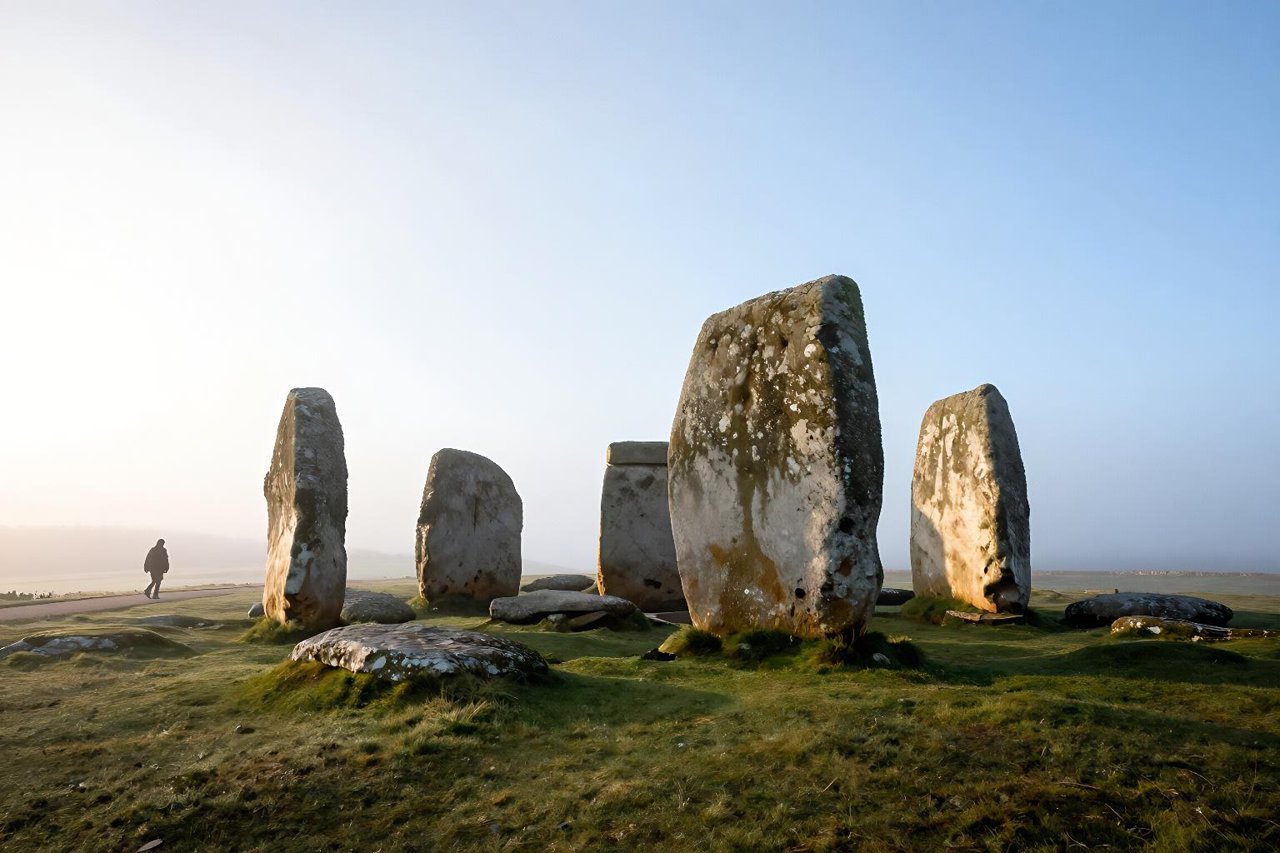
- Stone circle and henge: rings of uprights, sometimes inside a bank and ditch. Stonehenge and Avebury in Wiltshire are the best known.
- Alignment and stone row: long lines of standing stones, as at Carnac in Brittany, where thousands are arranged in rows.
- Cyclopean wall: walls of huge, roughly fitted blocks, such as the Bronze Age walls of Mycenae in Greece.
How old are they, and who built them?
Megalithic building began at different times in different places. Some tombs in western France and Iberia date to the fifth millennium BCE. Malta’s temples, including Ġgantija on Gozo, were built between about 3600 and 2500 BCE. Newgrange went up around 3200 BCE. Stonehenge’s main sarsen circle was raised around 2500 BCE.

The builders were farmers who kept cattle, grew cereals, traded axes and made pottery. They had no metal tools at first. Their world was timber, rope, bone, antler, stone and human muscle. Any proper account has to start with local communities, not mysterious outsiders.
The engineering problem: moving and raising big stones
Quarrying without metal
Most megaliths were quarried close to where they were erected, but not always. Stonehenge’s bluestones came from the Preseli Hills in west Wales, roughly 250 km from Salisbury Plain. The sarsens came from the Marlborough Downs about 25 km north. Quarry evidence at Carn Goedog and Craig Rhos-y-felin shows people prised out pillar-shaped bluestones using wedges and levers. Antler picks have been found in chalk quarries.
At Malta’s temples, builders cut globigerina limestone while it was soft, then let it harden. The blocks were not always enormous, but the walls and corbelled roofs required precise fitting.
Transport with timber, rope and grease
Moving a 25-tonne sarsen is a logistics problem. Experimental archaeologists have shown that a group can move a one-tonne block on a wooden sledge over greased planks. Scale that up, and a large stone needs more rope, more timber and a well-drilled team, but not magic. Rollers work on flat ground. Sledges and levers work better on slopes. Water transport is plausible for some stones, especially in Ireland and Scotland, but it is not proven for every long journey.
Rope matters as much as muscle. Prehistoric people made strong cordage from plant fibres, leather and sinew. A team pulling in rhythm can move far more than its individual members could manage separately.
Raising and setting the stones
Standing a stone upright usually meant digging a socket, sliding the base into it, then hauling the top up with ropes while people pushed from behind. Packing stones wedged the base tight. At Stonehenge, the uprights sit in chalk-cut pits with packed chalk and stone. The lintels were lifted with timber scaffolds, ramps and cradles. Their mortise-and-tenon joints lock the lintels onto the uprights.
Not every megalith is a post-and-lintel build. Newgrange’s chamber roof is corbelled, with layers of stone overlapping inward until they meet. Maes Howe uses similar dry-stone corbelling. Maltese temples have curved walls and carefully planned chambers, not just brute force.
Why build them? Power, ancestors and the sky
Megaliths served different purposes. Many were tombs. Poulnabrone held the remains of dozens of people over centuries. Newgrange contains a passage and chamber aligned so the winter solstice sunrise reaches the floor. Stonehenge’s main axis lines up with the midsummer sunrise and midwinter sunset. That does not make every megalith an observatory. It means the sky was part of the ritual world.
Building itself may have been the point. Quarrying, dragging and raising stone brought scattered farming communities together. Feasts, marriages and alliances probably happened around the work. A monument that took years to build also marked territory and memory. It told neighbours that this valley belonged to people with the labour and the ancestors to hold it.
Reading a megalithic landscape
Single monuments rarely stand alone. Around Stonehenge is Durrington Walls, a huge henge settlement where people feasted; the Avenue connects the two. At Avebury, the stone circle sits inside a massive bank and ditch, with Silbury Hill nearby. In Orkney, Maes Howe, the Stones of Stenness and the Ring of Brodgar form a compact ceremonial landscape. Brittany’s Carnac alignments run for kilometres.
When you visit, look beyond the obvious stones. Check sockets, packing stones, kerbstones and cup marks. Notice which direction a passage faces. Walk the surrounding earthworks and imagine timber posts, ditches and open ground where fields now are.
- Socket holes and packing stones: evidence of how uprights were fixed.
- Orientation: passage graves and stone circles often line up with solstice sunrises or sunsets.
- Surrounding earthworks: banks, ditches and avenues show the monument was part of a larger site.
- Tool marks: chisel marks, cup marks and quarry scars reveal construction methods.
Myths that refuse to die
Two myths cling to megaliths. The first is that druids built them. Druids appear in the written record centuries after Stonehenge was erected. They may have used the site, but they did not build it. The second is that only a huge slave population could have moved the stones. Experimental work suggests smaller, skilled teams with good organisation can do more than expected.
The more interesting story is local innovation. The Grand Menhir Brisé at Locmariaquer was quarried, transported and erected around 4700 BCE, then later broken. That is earlier than the pyramids of Giza by more than a thousand years. Malta’s temples are older than Stonehenge’s sarsen circle. These dates matter because they show megalithic building was not a single invention that spread from one place. It emerged in several regions as farming communities settled and competed for land.
A short field guide to visiting megaliths
Many megalithic sites are free and open, which is part of their charm and part of the risk. Erosion from feet, hands and wet weather damages soft stone and fragile ground. Stay on marked paths at Carnac. Do not touch cup-marked panels. Check tide times before walking to coastal sites. Bring a torch for passage graves if allowed, and keep it low. Book ahead for Newgrange, Maes Howe and Stonehenge, where access is controlled. Go early or late; low sunlight shows carvings and stone textures far better than flat midday light.
At Poulnabrone, the dolmen looks simple until you notice the capstone’s weight and the way the uprights are set into the limestone pavement. That moment of noticing is the real payoff. Megalithic structures explained in a book are abstract. Standing beside one, you feel the practical problem of moving several tonnes of stone with rope and muscle. The stones are not mysterious because they are impossible. They are impressive because they are possible.


