
Table of Contents
A bagel from a 1980s deli was about three inches across and carried roughly 140 calories. Walk into the same kind of shop today and you’re handed something closer to six inches and 350 calories. Nobody decided to eat more. The food simply arrived bigger, and most of us eat what we’re given.
That gap between what we think we eat and what actually lands on the plate is where portion control lives. It isn’t a diet, and it isn’t a test of willpower. It’s the practice of noticing how much food is in front of you, then adjusting it to match what your body actually needs.
Portion Control vs. Serving Size: They’re Not the Same Thing
A serving size is a reference number. It’s the amount the manufacturer or a nutrition guideline decided to print on the label, and it has nothing to do with your appetite. A portion is what ends up on your fork.
This distinction matters more than it sounds. A bag of crisps might list “three servings per pack” on the back, but the pack is designed to be eaten in one sitting. Same with a bottle of juice or a supermarket sandwich. Reading the label tells you about the food. It tells you nothing about how much you should personally eat.

Portion control is the habit of making that second decision yourself: how much of this do I actually want, rather than how much has been placed in front of me.
Why Portions Grew Without Anyone Noticing
Dinner plates in the 1960s were typically nine inches across. Many modern sets run eleven or twelve. Restaurant entrées have roughly doubled in size since the 1980s in most Western countries, and bigger portions don’t just look generous, they change what feels normal.
Researchers call this “portion distortion.” Show people a range of portion sizes and ask which looks like a sensible meal, and they reliably pick something far larger than a dietitian would. The reference point has shifted. If a normal pasta dinner looks small to you, that’s not a character flaw, it’s an updated benchmark.
There’s a visual trick at play too. The same amount of food looks meagre on a twelve-inch plate and generous on a nine-inch one. You serve yourself more onto a big plate without registering it, then eat the whole thing because it doesn’t look like much.
How Portion Control Works Inside Your Body
Eating less food isn’t the whole mechanism. The interesting part is what happens between the food hitting your stomach and the signal reaching your brain.
The twenty-minute lag
Your stomach has stretch receptors that fire when it fills, sending signals along the vagus nerve to say “enough.” The problem is timing. Those signals, plus the gut hormones released as food is digested, take around fifteen to twenty minutes to fully register as fullness.
Eat a large plate in eight minutes and you’ll finish before the message arrives. Eat a smaller plate over twenty minutes and you’ll feel satisfied on noticeably less food, because you gave the feedback loop time to work.
Energy density beats volume
Fullness tracks the weight and volume of food in your stomach more closely than it tracks calories. A hundred calories of roasted vegetables fills far more space than a hundred calories of chocolate, which is why a bowl of soup before dinner reliably reduces how much you eat afterwards.
This is the principle behind most working weight loss approaches, and it’s worth understanding properly rather than guessing. If you want the underlying science of energy balance and appetite, the full weight loss diet guide grounded in real research covers it in detail.
Protein and fibre change the maths
Protein and fibre both slow digestion and trigger stronger satiety signals than refined carbohydrates or fat alone. Two hundred calories of Greek yoghurt with berries will hold you far longer than two hundred calories of toast. Portions stay easier to control when the food you’re portioning is doing some of the work for you.
That said, no approach removes the need to watch quantities. Even on a very low-carbohydrate pattern like a keto diet built around ketosis and fat adaptation, calories still count, and a portion of nuts or cheese can quietly undo an entire day’s deficit.
Practical Ways to Make Portions Work in Real Life
You don’t need a food scale for every meal. A few structural changes do most of the heavy lifting.
- Use your hands as a rough guide. A palm-sized portion of protein, a cupped hand of carbohydrate, a thumb of fat, two fists of vegetables. It scales with your body size, which a printed guideline can’t do.
- Trade down on plate size. A nine or ten-inch plate instead of twelve. Same food, less of it, and it looks like a full meal.
- Serve from the hob, not the table. Family-style bowls on the table invite second helpings that nobody consciously chose. Portioning straight from the pan adds a small, useful pause.
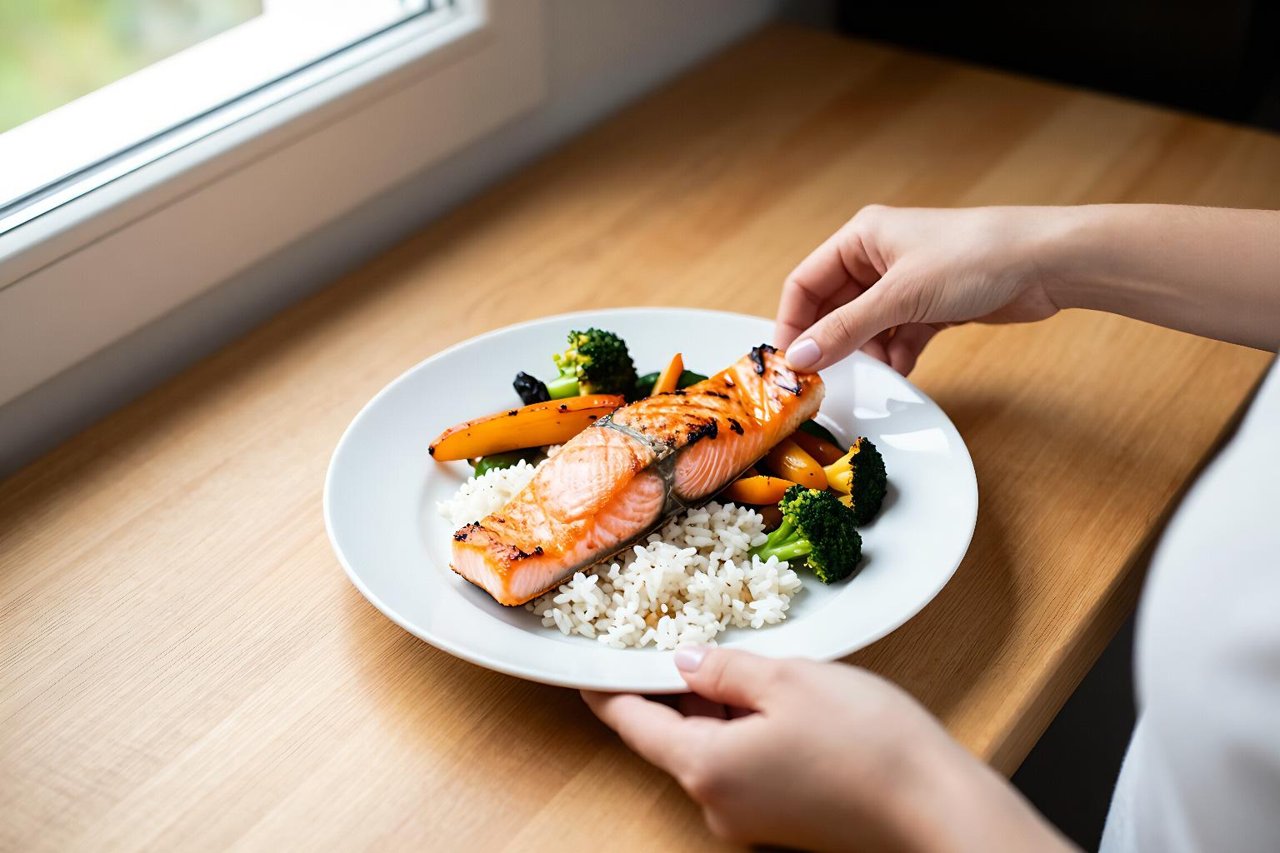
- Fill half the plate with vegetables first. Whatever space is left is where the protein and starch go. It’s a simple build order that limits the calorie-dense items automatically.
- Pre-portion snack food into a bowl. Eating from the packet means the portion is “the rest of the packet,” and it’s remarkably easy to blank on how much has gone.
- Use taller, thinner glasses. People pour roughly 30% more into a short, wide tumbler than a tall one holding the same volume.
Where Portion Control Goes Wrong
A lot of people take a sensible idea and turn it into a rule they can’t keep. Cutting portions so aggressively that hunger becomes constant is the most common mistake, and it usually ends in a binge three days later, followed by the conclusion that portion control “doesn’t work” for them.
Under-eating has real costs. Energy drops, training suffers, and a meaningful share of the weight lost is muscle rather than fat. Portion control isn’t the same thing as restriction. If you’re hungry an hour after every meal, the portion is too small or the meal is built wrong.
Weighing every gram at every meal is another trap. It’s useful for a week or two to recalibrate what a portion looks like, then it becomes a source of stress that most people can’t sustain.
Does It Hold Up Over the Long Term?
The research is quietly encouraging. In trials where people are given larger or smaller portions without knowing it, they eat 20-30% more or less with no change in reported fullness. Portion size is a genuine lever, not a placebo.
Longer-term, the pattern holds as long as the environment supports it. People who keep weight off tend to have built routines that make the right portion the default: a consistent breakfast, a smaller set of plates, snacks that aren’t stored in arm’s reach. The behaviour becomes automatic rather than conscious, which is what makes it survive a busy Tuesday.
It’s also worth seeing portions as one piece of a much bigger picture. Sleep, stress, activity and how you eat across a whole week all interact, and the people who do best tend to optimise the whole system rather than obsess over one variable. That’s essentially the argument behind what extreme longevity and health optimisation actually requires.
Start With One Meal This Week
Pick dinner. For three nights, serve yourself what you’d normally serve, then move about a fifth of it to one side before you start eating. Eat slowly enough that the meal takes fifteen minutes rather than seven. At the end, check whether you actually wanted that last fifth.
Most people find they didn’t, or that they’d have wanted it ten minutes later. That single feedback loop, repeated and gradually extended to other meals, is the whole practice. If you’d rather follow a set structure than improvise, a structured 21-day diet plan for weight loss gives you portioned meals to calibrate against before you go it alone.
Three weeks of that and you’ll have your own working answer to what a portion looks like on your plate, in your kitchen, for the food you actually eat. That’s more useful than any chart.


