
Table of Contents
At Cooper’s Hill in Gloucestershire, a nine-pound wheel of Double Gloucester cheese gets a one-second head start and then rolls down a slope steep enough that standing upright is a challenge. A pack of adults sprints after it, tumbles, and sometimes gets carried off on a stretcher. The winner takes the cheese home. Nobody can quite explain why this is a good idea, and nobody who has watched it wants it stopped.
That race is one of dozens of odd, fiercely contested events staged each year by small towns that have decided their reputation is worth more than their dignity. Some are centuries old. Some were invented by a pub landlord with a spare afternoon. All of them have rules, records and long memories.
Chess Boxing: Three Minutes of Pawns, Two Minutes of Punches
Berlin, 2003. A Dutch performance artist named Iepe Rubingh staged the first chess boxing match after reading a graphic novel about the idea, and it turned out the sport worked far better than it had any right to. Fighters alternate eleven rounds: three minutes at the board, two minutes in the ring.
You win by checkmate, knockout, or by leaving your opponent with under a minute on his clock. Headphones go on during the chess rounds so nobody can shout advice from the corner. The exhaustion is the whole point. Try calculating a knight fork with a fresh cut over your eye and your lungs still burning.

The World Chess Boxing Organisation has run championships most years since, and competitors now turn up from Britain, India, Iran and the United States. It is still small enough that the fighters all know each other by nickname.
Bog Snorkelling in a Welsh Town of 2,000 People
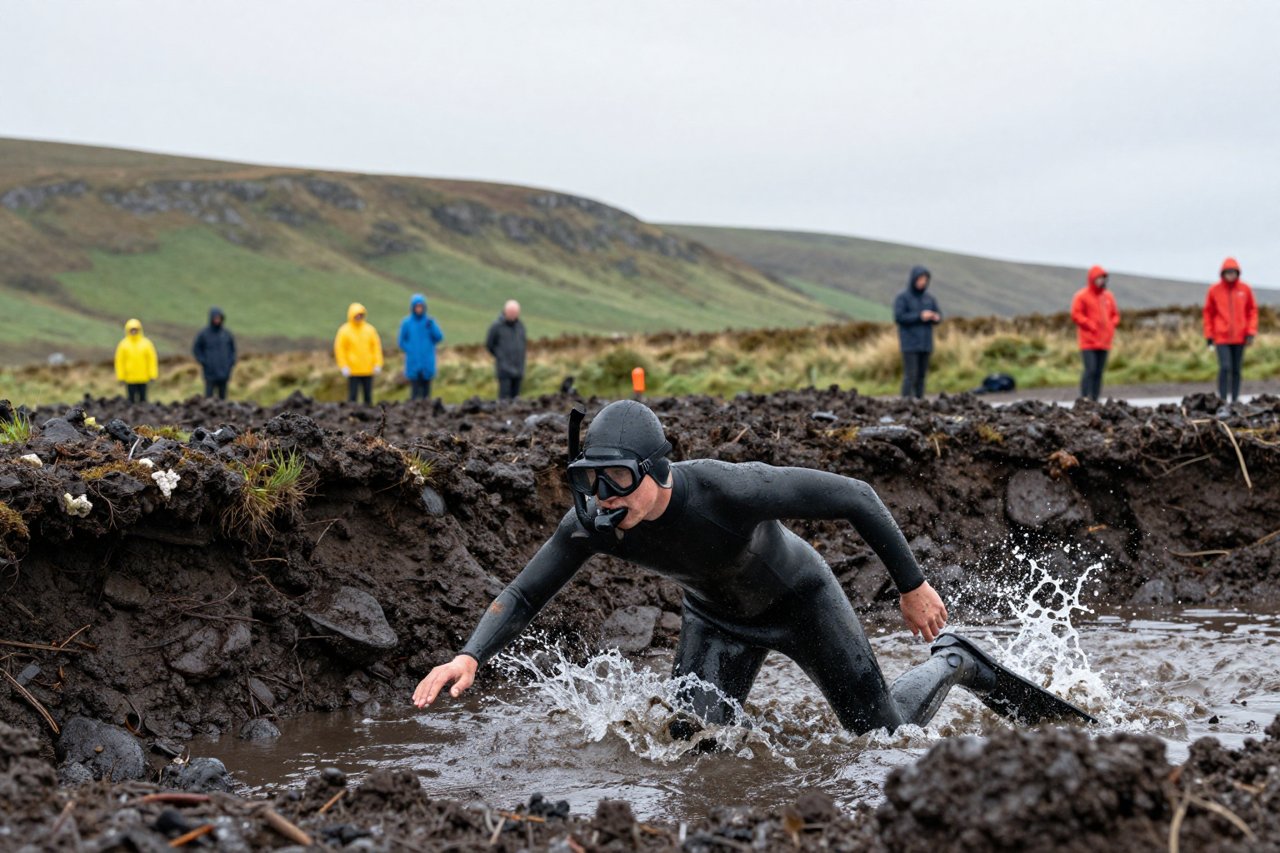
Llanwrtyd Wells, in mid-Wales, hosts the World Bog Snorkelling Championships every August bank holiday. Competitors swim two lengths of a 55-metre trench cut through a peat bog, in water that hovers around 4°C, wearing mask, snorkel and flippers. Only doggy paddle is allowed. Front crawl, breaststroke and butterfly are banned, and the marshals do enforce it.
The event began in 1985 when local publican Gordon Green needed a reason for visitors to come to town on a quiet weekend. The course record now sits comfortably under a minute and a half, which is remarkable given that visibility is roughly zero and the water is the colour of strong tea. The same town also runs the Man versus Horse Marathon, a 22-mile race across the hills where runners take on riders. Horses usually win; humans have managed it only twice in four decades.
Chasing Cheese Down a 50-Degree Slope
The Cooper’s Hill roll is about as close as Britain gets to a controlled avalanche. The cheese reaches speeds of around 70mph, so the race is really a test of staying on your feet while gravity does what it wants. Dislocated shoulders, broken ankles and concussions are routine, and volunteer medics line the bottom of the hill.
The event was officially cancelled on safety grounds in 2010, so locals simply ran it themselves, and it has continued in that loose, unofficial form ever since. Turn up on the late May bank holiday and you will find the slope packed.
Wife Carrying, Where the Prize Is Her Weight in Beer
Sonkajärvi, Finland, has hosted the Wife Carrying World Championships since 1992. The course runs 253.5 metres, with a waist-deep water obstacle and two dry hurdles, and you can carry your partner however you like. The Estonian carry, wife upside down with her legs over your shoulders, is the fastest and looks by far the most alarming.
The winning couple takes home beer equal to the wife’s weight, plus a modest cash sum. That is the honest scale of prize money at most of these events, nowhere near the commercial machinery that turned a handful of mainstream athletes into billionaires through endorsements and equity stakes. The rules do relax one detail: the “wife” doesn’t have to be married to you, but she must be over 17 and weigh at least 49kg. The course record, set by an Estonian pair, is 55.5 seconds.
Kabaddi and Sepak Takraw: Asia’s Breathless Specialities
Kabaddi is roughly 4,000 years old and built on one of the strangest rules in any sport. The raider must chant “kabaddi, kabaddi, kabaddi” continuously while crossing into the opposition half, tagging defenders and getting back out. Stop chanting, or sneak a breath, and you are out. You have 30 seconds to do the whole thing.
For decades it was a village game. Then the Pro Kabaddi League launched in 2014 and turned it into a televised, arena-filling product with player auctions and a following that dwarfs most European leagues. It also opened a realistic route into professional sport for teenagers, something that generations of young athletes chasing records in more established games rarely had.
Sepak takraw is the other one worth your evening. Three players a side, no hands permitted, a woven rattan ball and a net about five feet high. Strikers leap and rotate in mid-air to spike the ball down at angles that seem to ignore anatomy. Thailand dominates, Malaysia and Indonesia are close behind, and rallies regularly pass twenty touches.
Toe Wrestling and Shin Kicking: England at Its Most Stubborn
Toe wrestling was invented in 1976 at the Ye Olde Royal Oak in Wetton, Derbyshire, reportedly after an argument about whether the pub’s best darts player could beat anyone at anything. Two competitors lock bare toes on a wooden frame called a toedium and push. No bending the leg, no wrestling holds, best of three. The World Toe Wrestling Championships still run each summer and have produced genuine England-versus-Canada grudge matches, the kind of long-running needle that turns up in the most bitter rivalries in sport.
Shin kicking is older and far less polite. It takes place at the Cotswold Olimpick Games on Dover’s Hill, staged since 1612. Competitors grip each other by the shoulders, wear trousers stuffed with straw, and kick shins until somebody goes down. Metal toecaps were banned after a run of broken legs in the 1800s, which tells you plenty about how the earlier versions were conducted.
Buzkashi and Yak Racing: The High-Altitude Version
Buzkashi is played across Afghanistan, Kyrgyzstan and Kazakhstan by horsemen called chapandaz. The aim is to grab a headless goat or calf carcass weighing 40 to 70 kilograms, carry it around a flag or into a circle, and drop it there while hundreds of other riders try to take it off you. Matches can last hours. Legend traces the game back to Genghis Khan’s cavalry.
Higher up, on the Tibetan plateau, yaks race. The Yushu Horse Festival in Qinghai each summer fills a valley at 4,000 metres with traders, riders and families, and the yaks get their own categories alongside the horses: ridden at a gallop, sprinted over short distances, and judged on decoration. Betting is enthusiastic. Altitude sickness is a genuine hazard for spectators who flew in that morning.
How to Watch a Few of These Yourself
Most of these events are free or cost a few pounds at the gate, and they happen in towns with two or three guesthouses, so beds go first. Dates shift with bank holidays and religious calendars, so check the current year’s listing before you book anything.
- Bog snorkelling: Llanwrtyd Wells, Wales, August bank holiday weekend. Bring wellies and cash for the burger van.
- Cheese rolling: Cooper’s Hill near Brockworth, late May bank holiday. Stand behind the rope at the bottom, never halfway up.
- Wife carrying: Sonkajärvi, Finland, early July. The town fills with Estonians in costume.
- Toe wrestling: Wetton, Derbyshire, usually a summer Saturday. Small entry fee, smaller crowd.
- Shin kicking: Dover’s Hill, Chipping Campden, the Friday after Spring Bank Holiday.
- Chess boxing: Berlin, usually winter. Cards get announced a couple of months out.
What All of Them Have in Common
Look closely at any of these sports and you find the same three ingredients: a rule that sounds arbitrary, a community that has agreed to take it seriously, and a record somebody is desperate to break. They also solve a problem that big sport struggles with, because almost anyone can enter. A 52-year-old with a decent pair of shins and a tolerance for mud can line up beside a national champion. Try doing that at a Premier League ground.
If you go, watch the faces of the people who finish second. That is where you see the real thing: the same fury that fuels the world’s biggest competitions, compressed into a bog trench in Wales or a pub car park in Derbyshire. Nobody is there for the prize money. They are there because somebody else holds the record, and that cannot stand.


