
Table of Contents
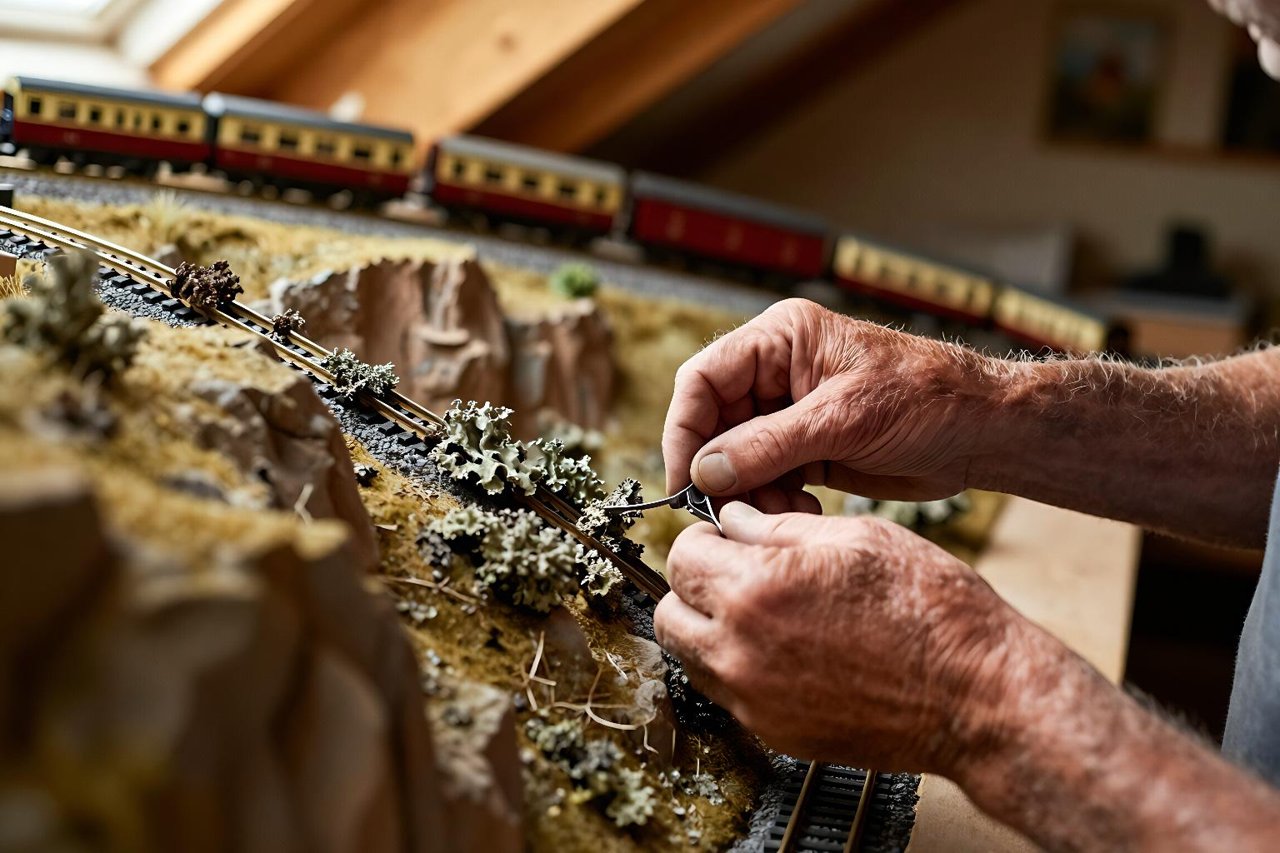
Rod Stewart spends his evenings gluing tiny trees. Not metaphorically. He disappears into an attic room, picks up a pair of tweezers, and adds lichen to a hillside that nobody outside his family will ever see up close. This is the same man who has filled stadiums for five decades.
Fame buys a lot of things, but it doesn’t buy hobbies. Most people pick up a hobby for the same reasons celebrities do: boredom, stress, or a stubborn childhood obsession that never quite wore off. What follows is a list of the top 7 celebrities with surprisingly unusual hobbies, and each one has gone deeper into their niche than anyone reasonably expected.
1. Rod Stewart: A 1,500-Square-Foot Model Railway
For roughly 23 years, Stewart quietly built one of the most elaborate private model railways in the world. He called it Three Rivers, and it fills about 1,500 square feet of his Los Angeles home with a post-war American city: a grand station modelled on Grand Central, freight yards, water towers, and scratch-built buildings that he designed himself.
He hid it for two decades because he assumed people would laugh. Then in 2019 he let Model Railroader magazine send a photographer, and the railway world realised a rock star had been quietly outperforming them.

This is not a boxed kit
Stewart hand-casts rocks, weathers rolling stock, and wired the layout so several trains run independently without colliding at the junctions. He has talked about losing entire nights in the room, which is exactly what the hobby is for. Nobody is paying him to do it. That’s the point.
2. Mike Tyson: Racing Pigeons
Before the belts and the headlines, Tyson was a shy kid in Brownsville, Brooklyn, keeping pigeons on the roof. He has said his first real fight started because a neighbourhood boy killed one of his birds. The pigeons came first, and they never left.
He has kept coops at his homes ever since, and in 2011 the Animal Planet series Taking on Tyson followed him into competitive pigeon racing. The sport works like this: birds are driven hundreds of miles from home, released together, and timed on their return. Prize money goes to the owner of the fastest bird. Tyson talks about it with the same reverence other people reserve for vintage cars.
3. Henry Cavill: Painting Warhammer Miniatures
Cavill plays Superman, which means long days on set and a lot of waiting around in a trailer. He fills that time with a paintbrush, a magnifier lamp, and small plastic Space Marines. He has spoken openly about collecting and painting Warhammer figures, and about the patience the hobby demands: thin coats, careful highlights, and no shortcuts.
The raid that nearly cost him the cape
His nerd credentials run deeper than miniatures. Cavill has told the story of missing Zack Snyder’s call telling him he’d landed Superman because he was mid-raid in World of Warcraft. He also built his own gaming PC. The man who wears the cape can also tell you which thermal paste to use.
4. Vin Diesel: Dungeons & Dragons
Diesel has been rolling dice since the mid-1980s, when a teacher introduced him to the game as a teenager in New York. He’s not a casual dabbler. In 2004 he wrote the foreword to 30 Years of Adventure, Wizards of the Coast’s official anniversary book, and he has described running sessions in his trailer between takes on the Riddick films, with Judi Dench joining in at least once.
It’s a strange pairing on paper: an action star who spends his downtime doing arithmetic and voices for imaginary elves. In practice it makes sense. D&D is improvisation, storytelling and problem-solving with rules attached, which is closer to acting than most people realise.
5. Angelina Jolie: Knife Throwing and Blade Collecting
Jolie has talked in interviews about a dagger collection she started as a teenager and about learning to throw knives properly, not just waving them around on a film set. She’s a serious collector of blades and has described the skill as oddly calming once you stop flinching.
You can dismiss it as action-hero posturing until you watch someone stick a knife in a target from across a room. It’s a precision sport with a steep learning curve, a lot of bruised knuckles, and no audience.
6. Susan Sarandon: Competitive Table Tennis
Sarandon didn’t just take up ping pong. In 2009 she co-founded SPiN, a chain of table tennis clubs that started in New York and spread to other cities, part bar, part serious training floor. She plays regularly and has argued, convincingly, that table tennis is one of the best things an ageing brain can do: fast reactions, constant geometry, no room for autopilot.
She has described the game as a great equaliser. A 20-year-old with a £15 paddle can humiliate anyone who loses focus for two points. That’s the appeal.
7. Tom Selleck: Avocado Farming
Selleck owns a ranch in Ventura County, California, where he grows avocados commercially. This is not a decorative orchard. He has talked about water costs, harvest yields, irrigation lines and the brutal economics of farming in a drought-prone state, and about selling his crop through a packing house like any other grower.
He has said the work is a genuine business rather than a hobby, which may be why it stuck. There’s something bracing about a television legend worrying about the price of water at six in the morning in muddy boots.
Why Obsessive Hobbies Stick When Casual Ones Fade
The sociologist Robert Stebbins coined the term “serious leisure” for hobbies that behave more like careers: they have a skill ladder, specialist equipment, a community, and a subculture that outlives any single participant. Stewart’s railway and Tyson’s pigeons both fit. So does competitive table tennis.
Most abandoned hobbies lack those four things. You buy a guitar, learn four chords, and run out of next steps. There’s nothing to be bad at for two years, and that struggle is the part that keeps people coming back.
If you want a hobby that survives past January, look for:
- A visible skill ladder. You should be able to see, clearly, that the person three years ahead of you knows things you don’t.
- Gear worth learning. Not expensive, just deep. A cheap set of chisels is fine. Knowing why a better one matters is the hook.
- A community with its own vocabulary. Scenery, weathering, and consist mean something specific to railway modellers. Feeling like an outsider is a temporary stage, not a barrier.
- Something you can’t finish in one sitting. A project that takes a year gives you a reason to return on a Tuesday night.
- No scoreboard. The best hobbies are the ones where nobody is grading you, because then the only competition is your own last attempt.
Start smaller than feels sensible. Buy the cheap version, learn the basics, and let the thing quietly get out of hand. That’s how a spare bedroom becomes a 1,500-square-foot railway, and how a kid from Brooklyn ends up racing pigeons against grown men with stopwatches.


