
Table of Contents
The broadcast runs close to four hours. The actual football is about 60 minutes of clock time and roughly 18 minutes of live action. That gap is where parties succeed or fall apart. Host it badly, and you spend the night opening bags in the kitchen while the room erupts at something you missed. Host it well, and you are sitting down with a drink before kickoff and staying there.
Here is a working playbook, built around how Super Bowl Sunday actually unfolds and around numbers that hold up when 20 people show up hungry.
Work backwards from kickoff, not from your invite time
Kickoff is usually around 6:30 p.m. ET, which is 5:30 in Chicago and 3:30 in Los Angeles. That is a strange window for a party: too late for lunch, too early for dinner, and right on top of the West Coast workday. The fix is to put a door time on the invitation that is 90 minutes before kickoff, then say plainly what time the ball is in the air. Nobody wants to arrive at 6:25 and find the anthem already finished.
Your own timeline should look something like this:

- Two weeks out: send the invite, ask who is driving and who needs a chair, and note the door time next to the kickoff time.
- Five days out: order the wings. Super Bowl weekend is the single busiest stretch of the year for wing shops, and the good ones stop taking orders by Friday lunchtime.
- Two days out: full shop, including ice. You will need more than you think.
- The day before: cook anything that improves overnight (chili, pulled pork, dips), chill the drinks, and test the stream on the actual television you plan to use.
- Morning of: move furniture, set out plates and a bin for empties, and get the food that needs the oven out of the way by 4 p.m.
- 90 minutes before kickoff: doors open, first round poured, pregame coverage on with the volume low.
The food math that stops you cooking for 40
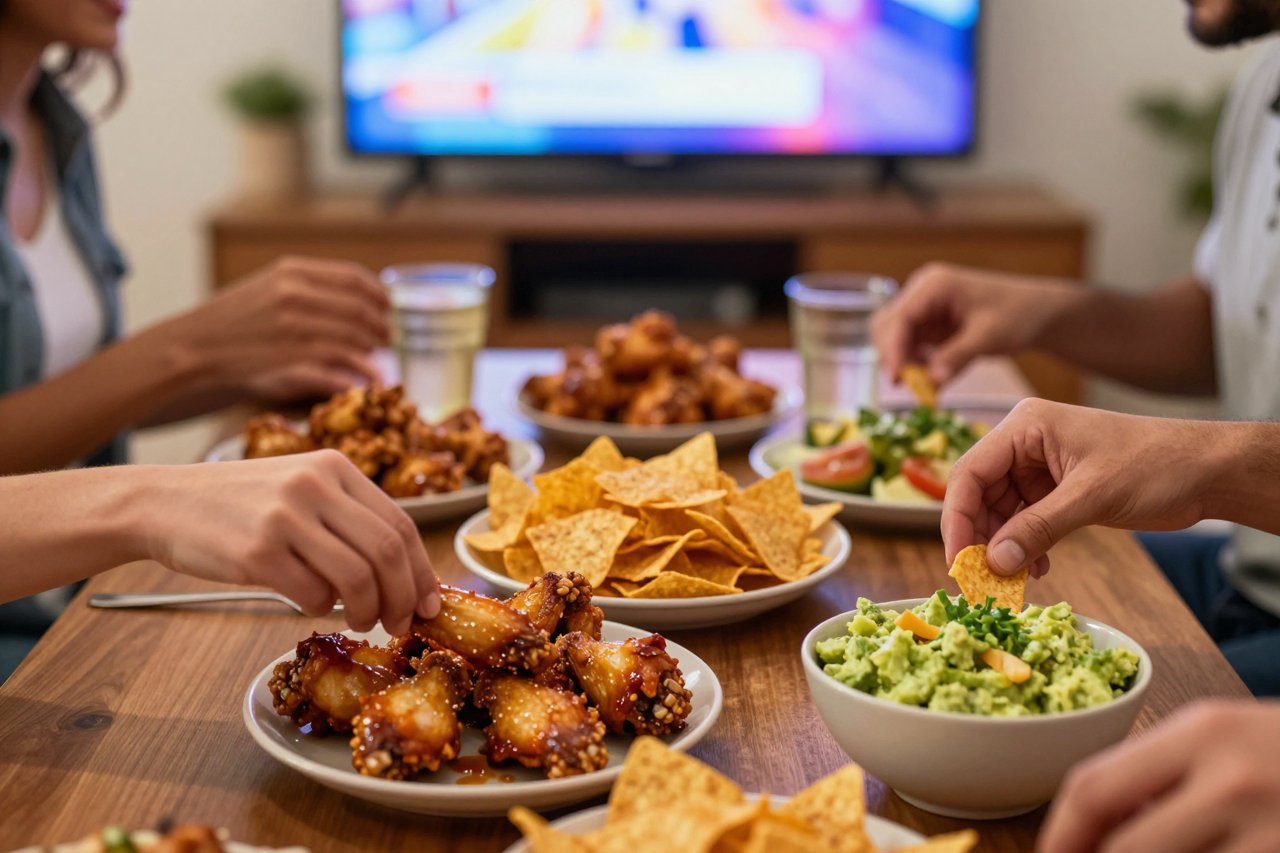
Most hosts overbuy protein and underbuy ice. A workable rule for a mixed crowd of adults: eight wings per person if wings are the main event, four if you are also serving chili or sliders. For 20 people that is either about 160 wings (five of those big catering trays) or 80 wings plus a pot of chili that feeds 20.
Beyond the wings, this is roughly what 20 guests will actually eat across four hours:
- Two large bags of tortilla chips and three jars of salsa, plus a dozen avocados’ worth of guacamole (one avocado covers about three people as a dip portion, and the extra absorbs the early rush).
- 40 slider rolls with 4 to 5 pounds of pulled pork or shredded chicken.
- One vegetable or fruit platter, mostly as insurance for the two guests who do not eat fried food.
- Four cases of beer (96 cans), a case of seltzer, and two litres of soda per six people for the non-drinkers and drivers.
- Two bags of ice beyond whatever fits in the freezer, because the cooler will be drained by halftime.
Serve everything buffet-style on one table, and put that table opposite the television rather than beside it. Guests walking to and from the food will cross the screen constantly otherwise, and by the second quarter three people will be standing in front of the fourth-down replay.
Set the room so nobody has to ask what happened
Arrange chairs in a shallow arc rather than rows, and plan seating for about 60% of the room. People stand, migrate and lean during a four-hour game, and a room packed with chairs feels stiff. Put the main television at eye level, not above a fireplace where everyone cranes their neck.
Turn on closed captions. A room of 20 people talking produces more noise than any soundbar can beat, and captions let the half-attentive guests follow the game without asking you to explain every flag. If you have a second screen, put it somewhere out of the main sightline: kitchen, hallway, the corner where the kids end up.
This is also the one night of the year when people who never watch football tune in, so a printed one-page sheet with both rosters, the starting quarterbacks and the two or three storylines of the week earns its keep. If you want to know which storylines will actually dominate the pregame chatter, the sports news calendar is worth a skim before you send invites.
Why the casual guests matter
The Super Bowl reliably draws well over 100 million viewers in the United States, which is why it sits so high among the most watched sporting events on earth. A good chunk of that audience is there for the ads, the halftime show and the food. Plan for them and the party works; ignore them and you get a room of people on their phones. For the full picture of how the game became this big, there is a solid primer on the NFL’s biggest game worth reading before you host.
Run a squares pool that stays fun
A hundred-square grid with the last digit of each team’s score is the easiest way to keep 20 people invested in a game they may not care about. Charge $5 a square for a $500 pot and pay $125 at the end of each of the first three quarters, with $125 on the final score. Or go to $10 a square and $250 a quarter if your crowd is comfortable with that.
Two practical notes. Write the numbers into the grid only after all 100 squares are sold, or the early buyers get an unfair look. And pay out on the score at the end of the quarter as it stands, not on the next play, to avoid arguments at the two-minute warning.
Prop bets keep the ad breaks interesting too: length of the national anthem, whether the coin lands heads or tails, the colour of the sports drink dumped on the winning coach. If you want to understand why the odds on those props look the way they do, there is a clear explainer on how sports betting odds and the vig actually work.
Treat halftime as the intermission it is
Halftime starts roughly two hours after kickoff and runs 25 to 30 minutes including commercials. Use the first eight minutes of it to restock ice, pull the second tray of wings out of the oven and take the trash bag around the room. Then sit down for the show. Do not try to do the washing up during the performance; you will miss it and guests will be standing in the kitchen asking where the paper towels are.
If you are serving dessert, this is the slot for it. Something cold and already plated beats a cake that needs slicing while everyone is shouting about a wardrobe change.
Plan the fourth quarter and the exit
The last 20 minutes of the game are when people either get very loud or start checking the time. Have coffee going by the start of the fourth quarter, and put out containers for anyone who wants to take food home. It sounds odd to plan for leftovers at 8 p.m., but it is the single most effective way to get surplus food out of your fridge before it spoils.
For the exit itself, the trophy presentation is your window. It is five to ten minutes long, it happens after the final whistle, and almost nobody wants to leave mid-speech. That is when you bag the trash, load the dishwasher and stack plates. Get those 20 minutes of work done and you will be sitting down with the last two guests instead of facing a kitchen at midnight.
One last thing worth doing: text the group the next morning with the squares winners and the final score. It takes 30 seconds, closes the loop on any money that changed hands, and quietly makes you the person everyone expects to host again next February.


