
Table of Contents
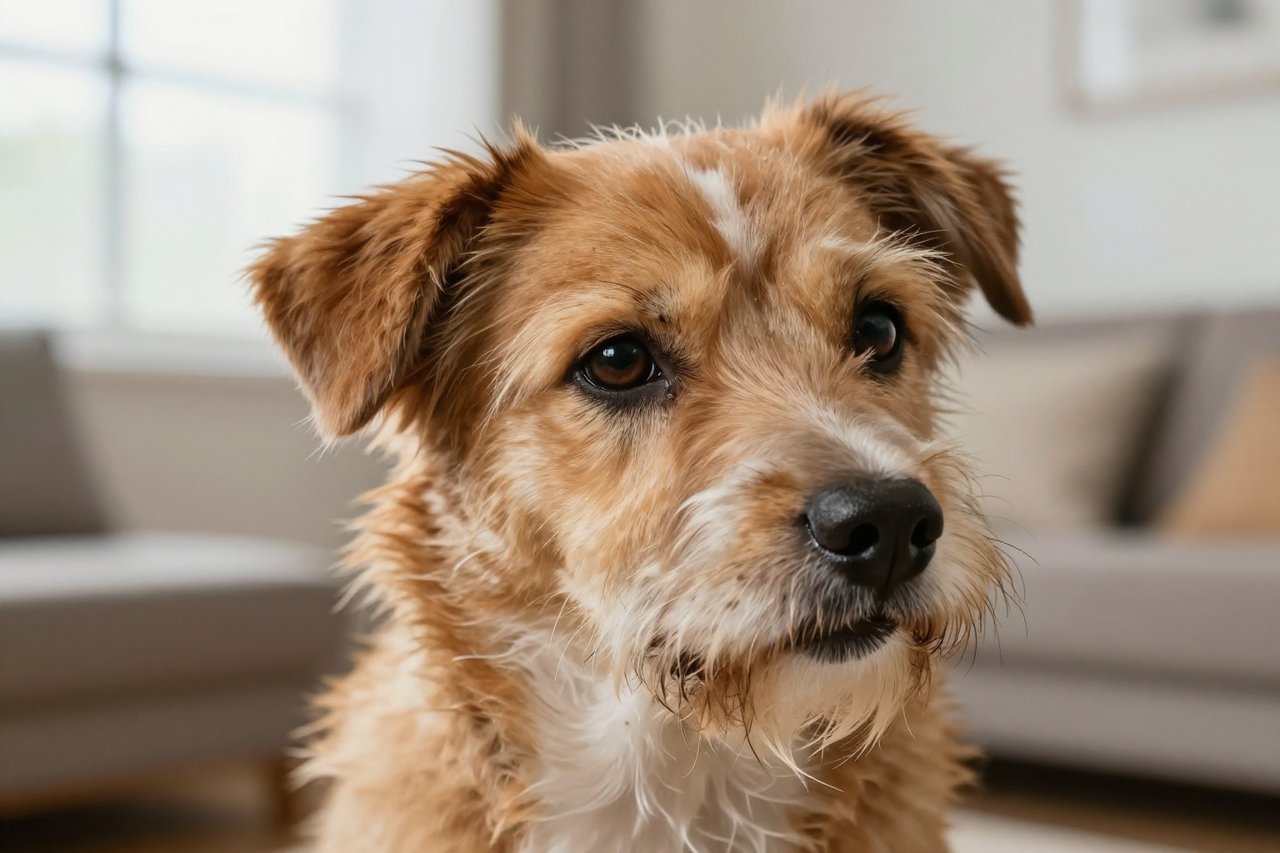
You say a word. Maybe it’s “walk,” maybe it’s “treat,” maybe it’s just their name in a slightly brighter tone than usual. The head cocks to one side. One ear flops. The eyes stay fixed on your face. It lasts a second or two and it is, without much competition, one of the most charming things a dog does.
The obvious question is what’s actually happening in there. Is the dog confused? Performing? Genuinely trying to understand you? The honest answer is that head tilting probably does several jobs at once, and the research is thinner than you’d expect for something this universal. But the pieces we do understand are more interesting than the cute-dog explanation.
Sound Location Is the Most Likely Reason
Dogs are built for hearing. Their audible range reaches roughly 45,000 Hz, well past the ceiling of human hearing at about 20,000 Hz. That extra sensitivity comes with a problem, though. Working out where a sound came from requires comparing what arrives at the left ear against what arrives at the right ear, and the differences are tiny: fractions of a millisecond in timing, and subtle variations in loudness.
Rotating the head changes both numbers. A tilt repositions the ears relative to the sound, giving the brain a fresh measurement to work with. Dogs do this constantly in noisy or echoing environments, and you can watch it happen. Take a dog somewhere with a big open soundscape, like a moor, a beach, or the wild outdoors of northern Norway, and notice how often the head tips sideways when a distant noise arrives from an unfamiliar direction.

The Outer Ear Does Most of the Work
A dog’s pinna, the visible flap, is controlled by around 18 separate muscles in many breeds. That’s why it swivels, perks and drops independently of the skull. Tilting the head effectively angles the funnel toward the source, the way you’d cup a hand behind your ear at a concert. Breeds with upright ears get more directional control out of this. Breeds with heavy drop ears, like basset hounds and cocker spaniels, get less, which may be why they seem to tilt more often and more dramatically.
Your Dog Genuinely Can’t See Past Its Own Nose
Here’s the part most people miss. A dog’s eyes sit wide on the skull, and a long muzzle creates a genuine blind spot directly in front of and below the nose. For a dog with a substantial snout, the lower part of your face, particularly your mouth, sits right in that gap.
Human faces are expressive, and a lot of the information is concentrated around the mouth and eyes. Tilting the head raises the muzzle out of the line of sight and brings the whole face into view. This is why the behaviour is so pronounced in long-nosed breeds like greyhounds, dachshunds and borzois, and comparatively subtle in flat-faced breeds like pugs. It also explains why the tilt often appears when you’re speaking: your dog is trying to look at the part of you that’s moving.
It’s Also a Social Cue, and We Encouraged It
Watch what happens after a dog tilts its head. Most humans laugh, soften their voice, or repeat the word. A dog that tilts gets more attention than a dog that doesn’t, and over thousands of years of living alongside us, that’s a strong selection pressure. The tilt has become part of how dogs communicate with people, functioning a bit like a raised eyebrow.
What the Word-Learning Study Found
A 2021 study published in Animal Cognition gave this idea some real evidence. Researchers tested dogs that had been taught the names of specific objects and found the dogs tilted their heads significantly more often when their owner said a familiar toy name than when they said something meaningless. The dogs that knew more object names tilted more than the dogs that knew fewer. The tilts clustered around the moment of hearing the word, not the moment of seeing the object, which points toward processing rather than celebration.
In other words, the tilt looks like concentration. It shows up when a dog is working something out, which is probably why it reads as attentive to us.
Why Some Dogs Tilt More Than Others
Individual variation is huge. Two dogs of the same breed in the same house can have completely different tilt habits, and there are a few reasons why:
- Muzzle length. Long-snouted dogs have a bigger blind spot to work around.
- Ear shape. Heavy, pendulous ears block sound more than pricked ears do.
- How much you talk to them. Dogs that hear a running commentary from their humans get more chances to tilt.
- Age. Puppies tilt constantly, partly because everything is new and partly because their ear canals and skulls are still settling.
- Personality. A dog that watches your face closely will tilt more than one that mostly follows its nose.
When a Head Tilt Is a Warning Sign
Most tilting is normal, brief, and clearly triggered by something you said or something your dog heard. The pattern to watch for is a tilt that doesn’t switch off. If your dog is holding its head at an angle for minutes at a time, or the tilt is always to the same side, that’s a different situation and worth a vet call.
- A persistent tilt, especially combined with a head shake or pawing at one ear
- Eyes flicking rapidly side to side, which vets call nystagmus
- Loss of balance, circling in one direction, or stumbling
- Vomiting or a sudden reluctance to eat
- Discharge, redness or a yeasty smell coming from the ear canal
- Drooping on one side of the face, or a lip that hangs oddly
Ear infections are the most common cause in younger dogs. Grass seeds and foxtails lodge in the canal during summer walks and produce exactly this picture: a tilt, a shake, and a dog that yelps when the ear is touched.
Senior Dogs and Vestibular Disease
In older dogs, a sudden severe tilt with loss of balance often turns out to be idiopathic geriatric vestibular disease, a disturbance in the inner ear machinery that controls balance. It looks alarming, and it usually comes on over a few hours with no obvious trigger. The encouraging part is that most dogs improve substantially within a few days and recover well over two to four weeks, though the head may stay slightly tilted. Your vet will want to rule out other causes first, including thyroid problems and middle ear disease, before settling on that diagnosis.
What to Do If the Tilt Is New
Film it. A ten-second video of your dog walking across the kitchen is worth more to a vet than a verbal description, because it captures the tilt angle, the gait and any eye movement in one go. Note when it started, whether it’s constant or intermittent, and whether your dog is still eating, drinking and jumping onto the sofa as usual. Those three details shape the conversation.
If your dog is otherwise bright, steady on its feet, and only tilts when you make an interesting noise, you can relax and enjoy it. If the tilt came with any of the signs above, get it looked at within a day. And if you want a cheap experiment in the meantime, try saying a familiar word and an unfamiliar one in the same tone, then watch which gets the head cock. Most dogs answer that question pretty clearly.


