
Table of Contents
The car door opens and the dog hits the driveway. In the next ninety seconds he will either glue himself to your shin or bolt for the gap beside the gate, and whatever happens, you have about an hour to set the tone for the next three months. Introducing a dog to a new home is less about grand gestures and more about controlling the small stuff: who approaches, how fast, and how much space the dog gets while his brain catches up with his legs.
Here is the plan I’d give a friend, in the order it actually matters.
Set the house up before the car pulls in
Do this the night before. It takes forty minutes and saves you a week of improvisation.
- A crate or covered pen in a quiet corner, with the door left open and a worn T-shirt of yours inside.
- Two water bowls in two rooms, so the dog never has to cross a threshold to drink.
- A 6ft leash, a slip lead, and a long line for the garden.
- An enzymatic cleaner, because accidents are not a failure of training, they’re a scheduling problem.
- A tag with your mobile number, fitted the moment the dog arrives, plus a backup on the collar.
- Cables tucked, bin lid clipped, chocolate and grapes moved above counter height.
Pick one room as the dog’s base for the first three days. Not the whole house. One room, one bed, one water bowl, and a door you can close if things get busy.

Make the first 24 hours boring on purpose
This is the hardest instruction to follow, especially if children are involved or you’ve waited months for this dog. Resist it anyway.
No visitors. No trip to the park. No new collar parade. Let the dog out on a leash into the garden, even if the garden is fenced, because an unfamiliar dog in an unfamiliar space with a gate he hasn’t noticed yet is how you spend a Saturday afternoon on Facebook groups. Then bring him in, show him the water bowl, and sit down somewhere and do nothing.
Aim for quiet by 9pm. Feed a small meal rather than a large one. Skip the bath, skip the toys scattered across the floor, skip the photo shoot. A dog who sleeps through his first night has already learned that this place is safe.
The 3-3-3 rule, translated into real life
You’ll hear the phrase three days, three weeks, three months a lot, and it’s a useful frame if you know what it actually describes.
Days one to three
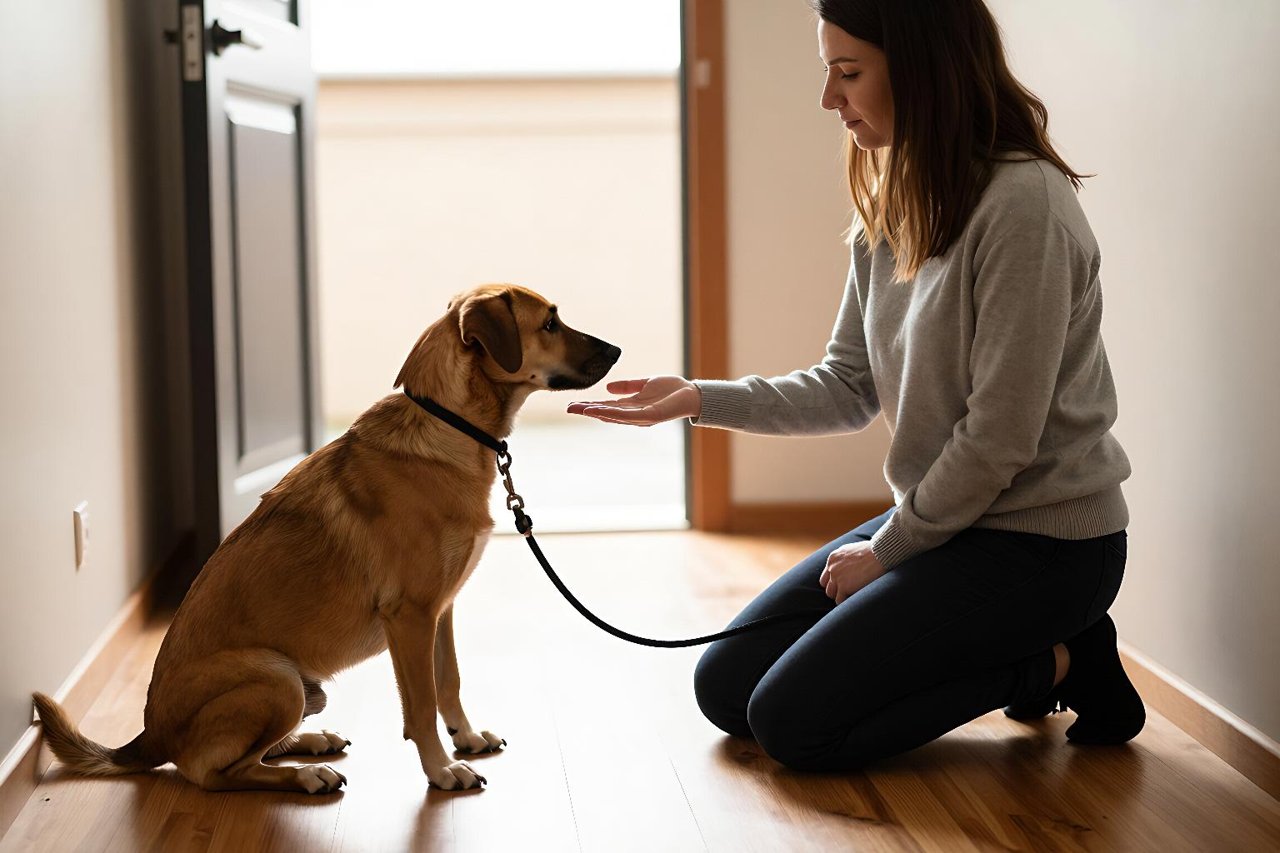
The dog is decompressing, not showing you his personality. He may refuse food, hide behind the sofa, sleep 18 hours, or pant for an hour straight. All normal. Keep handling to a minimum and let him choose when to approach.
Weeks one to three
This is when the wheedling begins. He’ll test whether the sofa is allowed, whether the bin opens, whether a growl gets him out of a nail trim. Behaviour often looks slightly worse around week two before it settles, because the dog now feels confident enough to have opinions.
Months one to three
The dog starts to know your routine: which footsteps are yours, when the school run happens, where his lead lives. Some rescue dogs take six months, and that’s still within normal range.
Introducing a new dog to the resident dog
Do not do this in the hallway. Arrange a first meeting on neutral ground, such as a quiet pavement or a park path neither dog considers his turf.
Two people, two leads, and a parallel walk with roughly three metres between the dogs. If both are relaxed after ten minutes, close the gap slightly. If either stiffens, widen it again. No face-to-face nose boops on leash. That setup is the classic trigger for a scrap.
Back at home, keep resources separate for the first fortnight: two crates, two beds, feeding in separate rooms with the doors shut, and toys picked up after each play session. Rotate who gets the sofa. Tension usually appears over food and doorways, not over affection.
Kids, guests, and the front door
Children need three rules, said out loud, twice: no hugging the dog around the neck, no putting your face level with his, and no following him when he walks away. Practise a treat scatter instead, where the child drops snacks on the floor and walks off, which teaches the dog that small humans are worth approaching calmly.
For adult guests, ask them to ignore the dog entirely for the first ten minutes. No eye contact, no outstretched hand over the head. A pat on the chest is fine once the dog has sniffed and moved away of his own accord.
Decide where the dog sleeps on night one
A crate in your bedroom is a perfectly good answer for the first week, even if it’s not the long-term plan. The dog settles faster when he can hear you breathe. If you’d rather he sleeps in the kitchen from the start, put the crate or pen there and expect two or three noisy nights.
If you’re still deciding what to buy, this comparison of the four main kennel options and when to use each covers crates, pens, runs and soft-sided carriers. For sizing numbers and setup, the beginner’s blueprint to kennel types and sizing is the one to read before you assemble anything.
Keep the food the same, then change slowly
Find out exactly what the dog was eating at the shelter or breeder and buy a bag of it. Feed that for the first week. If you want to switch to something else, do it over seven to ten days at roughly 25 per cent new food every third day.
Loose stools in the first week are common and usually stress-related rather than a sign of illness. A dog-specific probiotic can help steady things while his gut adjusts to the water and the routine. If the diarrhoea lasts more than 48 hours, or there’s blood, that’s a vet call, not a supplement.
Build a toilet and walk schedule you can actually keep
Puppies need out every two hours while awake, plus immediately after waking, eating, drinking and a big play session. Adult rescues need out every three to four hours at first, even if they were apparently house-trained elsewhere. New houses smell different, and the garden is a puzzle.
Take the dog out on a lead to the same patch every time, stand still, and wait five minutes. Praise quietly when he goes. Then bring him in. Free access to the garden for a new dog often means a lot of standing at the back door shouting.
Watch for the quiet stress signals
Most dogs don’t growl first. They yawn, lick their lips, turn their head away, show the whites of their eyes, tuck their tail, or shift their weight backwards. If you see three of those in a minute, the situation is too much and you should create distance.
You’ll see them at the vet, at the school gate, when the hoover comes out, and when a stranger leans over the fence. Noticing them early is the single most useful skill in the first month.
Check your fences, then widen the map slowly
Walk the perimeter yourself and look for the gap a 12kg dog can squeeze through, because there is always one. For puppies, or for any dog who’s shown an interest in exploring, a GPS collar is cheap insurance alongside a securely fitted tag.
For the first ten days, walk the same two short routes at the same times. Familiar smells build confidence faster than new ones. Add one new street per week, not one new park per day.
Book a vet visit within 72 hours of arrival, even if the dog seems perfectly well. Bring any paperwork, ask about worming and vaccinations, and take a stool sample if you can.
The mistake that undoes a good start
Almost every problem I hear about in week three comes back to one thing: too much freedom, too soon. The dog was fine for ten days, so the crate gets packed away, the run of the house gets granted, and the garden door stays open. Then the chewing starts, or the indoor marking, or the barking at the window.
Give freedom in layers instead. One room becomes two. Supervised becomes unsupervised for five minutes at a time. The crate door stays open and the dog keeps choosing to nap in it, which is exactly what you want.
If you already have a trip booked in the first couple of months, don’t cancel it out of guilt, but do plan it properly. A good guide to boarding a dog without the stress will tell you what to pack and how to trial a night away before you commit to a fortnight.
Six weeks in, a well-introduced dog should be sleeping through the night, greeting you at the door with a loose wiggly body rather than a bark, and taking treats from your hand in the kitchen without flinching. If you’re not there yet, that’s information, not failure. Slow the pace down, shrink his world back to one room for a few days, and rebuild from there. The dog isn’t behind schedule. He’s just still learning the map.


