
Table of Contents
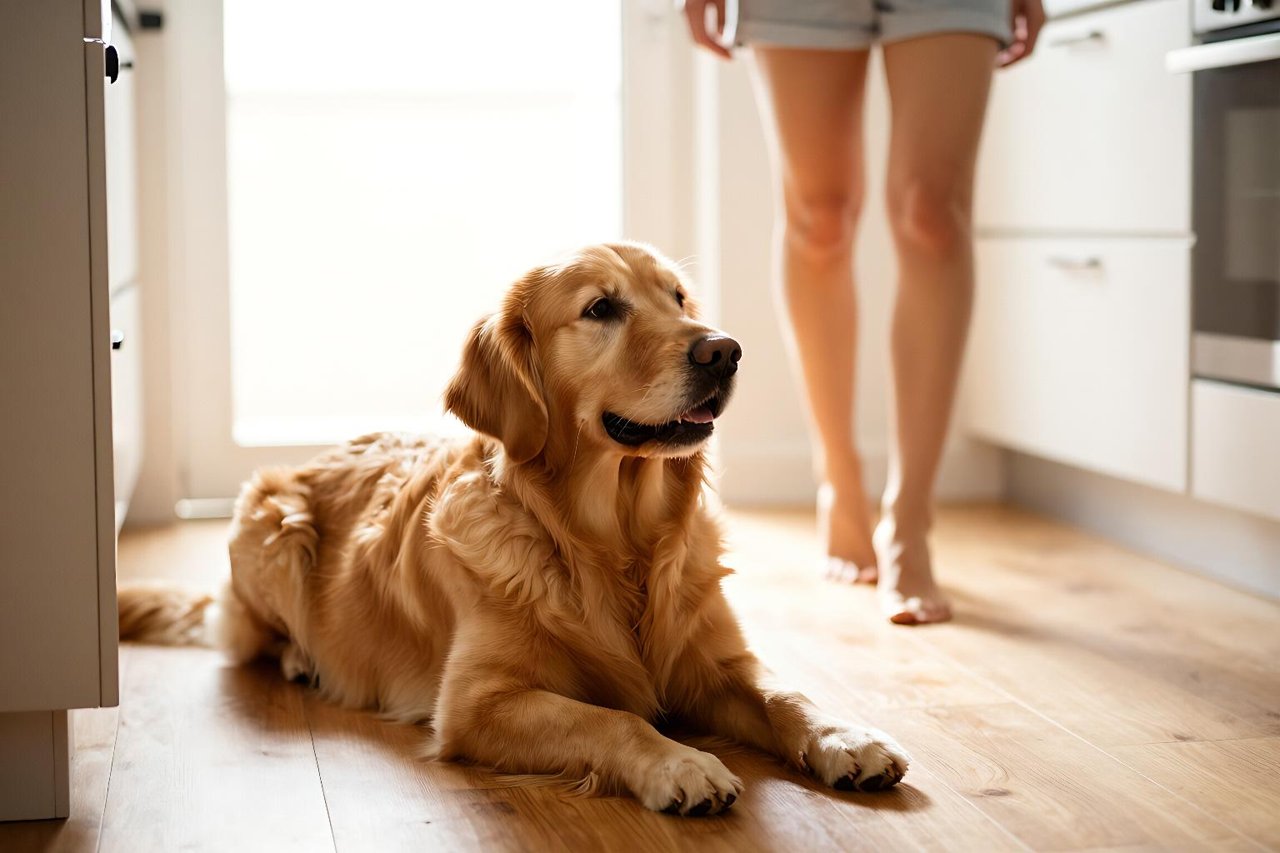
It’s 6:40 on a Tuesday morning. You stand up for a glass of water, and before you’ve taken three steps you hear the click of claws on the kitchen tile. You turn around. The dog is already there, tail going, waiting to see what happens next.
You go to the bathroom. The dog comes. You go to the bedroom to grab a charger. The dog comes. You open the front door to check the mail and get the same hopeful face you get every single time.
It’s easy to laugh it off as neediness or a bottomless appetite for snacks. But a dog that follows you everywhere is doing something more interesting than begging. The behaviour sits at the intersection of genetics, routine, reinforcement and attachment, and once you understand which part is driving it, you can decide whether to enjoy it, manage it, or gently dial it back.
Following You Is a 15,000-Year-Old Survival Strategy
Dogs didn’t come from wolves that ran from people. They came from the ones that hung around the edges of human camps, close enough to grab scraps but bold enough not to bolt. Over thousands of generations, the animals most comfortable near humans got fed, sheltered and bred. That pull toward people is now hardwired.

The evidence is hard to miss. Dogs read human gestures, like a pointed finger or a tilted head, far better than wolves do, and better than chimpanzees in some tests. A dog checking where you are is running the same mental software that let its ancestors figure out where the food was.
There’s also the territory question. Dogs don’t define home as a building. They define it as the place where their people are. Watch a dog in a strange hotel room and you’ll see it settle within a metre of whoever it came with. Your location is the anchor point.
Your Dog Is Reading You, Not Just Walking Behind You
By the time you’ve decided to stand up, you’ve already given away the plan. There’s the shift in your breathing, the creak of the chair, the angle of your feet, the sound of a laptop lid closing. Dogs are ruthless collectors of this kind of data.
They also have better tracking equipment than we give them credit for. A dog can follow your scent trail through a house long after you’ve left the room. It can hear the specific rattle of a cheese wrapper from two floors away. One dog I know can distinguish between the sound of work shoes going on (stay on the bed) and walking shoes (get to the door immediately).
They Learn Your Routine Better Than You Do
If you walk your dog at roughly the same time each day, its body clock syncs to yours. Cortisol and activity levels shift in anticipation. That’s why a dog starts pacing at 4:55pm when the walk has always happened at 5. The following isn’t random wandering. It’s a schedule you wrote without realising it.
The Reinforcement Loop You Probably Built by Accident
Every time the dog follows you into the kitchen and you glance down and say “hey buddy,” you’ve paid it. Every ear scratch, every “what are you doing, weirdo,” every sigh of amused resignation is a reward. Behaviour that gets paid gets repeated, and the payment doesn’t have to be food.
It gets stronger when the payment is unpredictable. Attention that arrives sometimes, but not always, is more powerful than attention that arrives every single time. So the dog keeps following, because this trip to the hallway might be the one where something good happens.
Boredom plays a part too. A dog with nothing to chew, sniff or solve has exactly one interesting object in the house, and it’s you.
Breed, Age and Personality Set the Volume
Some dogs were bred for close human contact and it shows. Herding breeds were developed to keep constant track of moving things, so a Border Collie shadowing you from room to room is doing precisely what it was designed to do. Companion breeds were selected for lap proximity over centuries. Our roundup of the most affectionate dog breeds that genuinely want to be near you covers the ones most likely to follow you into the bathroom.
Age matters as well. Puppies follow because you’re the secure base they check in with. Senior dogs often start following more, sometimes because their hearing or eyesight is fading and keeping you in view is easier than tracking you by sound.
When Following Crosses Into Separation Anxiety
A dog that trails you around the house but happily snoozes on the bath mat while you shower is fine. A dog that can’t eat, can’t settle and starts pacing the moment you put on a coat is not.
Watch for these signs, which point to genuine distress rather than affection:
- Drooling, panting or trembling within minutes of you leaving
- Chewing door frames, blinds or window sills, usually in the first 30 minutes
- Howling or barking that starts soon after departure and continues
- Refusing food while alone, even high-value food
- Scratching at doors or trying to follow you out of the house
A sudden change in following behaviour in an older dog is worth a vet visit. Pain, dental disease and thyroid problems can all make a dog clingier, and a dog that has started following you into every room at 11 years old may simply be losing its hearing and keeping you in sight instead.
How to Teach a Dog to Be Comfortable at a Distance
You don’t have to shut the bathroom door in your dog’s face. You do have to teach it that being two rooms away is survivable and, ideally, boring.
Start with a mat or bed in the room where you spend most of your evening. Reward the dog for lying on it while you’re nearby, then while you’re across the room, then while you’re in the kitchen. Keep sessions short, ten seconds at first, five repetitions, twice a day. Most dogs will hold a settle for several minutes within a fortnight.
Give the dog a job before you leave the room. A stuffed frozen toy or a puzzle feeder buys you ten to twenty minutes of genuine occupation, and that time adds up. There’s a reason so many enrichment-focused dog products are everywhere in 2026; occupied dogs don’t need to supervise you.
Stop paying for the following. No eye contact, no chat, no pat when the dog trails you into the laundry. Pay for the dog that stays on its bed instead. It feels cold for about three days, and then it works.
One clarification worth making: a dog glued to your ankle indoors is not the same as a dog that comes back to you in a park full of squirrels. Those are separate skills. If you want the outdoor version, this guide on how to teach a dog to come when called, even with a squirrel in the mix covers the training side properly.
Watch the Front Door
A dog that follows you everywhere is a dog that will follow you out the front door, past the bin, and down the pavement without pausing to check whether you noticed. If your dog is a bolter, a tracker is worth the money, and this honest comparison of a GPS dog leash versus other trackers will save you some guesswork.
What Those Footsteps Actually Mean
Here’s the part worth sitting with. A dog following you is choosing your company over a warm sofa and a quiet hallway. That’s a relationship, not a nuisance, and it’s the same bond that makes training work at all. The bond between a person and a dog built on small daily contact is what Bonnie Hartney talks about in this conversation on why you and your dog will love it.
So answer the tail wag sometimes. Let the dog join you for the pointless trip to the hallway. But build the skills that let it nap while you’re in the next room, because a dog that chooses to be near you is a very different animal from one that panics when you’re out of sight. The first is a compliment. The second is something you can fix, kindly, with a mat, a frozen toy and a bit of patience.


