
Table of Contents
Stand in the body shop of a car plant in Ulsan and you can read the ratio without anyone explaining it: roughly one industrial robot for every ten people on the floor. South Korea runs at 1,012 robots per 10,000 manufacturing employees, the highest density on earth, and almost all of them repeat a single motion until the shift ends.
That gap between the brochure and the factory floor is a useful way into this list. The main categories of robots aren’t separated by how clever they are. They’re separated by the job they were built for, and that job decides the arm, the sensors, the price and the failure modes.
Here are the top 7 types of robots and what they do, with the numbers that actually describe them.
1. Industrial Robots: The Ones That Build Everything Else
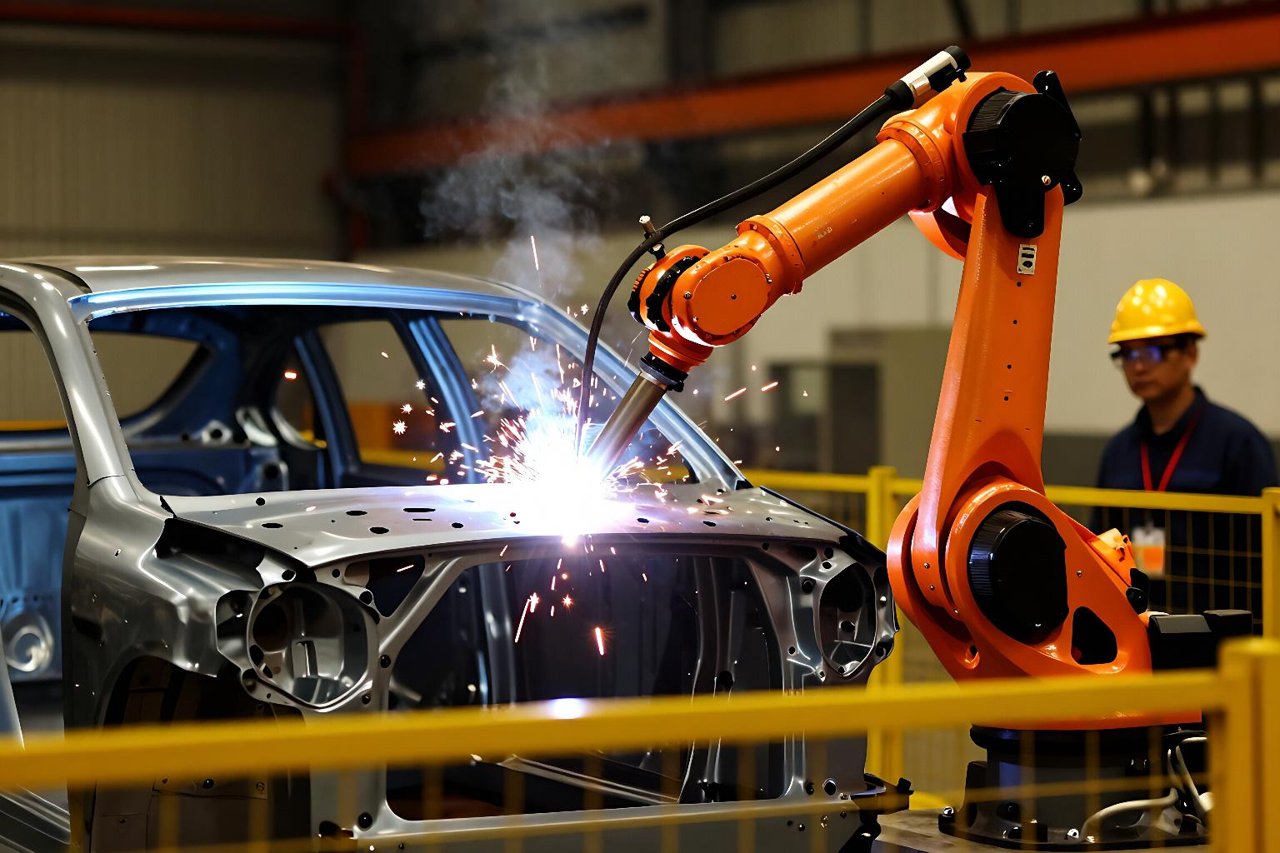
An industrial robot is a fixed base, a heavy arm and usually six axes of motion, bolted behind a fence. Payloads run from about 5 kg to well over a tonne. Repeatability on a decent welding arm sits around ±0.02 mm, which is finer than a human hand can hold on its best day and far finer than it can hold after six hours.

There were 4,281,585 industrial robots operating in factories worldwide at the end of 2023, according to the International Federation of Robotics, with 541,302 new units installed that year alone. Their day job is narrow and relentless: spot welding car bodies, spraying paint, palletising boxes, loading CNC machines, moving die-cast parts out of a press that would flatten a person.
None of them know what they’re doing. A welding robot runs a taught path, blind, and will happily repeat a bad weld 4,000 times. That’s the trade: brutal precision in exchange for zero adaptability.
2. Cobots: Industrial Arms That Share Your Workbench
Collaborative robots look like scaled-down industrial arms, but the difference is in the joints. Force-torque sensors let a cobot feel resistance, and under the ISO/TS 15066 standard they’re designed to stop or back off when they bump into something soft. That’s why you can stand next to one without a cage.
Universal Robots has shipped more than 75,000 of them, and the pattern across most installations is the same: a job that’s too dull or too fiddly for a person, but too low-volume to justify a six-figure automated cell. Loading parts into a mill. Driving screws. Gluing a bead along a housing. Pulling finished pieces off a conveyor and dropping them into a tray for inspection.
They’re slower than their caged cousins, often half the tip speed, and they lift less. What you buy is flexibility: wheel it to a new station, guide it through the new path by hand, run the batch.
3. Mobile Robots: The Ones Driving Around the Warehouse
Autonomous mobile robots, or AMRs, gave up the arm and kept the wheels. Amazon alone runs more than 750,000 of them, and the logic is simple arithmetic: a picker who walks 15 km a night picks fewer items than one who stands still while a shelf drives over.
The technology underneath is now fairly settled. Lidar and depth cameras build a map, software works out a route, and the robot re-plans when a pallet appears where it shouldn’t be. Older automated guided vehicles followed magnetic tape on the floor; AMRs don’t need the tape, which is why a warehouse can be re-laid out over a weekend.
The same machines turn up in places that aren’t warehouses at all. Hospital corridors, where they haul linens and lab samples on the 2 a.m. shift. Hotel hallways with towels. Factory floors carrying engine blocks between stations. This is one of the areas moving fastest from pilot to payroll, and it shows up in any honest look at technology trends that change everyday life and how soon you’ll notice them.
4. Service Robots: The Ones You Actually Meet
Service robots cover everything that isn’t manufacturing, and it’s the messiest category because it’s the one closest to normal people. The jobs split roughly like this:
- Domestic cleaning. Robot vacuums and mowers. Millions of units a year, and the mapping software has quietly become the interesting part.
- Last-mile delivery. Six-wheeled pavement bots from Starship and its rivals have completed well over six million autonomous deliveries, mostly campus and suburban food runs.
- Hospitality. Tray runners in restaurants, room-service delivery in hotels, check-in kiosks that move.
- Security and inspection. Patrol robots in parking structures and shopping centres, plus crawlers that inspect pipes and sewers where people shouldn’t go.
- Telepresence. A screen on a stick with wheels, used in schools and hospitals more than in offices.
These are the robots with the shortest useful lifespan and the highest consumer expectations, which is a rough combination. A delivery bot has to survive curbs, dogs, rain, and a person who kicks it for a video.
5. Medical and Surgical Robots: Steadier Than Any Hand
Surgical systems such as the da Vinci platform aren’t autonomous, and that’s the point. The surgeon sits at a console and the robot translates their hand movements into smaller, filtered motions inside the patient, with 3D vision magnified about ten times. Tremor gets removed. Wristed instruments can rotate in ways a human wrist can’t.
Intuitive Surgical’s installed base passed 8,600 systems, and those machines were used in roughly 2.3 million procedures in 2023. Prostate surgery, hysterectomies, hernia repair, some cardiac work.
The wider medical category goes further. Rehabilitation exoskeletons get stroke patients walking again. Capsule endoscopes swallow a camera and photograph the gut. Hospital logistics robots run supplies between departments. The common thread is precision or endurance, rarely autonomy.
6. Agricultural Robots: Weeding at 30 Plants a Second
Farming is where robotics gets genuinely physical. The Carbon Robotics LaserWeeder drags a bank of CO₂ lasers across a field and burns weeds out of the soil at a rate of about 30 a second, no herbicide involved. John Deere’s See & Spray rigs use cameras to spot individual weeds and hit them with a targeted dose, cutting chemical use by more than 60% in field trials.
Autonomous tractors now handle tillage and spraying with a remote supervisor watching several machines at once. The unsolved part is harvesting delicate crops. A robotic strawberry picker has to find a fruit under leaves, judge ripeness, and grab it without bruising, all in about three seconds. Engineers have been chipping at that problem for two decades and it’s still not solved at commercial scale.
7. Humanoid Robots: The Ones With a Hype Problem
Humanoids get the headlines because they look like us. The engineering case is narrower than the marketing: factories and homes were built around a human body, so a machine with the same reach and grip can use existing tools and doorways without rebuilding the plant.
Real deployments are small and specific. Figure’s machines have been tested at BMW’s Spartanburg plant. Agility’s Digit has been trialled in logistics warehouses. Unitree sells a research humanoid for about $16,000, and Hugging Face went further with a $299 desktop robot aimed at people who want to experiment rather than industrialise.
The honest constraints are hands, batteries and cost. A dexterous five-fingered hand with useful force control is still expensive and fragile. Runtime on most bipeds is two to four hours. And walking on legs is a solution to stairs, not a solution to productivity; plenty of useful work gets done by a torso on a wheeled base.
The trajectory matters, though. Cheaper actuators, better simulation and foundation models trained on video are all pushing in the same direction, and several of these bets overlap with the broader technologies that may genuinely transform the future, sorted from real to speculative.
How to Tell What a Robot Is Actually For
Spec sheets are written to impress and demos are edited to flatter. Five questions sort almost any machine in under a minute.
- How many degrees of freedom, and what’s on the end? A 6-axis arm with a simple gripper is a workhorse. A 20-DOF humanoid hand that drops things is a liability.
- What’s the duty cycle? An 8-hour battery claim usually means 5 hours of real work and a long charge.
- How many humans per robot? One supervisor for three machines is a business. One teleoperator per machine is a puppet with extra steps.
- What’s the mean time between failures, and who fixes it? Downtime costs more than the hardware in most deployments.
- Does it work in the mess, or only in the demo room? Lighting changes, clutter, a dropped box. That’s the test.
Vocabulary helps here, because half the confusion in this field is people using the same word for different things. Terms like autonomy, end effector, teleoperation and manipulation get thrown around loosely, and a plain-English AI glossary covering the core terms will save you from a lot of bad vendor conversations. Know which category a machine belongs to, and you’ll know roughly what it can do before anyone switches it on.


