
Table of Contents
Amazon’s fulfilment network runs on more than 750,000 mobile drive units, and that number keeps climbing. It’s a useful figure, but it isn’t the interesting one. The interesting one is that a mid-sized bakery, a regional hospital and a three-person e-commerce brand can now buy a similar class of technology that was once reserved for car plants with seven-figure capital budgets.
That drift from the factory floor into ordinary businesses is what makes robotics and automation worth understanding. The consequences are neither as frightening nor as frictionless as the headlines suggest.
Robots and automation aren’t the same thing
People use the two terms interchangeably, which muddies the conversation. Robotics is a hardware discipline: a physical machine that senses its environment, makes a decision and acts on it. Automation is broader. It covers any process that completes itself with minimal human input, and a lot of it has no moving parts at all.
The categories matter because they fail in different ways and pay back on different timelines:

- Fixed automation. A bottling line filling 40,000 cans an hour, doing exactly one thing beautifully and refusing to do anything else.
- Flexible automation. A CNC cell or pick-and-place arm that can be reprogrammed when the product changes.
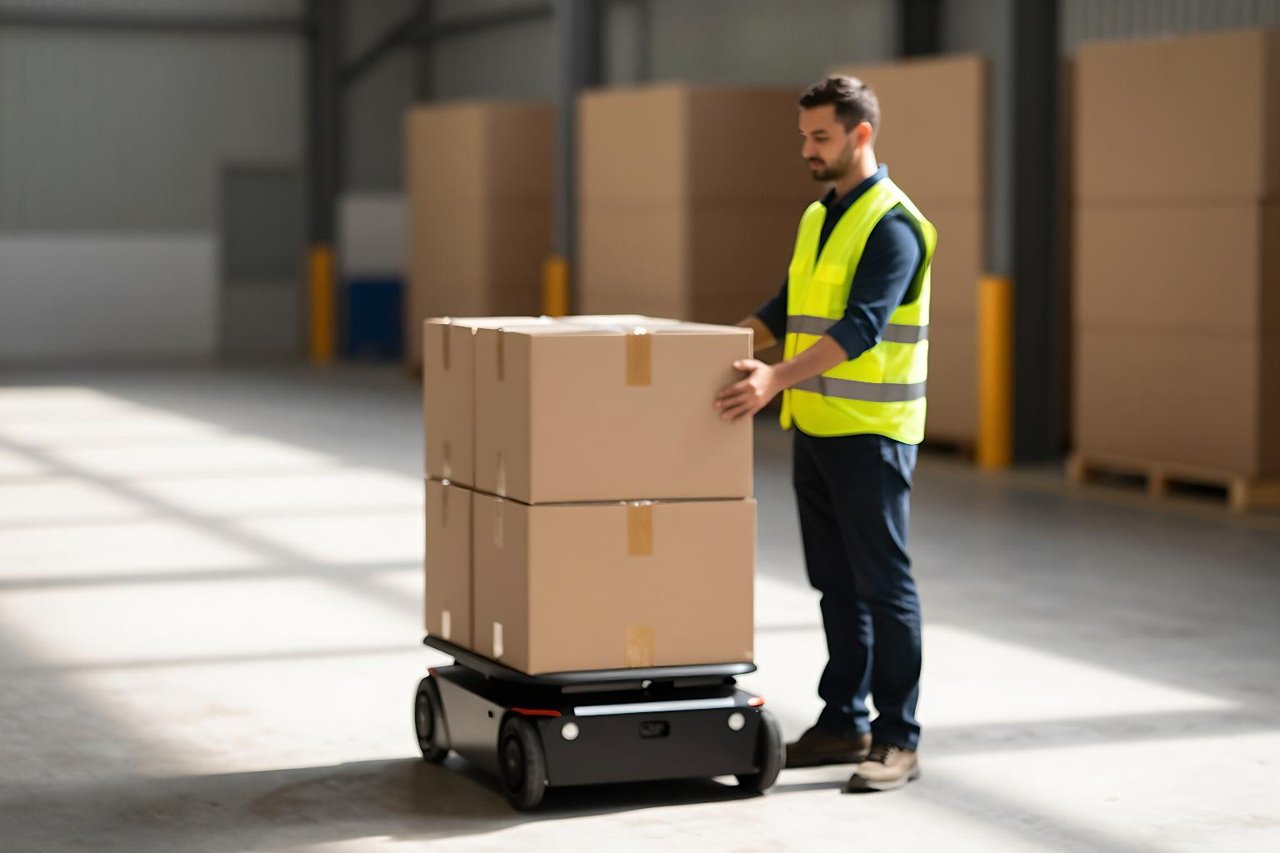
- Autonomous mobile robots. Machines that navigate a shared floor and improvise when a pallet blocks the aisle.
- Software automation. Scripts, workflow tools and AI agents that shift data between systems or clear support tickets.
Most disappointing projects happen when a business buys the wrong category for its problem. Buying a robot arm to solve what is really a paperwork bottleneck is an expensive way to learn that lesson.
Where the machines already earn their keep
Warehousing and logistics
This is the most mature market. Goods-to-person systems cut the walking distance out of picking, which was always the hidden cost. Ocado’s grocery grid and Symbotic’s case-handling systems run largely lights-out, and the mid-market has followed with cheaper autonomous forklifts and conveyor retrofits.
Manufacturing
Roughly 540,000 industrial robots were installed worldwide in 2023, according to the International Federation of Robotics, with more than half of them in China. Welding and palletising remain the entry points because the tasks are repetitive, dangerous and easy to measure.
Agriculture and food
Optical sorters now grade fruit at rates no human crew can match, throwing out blemished produce with a burst of compressed air. Robotic milking has quietly become standard on large dairy farms, partly because cows will happily walk to a machine at 3am.
Hospitals and classrooms
Surgical robots assist on hundreds of thousands of procedures a year, and researchers are pushing spatial computing into clinical training and patient education. Work like Xiangyi Cheng’s AR work in classrooms and hospitals shows how much of this progress is about interfaces rather than metal arms.
The price of entry is collapsing
Adoption follows cost. Two curves matter: the hardware and the software that makes the hardware useful. Both are bending downward faster than most operators expect.
The clearest recent example is Hugging Face’s $299 robot, a device priced like a games console rather than a capital asset. It won’t stack pallets, but it puts real manipulation hardware in the hands of students, hobbyists and small workshops. Every one of those units produces people who know how to program a machine before they ever enter a factory.
Investors have noticed the same inflection. When Paradigm raised a $1.2 billion fund and pointed it at AI and robotics, it confirmed something operators already suspected: the sector has moved past the demo stage and into the deployment stage.
Software automation is eating the desk work
Not every automation story involves hardware. Invoice matching, claims triage, scheduling, first-line customer support, internal reporting — the repetitive middle of knowledge work is being chewed through by systems that read, decide and route. Understanding how AI intelligent agents work and why they matter is now as relevant to an operations manager as knowing how a conveyor works.
The difference from earlier waves of software is autonomy. A traditional script follows instructions. An agent pursues a goal, checks its own work and escalates when something looks wrong. That makes it far more useful, and considerably harder to audit.
What automation does to jobs, honestly
The usual pattern in real deployments is task displacement rather than job elimination. A warehouse operative whose shift used to be 60% walking now spends more of it handling exceptions and fixing the machine’s mistakes. The role changes, the headcount often doesn’t.
That said, pretending nothing shifts would be dishonest. Routine, high-volume, low-variation work is exactly what automation is good at, and those are real jobs held by real people. The businesses that handle this well tend to retrain early and be blunt about it, rather than announcing a robot purchase and hoping the workforce takes it calmly.
What’s on the horizon
Legged robots are leaving the lab, and the designs are getting strange in productive ways. Look at the jet-powered robot and drone with a trunk experiments and you get a sense of how much movement is still up for reinvention.
Wider trends point the same direction: cheaper sensors, better foundation models for manipulation, and battery improvements that finally make mobile machines viable across a full shift. Several of these appear in this roundup of emerging technologies worth watching, and the through-line is that hardware is becoming software-defined. A robot’s capabilities increasingly upgrade over the network rather than requiring a new machine.
How to tell whether a robot is worth it
Most failed projects aren’t technology failures. They’re arithmetic failures, discovered eighteen months too late. Before signing anything, work through the boring questions:
- What’s the exception rate? A machine that handles 95% of cases still needs humans for the other 5%, and those humans may cost more than the original team.
- What’s the true integration cost? Budget two to three times the hardware price for conveyors, safety guarding, software connectors and downtime during installation.
- What’s the payback period? Under 24 months is comfortable. Beyond 36 months, the technology will probably change before you’ve recouped the spend.
- Who maintains it? A service contract in year one is fine. Needing a specialist flown in from another country for a jammed gripper is not.
- Does the task vary? Automation loves repetition and hates surprises. If the product mix changes weekly, flexible automation or a human crew wins.
One more test sits above all of these: whether the process is worth automating at all. Half the projects that stall in pilot could have been fixed by simplifying the workflow first. A robot bolted onto a chaotic process just makes the chaos faster and considerably more expensive to undo.


