
Table of Contents
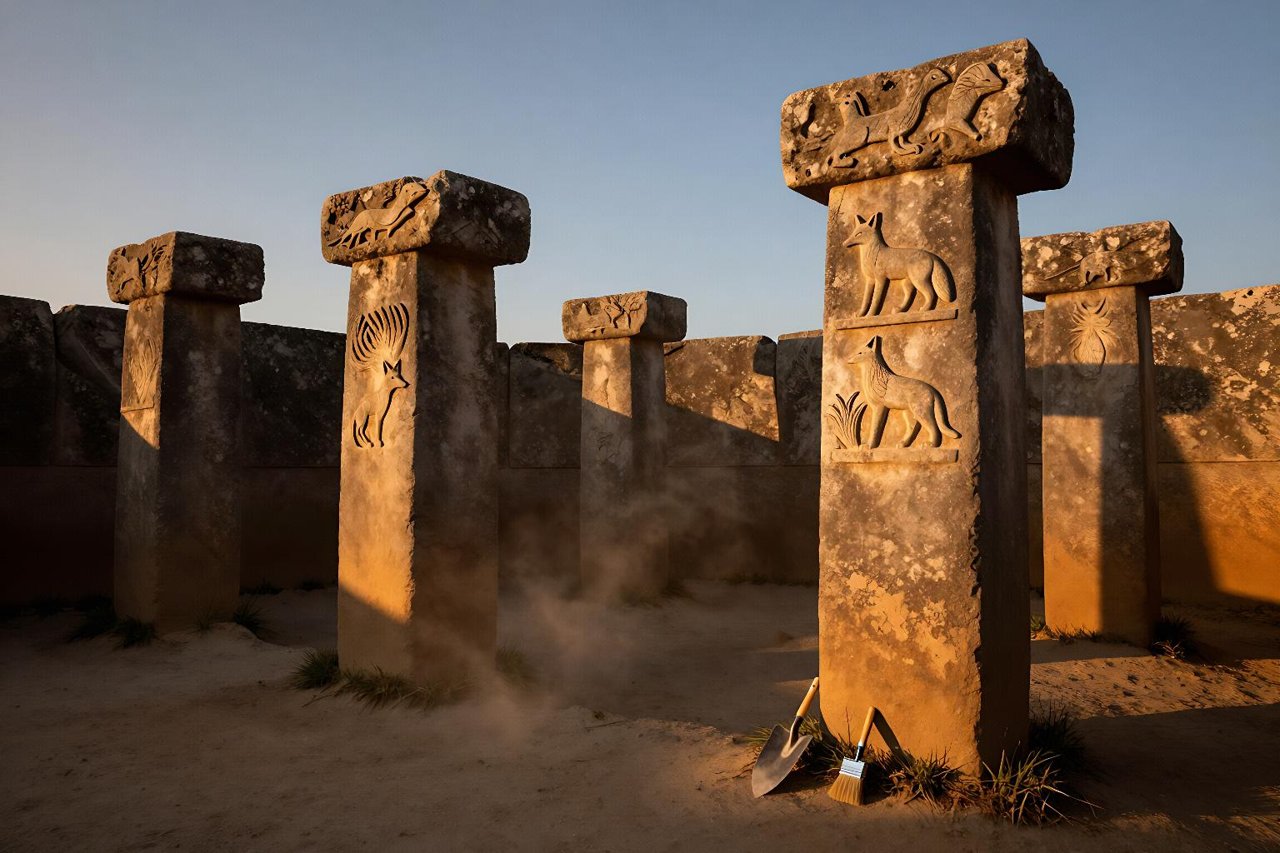
In 1995, a German archaeologist named Klaus Schmidt stood on a bare limestone ridge in southeastern Turkey, roughly 15 kilometres from the Syrian border, looking at slabs that local farmers had been ploughing around for years. Beneath the soil lay the oldest known monumental architecture on Earth: T-shaped limestone pillars, some 5.5 metres tall and weighing up to 16 tonnes, carved with foxes, scorpions, snakes and vultures.
Radiocarbon dating put the site at around 9500 BCE. That is roughly 7,000 years before the Great Pyramid and 6,000 before Stonehenge. The people who built it had no pottery, no metal, no wheels and no farms.
Then they buried the whole thing on purpose. Not collapsed, not abandoned in a hurry — backfilled, deliberately, enclosure by enclosure. Nobody knows why.
That single fact explains why mysterious ancient civilizations hold such a grip on us. The gaps in the record are not vague and romantic; they are specific, measurable and stubborn. Here are the ones that still keep archaeologists up at night.

Göbekli Tepe: Monumental Building Before Agriculture
About 20 stone enclosures have been identified at Göbekli Tepe. Only a fraction of the site has been excavated, and ground-penetrating radar suggests far more is still under the hillside. The pillars were quarried more than 100 metres away and moved without draught animals, since nothing had been domesticated yet.
The awkward part is what the site implies. The standard story runs that farming produced food surpluses, surpluses produced complex societies, and complex societies built temples. Göbekli Tepe reverses the order. Big organised labour came first, and the farming may have followed, partly to feed the crowds that gathered there.
Nearby Karahan Tepe, excavated from 2019 onwards, has thrown up similar pillars plus a carved human head and a chamber containing what appears to be a depiction of a man. The region was clearly busier, and stranger, than anyone assumed in the 1990s.
The Indus Valley: A Civilization With No Obvious Rulers
The Indus Valley civilization covered around 1.5 million square kilometres at its peak, around 2500 BCE — larger than Egypt and Mesopotamia combined. Its cities, Mohenjo-daro and Harappa chief among them, had grid-planned streets, covered drains that ran under every house, private wells and rubbish chutes.
Mohenjo-daro held perhaps 40,000 people. It also had the Great Bath, a 12 by 7 metre brick tank sealed with bitumen, sitting on a citadel mound.
What it did not have is equally striking. There are no obvious royal palaces, no monumental tombs stuffed with treasure, no reliefs of kings smiting enemies, no evidence of a standing army. Burials are modest, with few grave goods. Bricks were fired to a standard 1:2:4 ratio across an area the size of western Europe, accurate to within a few millimetres — a level of bureaucratic consistency that implies authority without telling us where that authority sat.
The Script Nobody Can Read
More than 4,000 inscribed objects have been found, mostly small seals. They use roughly 400 distinct signs. The longest single inscription is just 17 characters long, and there is no bilingual text to crack it against. Whether it encodes a language at all, or something more like commercial notation, is unresolved.
The cities emptied around 1900 BCE. The old invasion theory has largely collapsed under scrutiny — no burned layers, no mass graves, no sudden cultural replacement. Shifting monsoons, the drying of the Ghaggar-Hakra river system and the collapse of Mesopotamian trade all get blamed. Millions of people simply dispersed into villages and disappeared from the record.
Sacsayhuamán and Stones That Should Not Fit
Above Cusco, the Inca built a zigzag wall of andesite blocks, some standing over eight metres tall and estimated at 125 tonnes or more. They were fitted dry — no mortar — with joints so tight that a razor blade will not slide between them. The quarry at Rumiqolqa sits roughly 20 to 35 kilometres away, and the quarrymen had no wheels, no iron tools and no draught animals capable of hauling that weight up a mountain.
Sacsayhuamán is only the showiest example. Yucay, Ollantaytambo and the walls of Cusco itself show the same obsessive joint-work. The wider catalogue of ancient engineering that still outstrips modern assumptions runs from Roman concrete that sets underwater to Damascus steel and the Antikythera mechanism.
Britain has its own version of the problem, on a smaller scale. The sarsens at Stonehenge weigh up to 25 tonnes and the smaller bluestones were hauled around 240 kilometres from the Preseli hills in Wales. The logistics of how stone circles were actually built are testable, and experimental archaeologists have spent decades proving it was possible with ropes, timber and a lot of people. Difficult is not the same as impossible.
Lidar and the Maya Cities Nobody Could See
In 2018, a consortium called PACUNAM surveyed 2,100 square kilometres of Guatemalan jungle with airborne lidar. It found roughly 61,000 structures — houses, defensive walls, raised causeways, agricultural terraces — in a landscape that had previously been mapped at a rate of about two square kilometres per decade on foot.
Researchers had walked past some of these ruins for years without registering them as ruins. Vegetation does that. The techniques now doing the heavy lifting, and how lidar and drought data are rewriting the map of the ancient world, have changed the pace of discovery dramatically.
The Maya abandonment remains one of the great puzzles. Between roughly 800 and 950 CE, the southern lowland cities stopped being built in. Millions of people left. Sediment cores from Lake Chichancanab point to repeated droughts of up to 50 percent rainfall reduction, layered on top of deforestation, soil exhaustion and inter-city warfare. It was not one disaster. It was a slow failure of several systems at once, which is much harder to model and much more relevant to us.
1177 BCE: When Half the World Fell Apart Together
The collapse of the Late Bronze Age is the closest thing history has to a controlled experiment. Within about fifty years, the Hittite capital Hattusa was burned and abandoned, Mycenae and Pylos were destroyed, and Ugarit on the Syrian coast was sacked and never properly reoccupied. Trade routes that had carried tin from Central Asia to the Mediterranean for centuries stopped dead.
Clay tablets from Ugarit, baked hard in the fires that destroyed the city, preserve a frantic last correspondence: grain shipments requested, ships reported sunk, enemies sighted at sea. The culprits, collectively labelled the Sea Peoples, remain unidentified with any confidence, and the list of possible causes reads like a menu of everything bad at once — drought, earthquakes, migration, collapsed tin supply, iron-working disruption. It sits alongside other ancient mysteries that still resist a clean answer.
Where the Evidence Is Actually Coming From
The romance of lost cities tends to obscure how unglamorous the real progress is. Most of it happens in laboratories, working on material that would have been thrown away a generation ago.
- Ancient DNA: sequencing of skeletal material has demolished several tidy migration stories and pinned down plague outbreaks, including one that appears to have hit Neolithic populations in Scandinavia.
- Isotope analysis: strontium and oxygen ratios in tooth enamel reveal where individuals grew up, exposing migrations that pottery styles never hinted at.
- Sediment and ice cores: these give year-by-year climate records, letting researchers match a drought to a specific abandonment instead of guessing.
- Satellite imagery: infrared and multispectral shots have exposed buried roads, canals and entire settlements across Iraq, Egypt and the Amazon basin.
- LiDAR: now cheap enough that smaller projects can afford it, which is why new Mexican and Central American sites appear almost annually.
These tools rarely confirm the dramatic version. They tend to replace one mystery with a more interesting, better-evidenced question. The Amazon geoglyphs are a good example: more than 450 geometric earthworks have been recorded in Acre state, Brazil, cut into forest that was assumed to be pristine. They were built by societies that managed the landscape intensively, and the forest that grows over them today is partly their creation.
That is the pattern worth holding onto. Every mysterious ancient civilization that has been studied properly has turned out to be more capable, more organised and more deliberate than the first guess allowed. Some of the archaeological finds that still defy explanation will close up in the next twenty years as excavation, dating and genetics catch up. A few will not, and those are the ones to watch. When a site as big as Göbekli Tepe turns up in a region nobody was looking at, the safe assumption is that it is not the last one down there.


