
Table of Contents
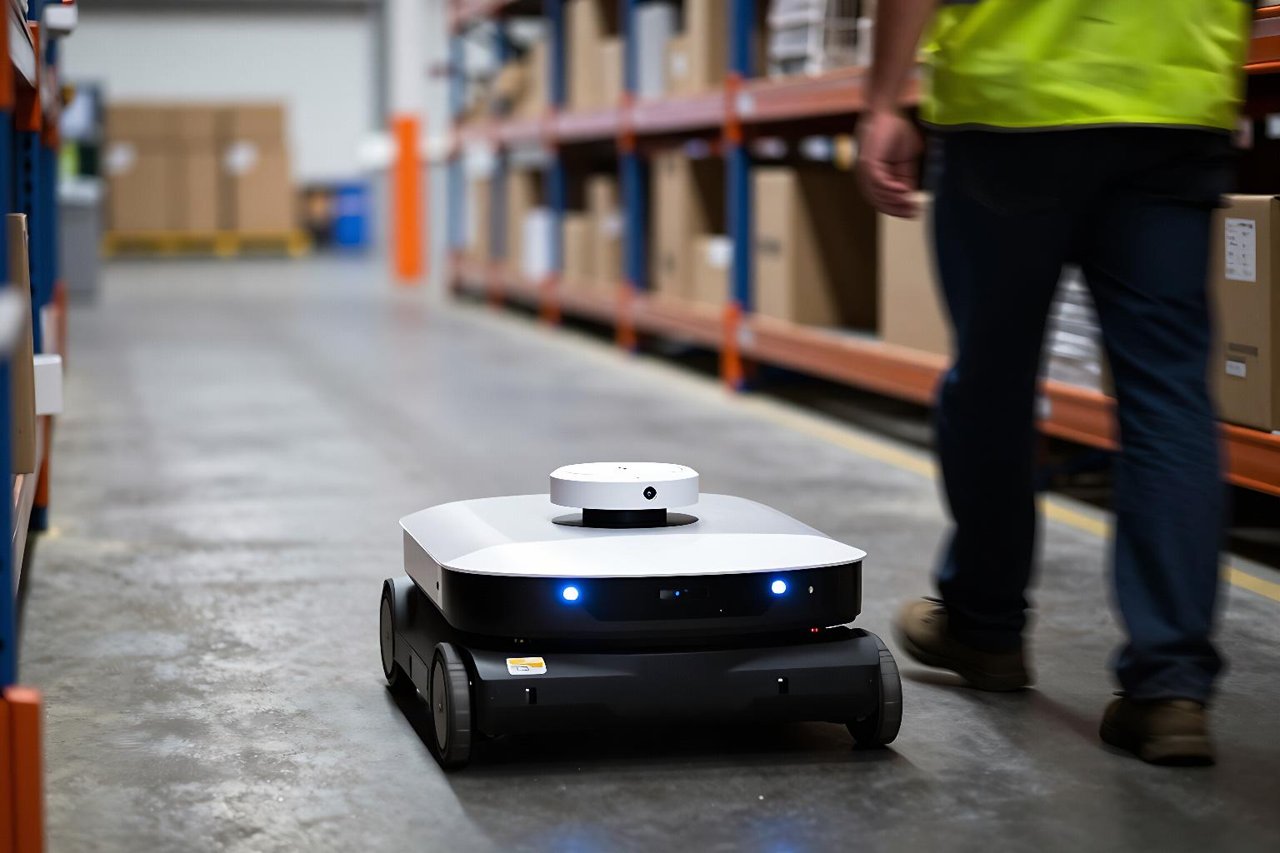
A pallet-moving robot rolls down aisle 14 at two metres per second. A worker steps out from behind a stack of boxes. The machine slows, angles left, and passes with about thirty centimetres to spare. Nobody on the mezzanine looks up. Behind that shrug sits roughly four decades of engineering.
Ask most people what makes a robot impressive and they’ll point at the arm, the gripper, the thing doing the lifting. Navigation gets ignored, which is odd, because a machine that can’t work out where it is or what’s around it is just very expensive furniture. Strip the autonomy out of an autonomous mobile robot and you’ve bought a heavy trolley.
The good news is that the underlying stack is now well understood, and it’s remarkably similar whether you’re looking at a hospital delivery bot or a 400-kilogram towing tractor. The differences show up in tuning, sensor choice and how much you’re willing to spend on redundancy. That’s also why some deployments of robotics and automation pay off handsomely while others quietly get shelved after six months.
Three Questions, Asked Over and Over
Every navigation system, from a £300 vacuum to a mining survey crawler, answers the same three questions on a loop. Where am I? What’s around me? Where do I go next?

The first two are localisation and perception. The third is planning. Sensors feed the first, a map connects them, and the planner converts the answer into wheel speeds or joint commands. That loop typically runs between 10 and 50 times per second. Treat it as a hard deadline. Miss it and the robot is steering on information that’s already out of date.
Sensing: Far More Than a Camera
A single sensor will almost never do the job. Autonomy engineers talk about sensor fusion, which is a fancy way of saying they hedge.
- LiDAR. A spinning 2D unit fires tens of thousands of laser pulses a second and measures return times to build a slice of the world. A 3D unit like a 16-channel puck produces around 300,000 points per second, good for detecting a low pallet or a curb that a flat scan would miss.
- Depth cameras and stereo pairs. Cheap, dense, and excellent at classifying what an obstacle actually is. Weak in direct sunlight and prone to confusion on blank white walls.
- Wheel encoders and inertial measurement units. The unglamorous backbone. An IMU sampling at 200 Hz catches the yaw change when a robot hits a floor transition, which no laser scanner would notice.
- Ultrasonics and bumpers. Short range, crude, and still the last line of defence. Every serious platform has contact sensors, because software will always have a bad day eventually.
Outdoors, add RTK GPS, which can pin a position to within a couple of centimetres when the satellites behave. Under tree canopy or between tall buildings, it won’t, and the robot falls back on the rest of the stack.
Maps, and the Harder Problem of Knowing Where You Are On Them
Most mobile robots don’t arrive with a map. They build one as they go, a technique called simultaneous localisation and mapping. SLAM is the reason a robot vacuum can wander your kitchen for twenty minutes and still find its dock.
In practice it usually means an occupancy grid: a fine lattice of cells, each marked free, occupied or unknown. As the robot moves, it compares new scans against what it expects to see. Matching features confirm its position. A loop closure happens when the robot recognises somewhere it has been before, and the whole map snaps into a slightly corrected shape.
That correction matters more than it sounds. Small heading errors accumulate. Drive 200 metres with a two-degree bias and you’ll be off by seven metres when you arrive, which in a warehouse is three aisles away.
Planning in Two Layers
Path planning splits cleanly. The global planner works on the map, finding a route from A to B, usually with A* or Dijkstra’s algorithm. Both date to the 1950s and 1960s and both are still doing the heavy lifting because they’re fast and predictable.
The local planner handles the next metre. It runs at a much higher rate, watches the live sensor feed, and adjusts the path around whatever has appeared. Modern stacks often use a timed elastic band or dynamic window approach, both of which treat motion as something to optimise rather than a line to follow.
Between them sits a costmap, a map overlay where cells near obstacles get inflated penalties. Tuning that inflation radius is where a lot of real deployments succeed or fail. Too tight and the robot clips pallets. Too generous and it refuses to enter a narrow aisle it could comfortably handle.
When the World Won’t Hold Still
Static maps are a comfortable fiction. Warehouses rearrange overnight. Hospital corridors fill with beds and trolleys. A delivery robot on a city pavement has to cope with dogs, puddles and people who deliberately stand in front of it to see what happens.
Handling moving obstacles means predicting, not just reacting. Velocity-obstacle methods project each detected object forward a second or two and pick a heading that avoids all the projections at once. Social navigation goes further, borrowing from pedestrian behaviour research so a robot yields on the correct side and doesn’t stop dead in a doorway and block everyone.
There’s a real distinction here between platforms. The same navigation stack that guides a warehouse AMR through a semi-structured aisle is massively over-engineered for a lawnmower, and badly under-specified for a machine working alongside the public. That gap is central to what actually separates industrial robots from service robots.
Learning to Drive Instead of Being Told How
Classical planners need a rule for every situation, and the rulebook grows without limit. That’s why teams increasingly train policies instead. Reinforcement learning lets a robot discover through millions of simulated attempts that hugging the left wall in a narrow corridor is faster than stopping to re-plan. Imitation learning copies the trajectories of skilled human operators and generalises from there.
The catch is the sim-to-real gap. A policy trained in a clean simulation and dropped into a real building tends to fail on the details: slightly different friction, a scuffed floor, sunlight streaking across a lens. Domain randomisation helps by varying lighting, textures and physics during training so the policy stops relying on anything too specific. If you want the mechanics behind that, this explainer on how AI learning works covers the training side in more depth.
The Failures That Never Make the Demo Reel
Field engineers keep a private list of things that break navigation, and it’s the same list everywhere.
Glass doors are a classic. LiDAR passes straight through, so the robot sees an open corridor and drives into the lobby window. Mirrors create phantom rooms. Black carpet absorbs laser returns and leaves a hole in the map the robot treats as a cliff. Low winter sun blinds cameras for eight seconds at a time. Polished concrete throws specular reflections that look like solid objects.
Then there’s the kidnapped-robot problem: someone picks the machine up and puts it down somewhere else, and it confidently believes it’s still where it was. Recovery behaviour matters more than accuracy here. A good robot notices that the world doesn’t match, stops, spins, and relocalises. A bad one drives into a wall while insisting everything is fine.
People Are the Variable No Map Accounts For
The hardest part of navigation in shared spaces isn’t detection, it’s legibility. A robot that swerves at the last moment may be technically safe and still terrify everyone in the corridor. Motion that telegraphs intent, slowing early, choosing the obvious side, giving a wide berth, gets trusted in a way that pure efficiency never does.
That trust gap is why pilots succeed or stall, and it’s the same hesitation that shows up whenever automation arrives on a shop floor, as this piece on why people resist the AI migration makes clear. Engineers can tune a costmap in an afternoon. Convincing a night-shift team that the new machine won’t clip them takes longer, and it’s best earned through slow, boring, visible reliability rather than a polished launch video.
Which brings the whole thing back to that moment in aisle 14. The impressive part wasn’t the algorithm. It was the fact that nobody noticed.


