
Table of Contents
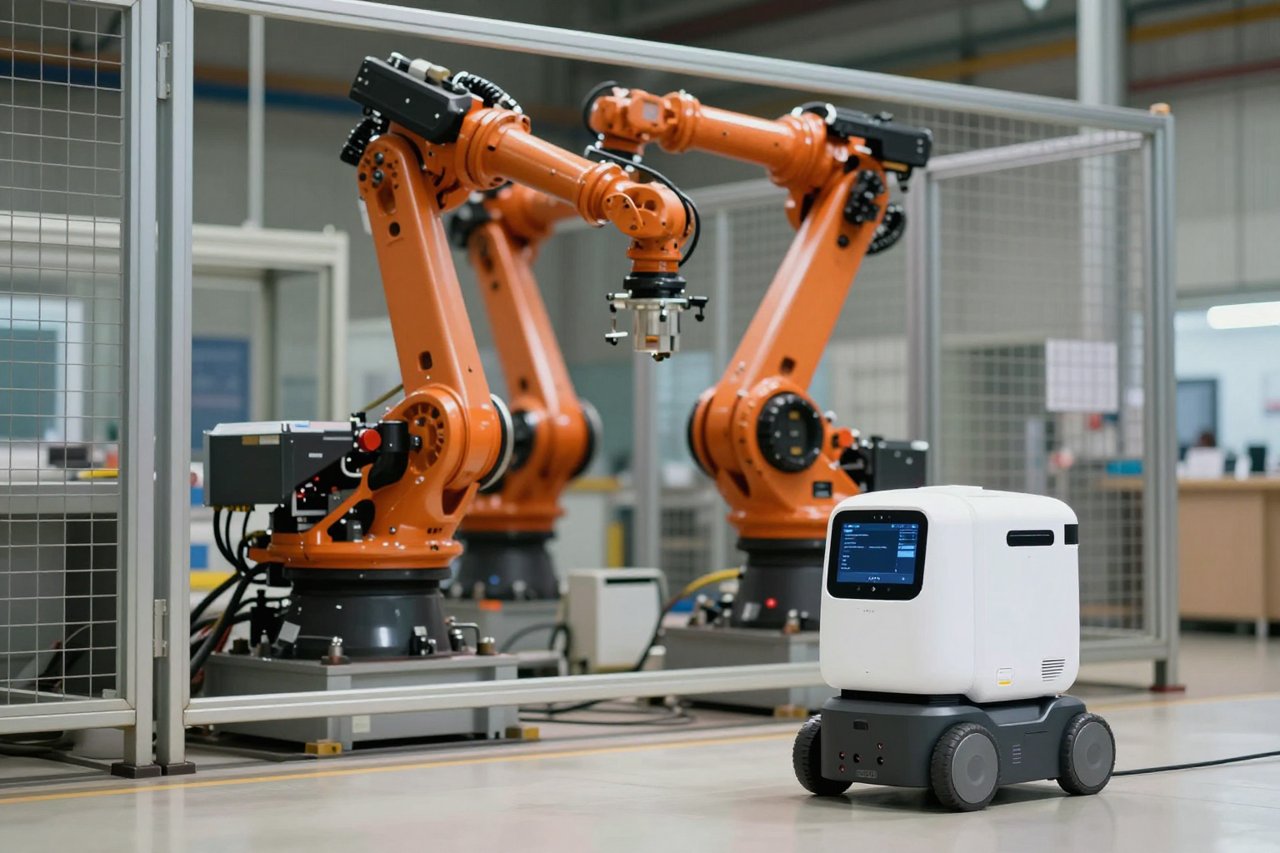
Walk into a car plant and you’ll meet a robot the size of a wardrobe, sealed behind a mesh fence, swinging a half-tonne spot-welding gun with the precision of a Swiss watch. Walk into a hospital corridor at 11pm and you’ll meet something else entirely: a knee-high machine carrying blood samples, politely asking people to step aside.
Both are robots. Both are automating work that used to belong to a person. They are not the same species, and treating them as one category is how projects get scoped badly and budgets get blown.
The industrial robots vs. service robots distinction sounds academic until you’re the one specifying a system, signing the purchase order, or standing next to it on a night shift. The safety rules, the risks, the payback periods and the skill sets all pull in different directions.
Industrial Robots: Designed for a Cage
An industrial robot is defined by its job rather than its shape. It performs a task in manufacturing or heavy logistics, usually bolted to a plinth, usually repeating the same motion hundreds of thousands of times. The International Organization for Standardization covers them under ISO 10218, a standard built around one assumption: humans and robots will be kept apart.

That assumption shapes everything downstream. A six-axis arm from Fanuc, KUKA, ABB or Yaskawa might cost $25,000 for a small unit and $400,000 for a foundry-grade monster. It is usually sold as a component, the way a gearbox is sold. The buyer integrates it. Safety fencing, light curtains, grippers, vision systems, conveyors and programming can easily double or triple the sticker price before the first part is produced.
What the numbers actually look like
Repeatability on a decent mid-size arm sits around ±0.02mm. Payload runs from 3kg on a small SCARA up to well past 1,000kg. Cycle times are measured in seconds and held for years without drift. The International Federation of Robotics recorded roughly 541,000 industrial robot installations worldwide in 2023, with China taking more than half, and the global operational stock passed 4.2 million units.
None of that describes a machine you can redeploy on a Tuesday afternoon. Industrial robots are capital equipment bought against a five-to-fifteen-year horizon, and the economics only work if you run them hard, ideally across two or three shifts.
Service Robots: Built to Share a Room
Service robots do work that isn’t manufacturing, and they’re designed for spaces people already occupy. That single constraint explains most of their engineering. They’re slower, lighter, quieter, and far more likely to be covered in sensors.
The category is broader than most people expect:
- Professional service robots: Lely’s automated milking systems, Intuitive Surgical’s da Vinci platforms, autonomous mobile robots shuttling totes in warehouses, crop-weeding machines in vineyards, and inspection robots crawling inside pipelines.
- Consumer service robots: robot vacuums, pool cleaners, lawn mowers. Millions of units a year, sold in retail boxes.
The IFR counted around 205,000 professional service robots sold in 2023, alongside a consumer market measured in the millions. Amazon alone operates more than 750,000 mobile robots across its fulfilment network, moving shelving units to pickers rather than moving pickers to shelves.
The Differences That Change a Buying Decision
Strip away the marketing and five practical gaps separate the two families:
- Environment: industrial robots assume a controlled cell; service robots assume clutter, children, wheelchairs and unpredictable flooring.
- Speed versus judgement: an industrial arm wins on cycle time; a service robot wins on navigation, perception and recovery from the unexpected.
- Safety framework: ISO 10218 and guarding for the factory floor, ISO 13482 for personal care robots that share space with untrained people.
- Sales model: capital equipment with a systems integrator versus off-the-shelf units or subscription pricing.
- Programming: teach pendants and offline simulation on one side, app dashboards and mapping wizards on the other.
Where the Categories Collide
Classification follows intended use, not postcode. A self-driving forklift moving pallets inside a factory is officially a service robot, because its job is logistics rather than processing. A collaborative arm welding brackets on an assembly line is an industrial robot, even though it has no fence around it.
Cobots are where the boundary gets genuinely messy. Under ISO/TS 15066, a collaborative robot can share a workspace with a human provided force and speed are limited and hazards are assessed. The machine is industrial by application and cooperative by design. Mobile manipulators, which pair an autonomous base with an arm, muddle things further: they navigate like service robots and work like industrial ones.
The Integration Tax and the Payback Maths
With industrial systems, the robot is often the cheapest part of the project. Integration, fixturing and commissioning routinely run two to four times the hardware cost, and payback typically lands somewhere between 18 months and four years depending on labour rates and shift patterns.
Service robots flip that equation. An autonomous mobile robot might cost $30,000 to $60,000 and be productive within a fortnight. A robot vacuum costs a few hundred dollars and pays back in saved hours rather than saved headcount. Lower ceilings, faster deployment, and much smaller penalties for getting it wrong.
The Human Side of the Split
Workers tend to react differently to the two categories. An industrial robot takes a defined task away from a defined role, and everyone on the line can see it coming. A service robot typically removes the travelling, lifting and fetching that nobody enjoyed in the first place, which is why hospital portering staff often welcome the machines more readily than assembly workers do.
That doesn’t make adoption frictionless. Public opinion on automation is uneven, and survey work on how people feel about AI-driven job displacement shows trust splitting along lines of familiarity and control. The type of robot matters, and so does whether the people beside it were consulted before the crate arrived.
The Question That Sorts Them Out
Before you read a single spec sheet, ask one thing: is the environment being rebuilt around the robot, or is the robot being built for the environment?
If the answer is the first, you’re in industrial territory. Expect cages, integration partners, a long payback and a system that rewards volume. If it’s the second, you’re buying a service robot. Expect shorter deployments, softer economics, and a machine that has to survive real people being real people around it.
Get that question right and the rest of the specification tends to fall into place. Get it wrong and you end up fencing off a corridor, or worse, putting a service robot where a 400-volt arm belongs.


