
Table of Contents
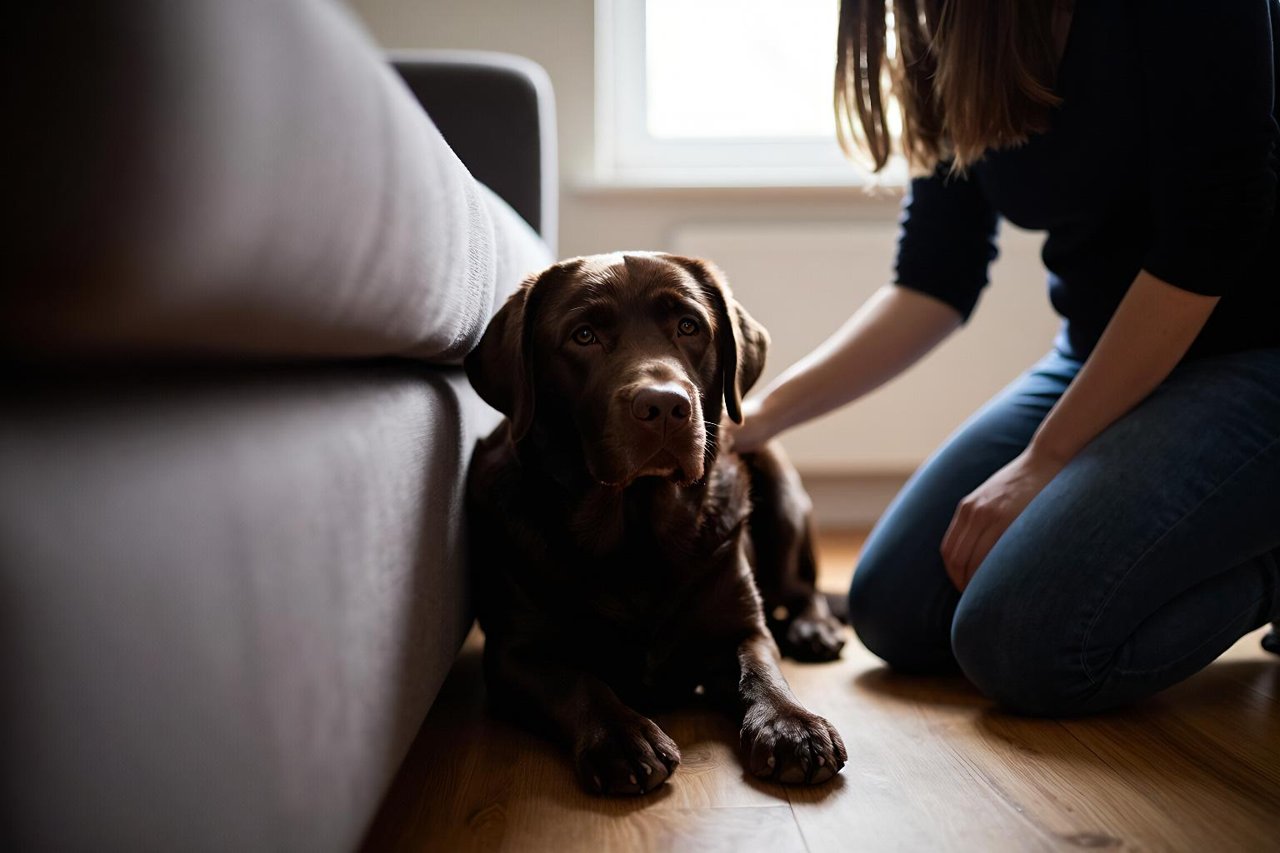
Bear was a 70-pound Lab mix who slept in the middle of the hallway, exactly where you needed to walk. One Tuesday morning he wasn’t there. His owner found him wedged behind the couch, chin flat on his paws, eyes open, not asleep. No vomiting. No limp. Nothing you could point to. Two days later, a blood panel came back with pancreatitis.
That scene plays out in veterinary clinics constantly. Dogs don’t announce that something is wrong. They go quiet, they go small, and they go somewhere you aren’t looking. Often the first real clue is a change in where your dog chooses to be.
The old instinct behind the disappearing act
Dogs inherited a simple rule from their ancestors: an animal that looks weak becomes a target. A wolf with an infected paw doesn’t limp at the front of the pack. It drops back, curls up, and stays still. Stillness conserves energy, and energy is exactly what a body fighting infection or injury needs to spend elsewhere.
Hiding also cuts down on the number of interactions a sick animal has to manage. Every greeting, every nudge from a housemate, every hand reaching for a collar is work when your abdomen hurts.

Your bedroom closet is a long way from a den in the mountains, but the wiring hasn’t changed much. When a dog feels off, the urge isn’t to find you and ask for help. It’s to find a small, dim, enclosed space and wait for the feeling to pass.
What hiding actually looks like in a house
Most people picture a dog trembling under a bed. In practice it’s subtler, and it varies with the dog’s personality and the kind of discomfort involved.
- Choosing a brand-new spot: behind the sofa, deep in a closet, on the cool tile behind the toilet, under the deck, or pressed against the back of an open crate
- Skipping the greeting at the door when the car pulls in, which for a sociable dog is a louder alarm than any symptom
- Not coming when called, or coming over slowly with a lowered head and a tucked tail
- Ignoring the sound of the treat jar or the leash rattling
- Vanishing for long stretches at the same time each day, especially after meals or after stairs
- Sleeping more, but in a spot that isn’t a normal sleeping spot
The location matters less than the change. A dog who has always napped under the desk is behaving normally. A dog who never did until last Thursday is not.
Hiding, or just denning?
Dogs genuinely enjoy snug spaces. The difference is whether your dog still comes out for the things that matter. A dog who naps under the bed but rockets into the kitchen when the fridge opens is being a dog. A dog who stays put through the clatter of a food bowl is answering a different question.
Pain is the most common reason a dog goes quiet
Dogs are exceptional at masking pain, partly because the animals that broadcast discomfort got picked off. Dental disease is a good example. By the time most dogs are two or three, some degree of periodontal disease is already present, and a dog with a sore tooth often eats slower, chews on one side, and then retreats to a quiet corner afterward. Owners frequently report the hiding before they notice the bad breath.
Osteoarthritis is another one. It shows up in roughly one in five adult dogs and in the majority of dogs over eight. The classic presentation isn’t a yelping dog. It’s a dog who stops jumping on the couch, starts sleeping in a corner of the room instead of on the bed, and gets stiff for a few minutes after standing up.
Back and neck pain look different again. A dog with a disc problem may hide under furniture and then snap when reached for, which gets misread as a sudden behavior problem. If a dog who has never shown aggression growls when you touch their neck or lift them, pain is the first thing to rule out.
Nausea and stomach trouble send dogs to the bathroom floor
A nauseated dog usually gives you a warning: lip licking, repeated swallowing, drooling, grass grazing, restless pacing. Then the pacing stops and they disappear into a cool, hard-floored spot, often the bathroom. Something about the tile seems to help.
Gastrointestinal discomfort is behind a huge share of hiding episodes, from simple dietary indiscretion to pancreatitis, parasites, or an obstruction. If your dog’s habit involves eating things that aren’t food rather than avoiding food, that’s a separate puzzle, and there’s a useful breakdown of why dogs eat poop that covers the medical and behavioral angles.
Fear and stress look identical from the doorway
Not every hiding dog is physically ill. Thunderstorms, fireworks, a new baby, movers in the house, a change in work schedules, or a recent move can all push a dog into a safe room. The giveaway is timing. Fear-based hiding tracks the trigger and resolves when the trigger does. Illness-based hiding tends to be tied to eating, activity, or a slow downward drift over days.
Anxious dogs also hide more in general, and the two problems can feed each other. A dog who is already braced for something bad handles pain with less margin. If you’re dealing with a dog who startles easily or shuts down around strangers, the guidance on helping a reactive or fearful dog is worth reading alongside a vet visit, not instead of one.
Conditions where hiding tends to show up first
Certain illnesses are notorious for presenting as “he just seems off.” Keep them in mind, especially with middle-aged and senior dogs:
- Kidney disease, which often brings increased water intake before anything else, with the dog retreating afterward
- Dental pain, easy to miss because dogs keep eating long after it starts hurting
- Arthritis and spinal disease, where the dog avoids the stairs and the bed
- Hypothyroidism, with sluggishness, weight gain, and a dog who stops seeking attention
- Cancer, particularly in the abdomen or chest, where early signs are vague and intermittent
- Cognitive dysfunction in older dogs, which can bring staring at walls, pacing at night, and hiding in closets
How to check a hiding dog without making it worse
Sit down on the floor a few feet away rather than reaching in. Let the dog come to you, and offer something soft and smelly rather than a hand over the head. If they stay put, do your assessment gently and quickly.
Lift the lip and look at the gums. Healthy gums are bubblegum pink, and pressing a fingertip against them should refill the color in under two seconds. Pale, white, blue, or brick-red gums are all reasons to call the vet today. Gums that feel tacky, plus skin that stays tented when you pinch the scruff, point toward dehydration.
A normal resting temperature for a dog sits between about 101 and 102.5°F, taken rectally with a digital thermometer. Resting breathing runs roughly 10 to 30 breaths per minute, and heart rate between 60 and 140 depending on size. Count for a full 30 seconds and double it. Numbers you write down are far more useful to a veterinarian than “breathing fast.”
Signs that mean go now, not tomorrow
Skip the wait-and-see if you see pale or blue gums, labored or noisy breathing, a hard or swollen abdomen, collapse, repeated vomiting, straining to urinate with nothing coming out, a temperature above 103°F or below 99°F, or a dog who cries when moved. Any of those, and you’re in the car.
Helping them feel safe while you sort it out
Don’t drag a hiding dog out for company. Leave the chosen spot available, add a blanket to it, and keep the lights low nearby. Move water close by and offer small, bland meals rather than a full bowl. Keep children and other pets away from the area so the dog isn’t guarding sleep.
Once your dog is eating and moving again, gentle scent work is one of the easiest ways to rebuild confidence. A few treats hidden under a towel or a slow sniffing walk does more for a recovering dog than a game of fetch, and there are good reasons nose-based enrichment beats most other activities for a dog who’s feeling fragile.
You’ll also see plenty of products marketed for the quiet, withdrawn dog, from pheromone diffusers to calming chews. Some have decent evidence behind them and some have almost none. If you want to judge those claims yourself rather than trust the packaging, this guide to evaluating scientific research on dogs and cats will help you sort a real study from a testimonial.
The pattern you’ll notice before the vet does
Start a note on your phone the day the behavior changes, and be specific. Write down the time your dog disappears, how long they stay hidden, whether it happens before or after meals, whether they come out for a favorite treat, and whether they slept through the night. Add water intake, stool changes, and anything that happened in the house that week.
A dog who vanishes for forty minutes every evening at seven, right after dinner, is telling a very different story than a dog who has been behind the couch since six in the morning and skipped breakfast. That written timeline turns a vague “he’s been acting strange” into something a veterinarian can work with on the first visit instead of the third. Hiding is rarely the whole message on its own, but combined with a few dates and times, it’s often the fastest route to an answer.


