
Table of Contents
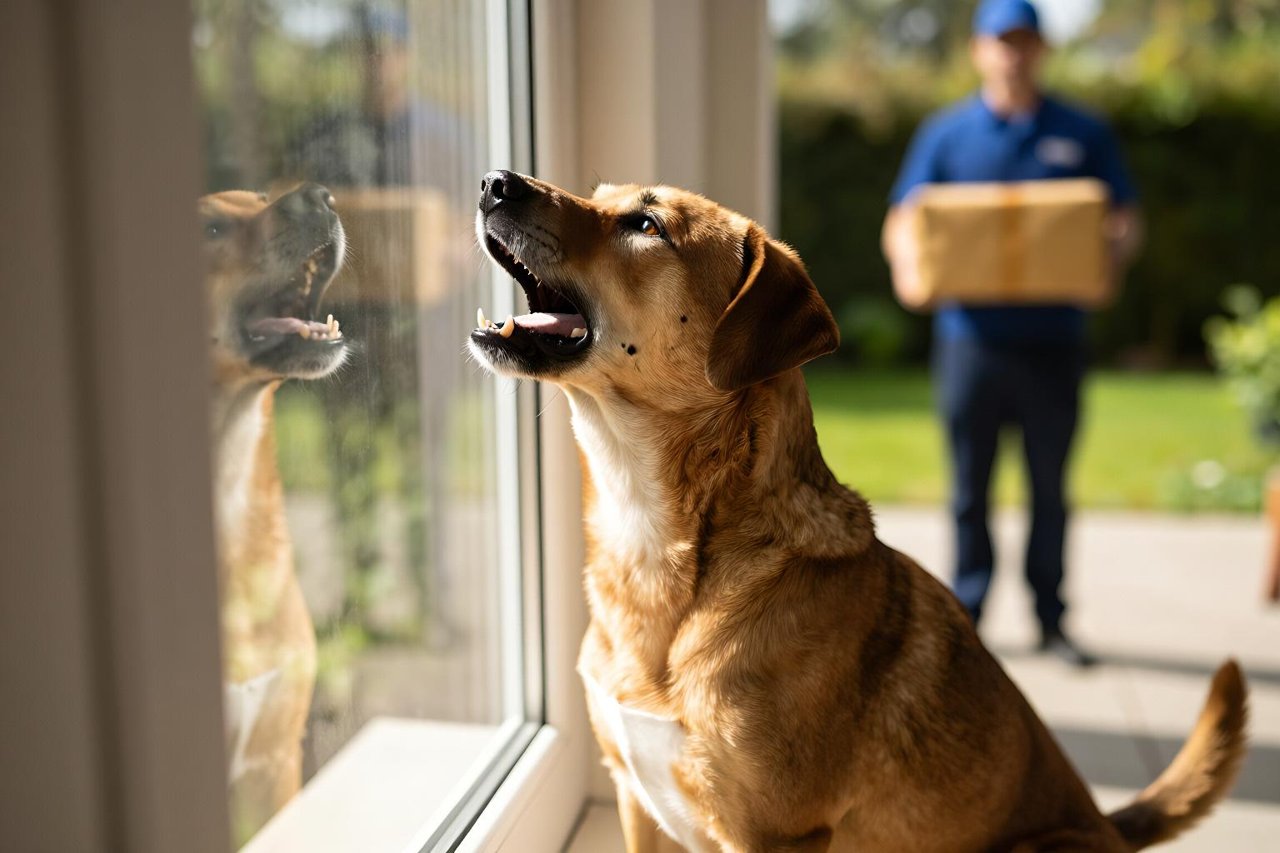
Your dog is flat out on the sofa, legs twitching, completely gone. Then a delivery driver opens the garden gate and the entire house detonates. Four seconds later the driver is back in the van and your dog is doing a victory lap of the hallway.
From the outside it looks like overreaction. From the dog’s side of the window, something arrived, the dog made noise, and the something left. In canine logic, the barking worked.
That mismatch is the root of most stranger-related barking. The behaviour isn’t defiance, and it isn’t a personality flaw. It’s a fast, effective strategy that a dog has learned pays off, usually for more than one reason at once.
Barking Is Information, Not Attitude
Dogs have a small toolkit: barks, whines, growls, huffs, plus a whole vocabulary of posture. The same bark can mean “stay away”, “come back”, “I can hear you upstairs” or “I would like a snack”. You can’t diagnose it by sound alone.

What you can read is the rest of the body. A dog barking with weight shifted forward, tail high and stiff, ears up, is making a confident claim on space. A dog barking while backing up, ears pinned, tail tucked, lips pulled long, is frightened. Those two dogs need completely different handling, and treating a scared dog like a pushy one is how simple barking turns into a real problem.
The Distance Rule Behind Almost Every Incident
Trainers talk about a dog’s threshold: the distance at which it can still think clearly. At 30 metres your dog might glance at a stranger and carry on sniffing. At three metres on the same narrow pavement, the thinking part switches off and the noise starts.
This explains why the postman gets the worst of it. He arrives, comes close, makes noise at the door, leaves, and repeats the whole thing tomorrow at roughly the same time. It’s unpredictable enough to be alarming and repetitive enough to feel like a pattern. Same with meter readers, food delivery riders, and the neighbour’s cousin who always wears a hood.
Distance also explains a lot of street behaviour. A dog patrolling a fixed patch of pavement will bark at anyone unfamiliar who crosses it, and the closer they get, the more intense the response. Anyone who has walked home past a group of street dogs after dark has seen that escalation up close, and it sits inside a much bigger set of challenges around how cities manage free-roaming dog populations.
Fear Is Usually the Engine Underneath
Ask most owners and they’ll say their dog is “protective”. Sometimes that’s accurate. Very often what’s happening is uncertainty: a stranger is unfamiliar, unpredictable, and staring, and barking is the cheapest way to make the stranger go away.
Fear-based barking has a few reliable fingerprints. It tends to happen at closer range, it ramps up fast, and it often comes with retreat or a lot of false starts. If your dog barks and then hides behind your legs, you’re not dealing with a guard dog. You’re dealing with a worried one, and the questions owners ask about reactive and fearful dogs are worth reading before you start changing anything.
Strangers don’t look like strangers to us, but they do to your dog
Human faces are not a dog’s strong point. Silhouette, movement and smell carry far more weight. So a person in a wide-brimmed hat, someone carrying a large box that hides their shape, a cyclist in a helmet, a person using crutches, or anyone walking with an odd gait all read as “not a normal human” to a lot of dogs. That’s why your dog ignores the vet but loses it at the man with the umbrella.
Genetics Set the Volume Knob
Some breeds were developed to announce arrivals, some to chase things off a property, some to work closely with people and not care much either way. A Maremma doing its job and a Chihuahua doing its job are producing the same message at wildly different decibels, and neither is misbehaving.
Age matters too. Between roughly six and eighteen months, dogs go through fear periods and a surge of hormones that makes them jumpier about novelty than they were as puppies. A dog that was relaxed at eight months can suddenly start barking at the same delivery driver at twelve months. If that timing sounds familiar, the adolescent phase in dogs is worth understanding rather than fighting.
Territory, Barriers and the Front Door Problem
Dogs treat the home and its surroundings as an extension of their resources. A stranger crossing that boundary is treated roughly the way you’d treat someone walking into your kitchen unannounced.
Barriers make it worse. A dog behind a window, a gate or a fence can see the intruder but can’t investigate, sniff or follow. That frustration spikes the intensity of the barking and, over months, teaches the dog that the fence is the only thing keeping disaster at bay. That’s how you end up with a dog who barks at the window for twenty minutes after the person has gone.
Things Owners Do That Accidentally Reward It
Most of the habits that keep stranger barking alive are attempts to help. These are the common ones:
- Shouting “quiet!” or “enough!” across the room. To a dog already barking, that’s you joining in with the alarm.
- Picking the dog up, cuddling or soothing mid-bark. Comfort is nice, but it pairs attention with the exact behaviour you want to reduce.
- Letting every visitor fuss over the dog the moment it stops barking for half a second. The dog learns that barking summons attention, and stopping is temporary.
- Repeating exposure without adjusting distance. Ten strangers in a week at two metres isn’t practice, it’s flooding, and it usually makes the fear sharper.
- Treating it as funny in puppyhood. A four-kilo puppy barking at the postman is charming. A thirty-kilo dog doing the same thing at two years old is a complaint waiting to happen.
What Actually Changes the Behaviour
Nothing works instantly, and anyone selling instant is selling something else. What does work is consistent and fairly boring: reduce the rehearsals, give the dog something to do instead, and change how the dog feels about the sight of a stranger.
Cut the number of daily rehearsals
Every bark at a passing stranger is a practice rep. Frosted film on the front window, a baby gate across the hallway, a solid fence panel where the dog can see through, a dog walker who takes a quieter route: all of it buys you time and lowers the dog’s general arousal before you start training.
Teach a behaviour that competes with barking
Pick something incompatible with noise: lying on a mat, going to a spot by the door, holding a toy. Reward it heavily and rehearse when nobody is at the door, then when someone is a hundred metres away, then fifty, then at the gate. The methods that genuinely reduce barking in dogs all follow this same logic, and the article is blunt about the popular approaches that backfire.
Change the emotional association
This is the slow part. Stranger appears at a distance your dog can handle, food appears. Stranger leaves, food stops. Repeat a few hundred times over several weeks and the sight of a person on the pavement starts predicting chicken rather than threat. The key detail is that the food must come before the barking, not after it, which is why distance matters so much.
Handle visitors on your terms
Ask guests to text when they arrive, put the dog behind a gate or on a lead, and let the dog choose whether to approach. A guest who ignores the dog entirely for the first five minutes, no eye contact, no reaching out, does more for the relationship than one who leans in for a pat. Meet outside on neutral ground where you can, and give the dog an exit route.
How Long It Takes, Realistically
A dog who has been barking at strangers for three years will not be cured in a fortnight. Simple management changes often produce a noticeable drop in a week or two. Proper desensitisation usually runs six to twelve weeks of short daily sessions before the change feels solid. Progress is uneven, and a bad week after a fireworks night or a house move is normal rather than proof that it isn’t working.
Get professional help if the barking comes with lunging, muzzle-punching, or any attempt to make contact, if your dog is too stressed to eat treats in the presence of people, or if you’ve been managing it alone for months with no change. A single session with a qualified behaviourist is cheaper than a year of guessing.
The Neighbour Question
If you live in a flat or a terrace, the barking is not only your problem, and pretending otherwise tends to make things worse. Tell the neighbours before they complain. Explain what you’ve changed, when it happens, and how long you expect it to take. Most people are far more tolerant of a dog making noise at 5pm for six weeks than of a dog making noise indefinitely with no explanation.
Log the barking for a week if it feels constant. Owners routinely underestimate how much their dog barks when they’re out, and a cheap indoor camera will tell you whether you’re dealing with twenty minutes of doorbell barking or four hours of distress. Those are two very different problems, and the second one needs a vet or a behaviourist involved rather than a training plan off the internet.


