
Table of Contents
Walk down any pharmacy skincare aisle and you’ll find an entire wall of sunscreen: sprays, sticks, tinted fluids, mineral lotions at SPF 30, chemical gels at SPF 90. The sheer number of options suggests the choice matters enormously. The truth is less dramatic. The gap between a decent sunscreen and a genuinely great one is far smaller than the marketing suggests. What separates people who protect their skin from those who don’t comes down to three distinctly unglamorous habits: applying enough, reapplying at the right moments, and not treating overcast days as a free pass.
Estimates put the share of visible facial ageing caused by UV exposure somewhere around 80%, with the rest coming from genetics, smoking, sleep and the ordinary passage of time. That figure is why dermatologists get so repetitive about sun protection. It’s also why the effort pays back more reliably than almost any serum on the shelf. The lifestyle habits that show up in the mirror first matter too, but UV exposure sits at the top of that list for a reason.
UVA, UVB, and What “Broad Spectrum” Really Covers
UVB is the shorter wavelength. It’s the one that burns, and it’s what the SPF number measures. UVA is longer, penetrates deeper, and stays roughly consistent all day, passing through windows, cloud and car windscreens. It’s the wavelength tied to pigmentation, leathery texture and the fine lines that make people wonder what happened to their skin somewhere in their thirties.
An SPF 50 product with poor UVA coverage is not better than an SPF 30 with solid UVA coverage. It’s a different trade-off, not an upgrade. Look for the words “broad spectrum” on the label, and where a PA rating appears (PA+, PA++, PA+++, PA++++), aim for at least PA+++ for daily wear. In the UK you may see a Boots star rating instead; four or five stars indicates UVA protection scaled to the SPF.

No sunscreen blocks 100% of UV. SPF 30 filters roughly 97% of UVB and SPF 50 around 98%. Past that point the gains get very small while the texture gets heavier. That matters, because a formula you resent wearing gets applied thinly or not at all.
How Much You Actually Need (More Than the Bottle Suggests)
Lab testing uses 2 mg of product per square centimetre of skin. In everyday terms that’s about a quarter teaspoon for the face and neck, and roughly a shot glass (30 ml) for an adult body in a swimsuit. Most people apply somewhere between a quarter and half of that, which quietly turns an SPF 50 into something closer to SPF 15.
Practical versions that work in a real bathroom:
- A two-finger length of product squeezed along the index and middle fingers covers most faces and necks.
- For the body, count roughly one teaspoon per limb, one for the front of the torso and one for the back.
- Tinted fluid and makeup with SPF are a bonus, not a base coat. Nobody wears enough foundation to reach the number on the bottle.
The Spots Almost Everyone Misses
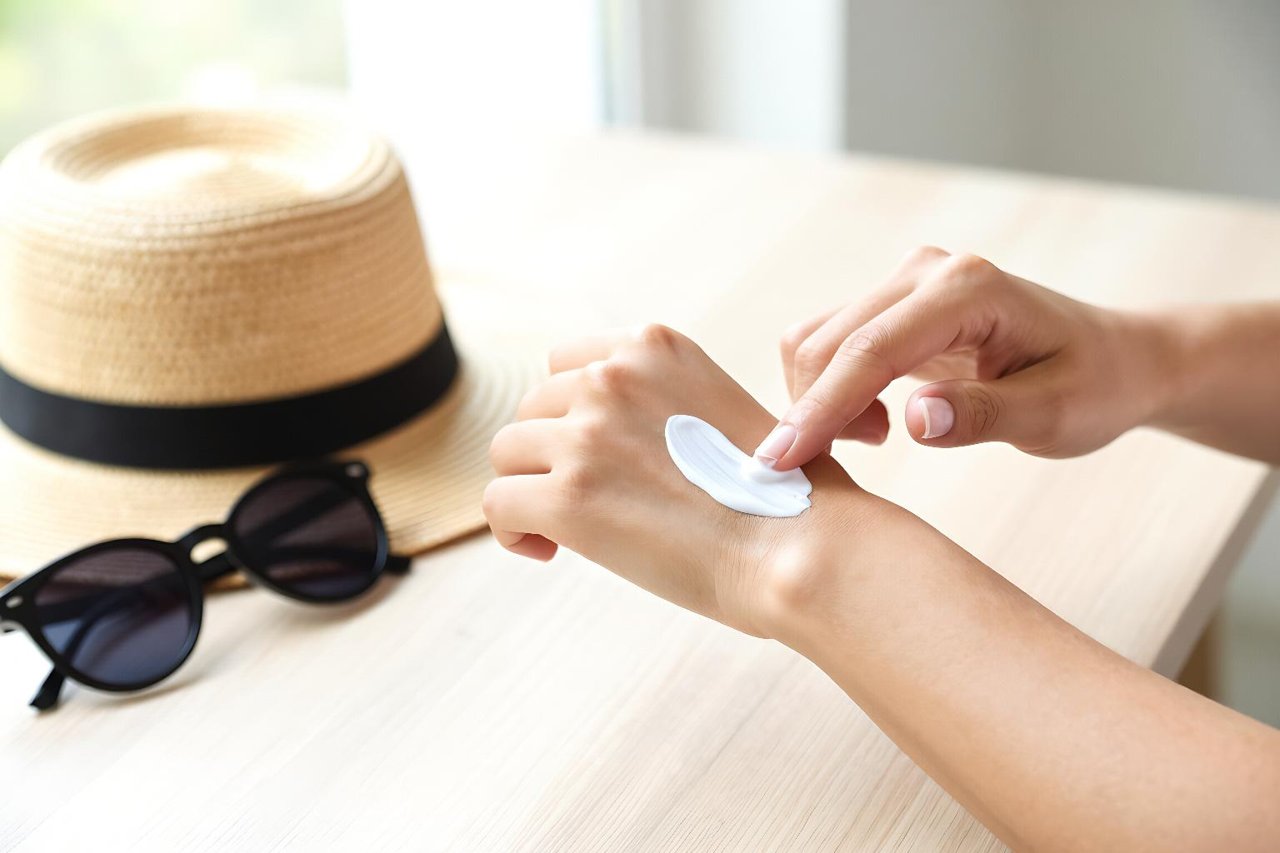
Even careful people skip the same places. The tops of the ears. The hairline and any exposed scalp along a parting. The eyelids, where the skin is thin and skin cancers are commoner than most people assume. The backs of the hands, which age visibly and catch sun during a twenty-minute drive. Also the side of the nose and the tops of the feet.
Sprays have their own problem. People mist once and assume coverage. A spray needs to be applied until the skin visibly glistens, then rubbed in properly, which rather defeats the convenience argument.
Reapplication Is Where Good Intentions Fall Over
One morning application does not hold until dinner. Filters break down, absorb into the skin, and transfer onto clothing and car seats. Every two hours is the standard advice, and immediately after swimming, heavy sweating or towelling off. That holds true even with water-resistant formulas, which are tested at 40 or 80 minutes of immersion rather than a whole afternoon.
For makeup wearers, the workable options are an SPF setting spray, a powder with sun protection (patchy, but better than nothing), or a cushion of the same sunscreen tapped over the top. It feels fussy for a week, then it becomes automatic.
Shade, Fabric and Timing Do Half the Work
Sunscreen is not a force field. A hat with a wide brim, tightly woven clothing and a UPF-rated top for long outdoor days block far more UV than a lotion applied thinly at 8am. Sunglasses with proper UV filtration protect the eyes and the thin skin around them, which is where damage shows up first.
Timing helps too. In most places the UV index peaks between 11am and 3pm, and it roughly doubles between 10am and midday. Checking the UV index on a weather app and moving a run an hour earlier is a genuinely effective strategy, and considerably cheaper than a second bottle of serum.
Picking a Formula You’ll Actually Wear
Chemical filters absorb UV and convert it to heat. Mineral filters (zinc oxide and titanium dioxide) sit on the surface and scatter it. Modern formulations blur the line and plenty of products combine both. Neither approach is inherently safer. The best sunscreen is the one that doesn’t sting your eyes, doesn’t pill under makeup, and doesn’t leave a ghostly cast that makes you avoid it.
If your skin reacts to everything, identifying which filters, fragrances or preservatives cause the trouble shortens the search dramatically. There’s a detailed walkthrough in this beginner’s guide to sunscreen for sensitive skin covering patch testing and ingredient lists. Fragrance-free formulas with fewer actives are the safest starting point.
What Changes With Age, and What Doesn’t
Photodamage accumulates. The freckles and texture changes that appear in your forties were largely deposited in your teens and twenties, and the skin’s ability to repair declines alongside its ability to hold moisture. That makes daily protection more important rather than less, and it makes consistency matter more than the SPF number. If you’re navigating that decade, there’s more specific guidance on what genuinely helps mature skin after 40.
It’s also worth untangling sun damage from the folklore sold alongside it. Several of the most expensive myths about wrinkles and ageing (that a high SPF means you can skip reapplying, that a base tan protects you, that window glass blocks UVA) cost people real money and real skin.
A quick note on vitamin D, since it comes up constantly. Everyday incidental exposure plus a normal diet covers most people. Where deficiency is a genuine concern, a supplement is the sensible route rather than deliberately burning your forearms.
Making Sun Protection Survive a Real Week
The plan that works is the one that fits the life you already have. Sunscreen on the bathroom shelf next to your toothbrush gets used. Sunscreen in a drawer gets forgotten. A pump bottle by the front door works for the backs of hands before a commute, and a stick in your bag handles the lunchtime top-up.
Two or three anchor points are plenty. Apply before you leave the house, not in the car park. Keep a second product somewhere you’ll see it at midday. Replace bottles that have sat in a hot car over a summer. Heat degrades filters, and the expiry date printed on the packaging is not decorative.
The unglamorous version is the honest one: an inexpensive broad-spectrum SPF 30 you use generously and reapply beats a £60 fluid you ration to make it last. If you’re still assembling the rest of your shelf, the core skincare products worth understanding will help you work out what else earns a place, and this guide to building a skincare routine you’ll still keep on a bad week covers how to make the habit hold when mornings get rushed.


