
Table of Contents
Two women start the same eight-week strength programme. One drops 4 kg. The other loses almost nothing, and by week six she is ready to quit. What the scale never tells her is this: her waist is 5 cm smaller, she has added 12.5 kg to her squat, and last Tuesday she carried two bags of shopping up four flights of stairs without stopping. Her body changed. The number didn’t.
Bodyweight is one data point in a system that has dozens. It swings with salt, sleep, hormones, and whether you drank a litre of water before stepping on. A salty dinner can add 1.5 kg overnight that has nothing to do with fat. If you want to know whether your training is actually working, you need a wider dashboard than a single figure on a bathroom floor.
Why the Scale Is a Blunter Tool Than You Think
Human bodies are roughly 55–65% water, and that water shifts constantly. Glycogen stores hold onto roughly 3 grams of water for every gram of carbohydrate, which is why a low-carb week can look like miraculous fat loss and a pasta weekend can look like failure.
There is also a composition problem. Muscle is denser than fat, so a woman who loses 2 kg of fat and gains 2 kg of muscle weighs exactly the same and takes up less space. The scale reports the sum and hides both halves of the equation. It cannot tell you where anything changed, only that the total moved or didn’t.

Photographs: The Evidence You Can’t Argue With
Progress photos work because they capture shape rather than mass. Most people ruin them with different lighting, different times of day, or a phone held at a different angle, then conclude nothing is happening.
Rules that make photos comparable
- Same spot, same window light, same time of day (morning works best for most people).
- Same clothes, or as close as you can manage. Shorts and a sports bra beat a baggy t-shirt.
- Three shots: front, side, back. Stand naturally, don’t suck anything in.
- Every four weeks, not every four days. Save them into a folder named by date.
The temptation is to look at them constantly. Don’t. Open last month’s folder on the first of the month, compare, then close it. Change over four weeks is visible. Change over four days is noise.
The Tape Measure Doesn’t Care About Water Weight
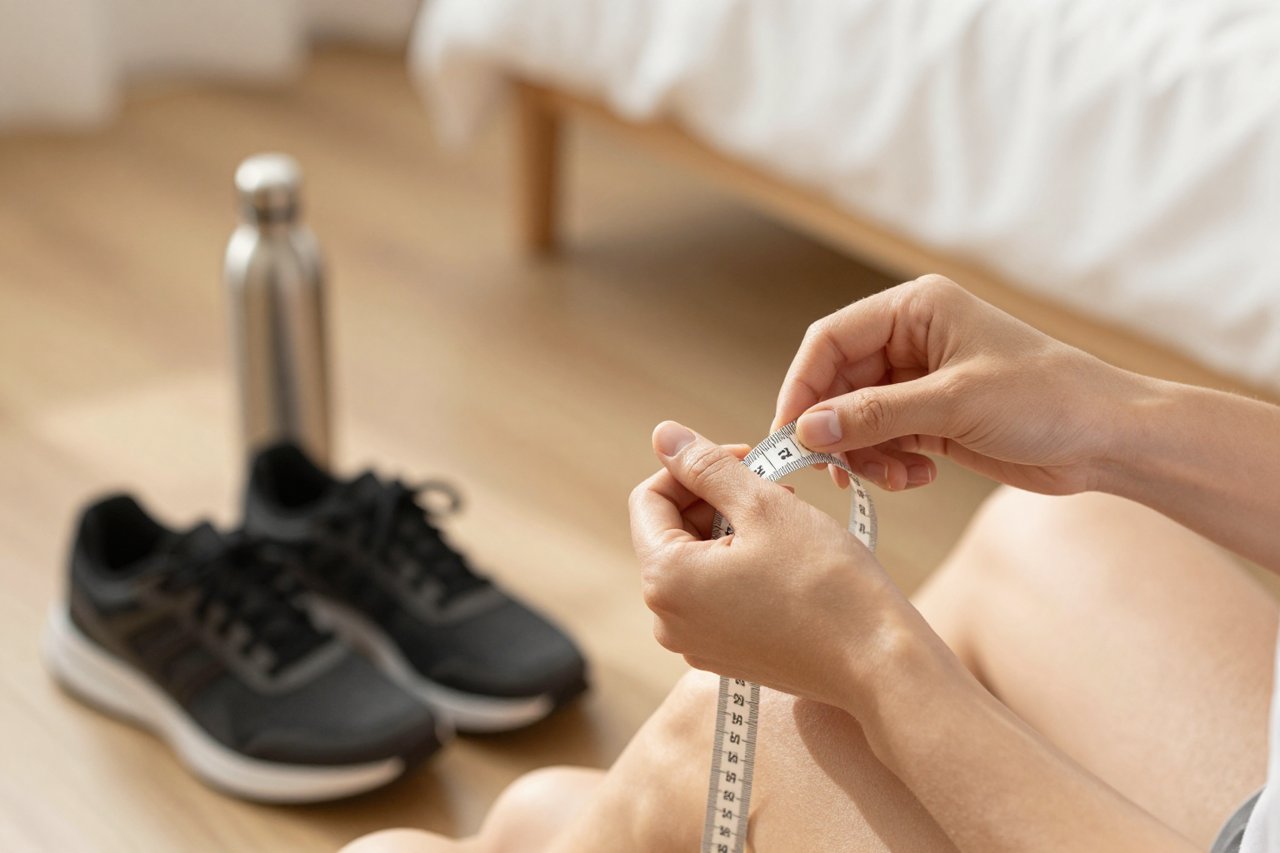
A soft tape measure is the cheapest useful tool you own. Measure your waist at the navel, hips at the widest point, chest at the fullest part, mid-bicep with the arm relaxed, and thigh 10 cm above the kneecap. Write the numbers down, wait a minute, and measure each site again. Use the second set. Tension on the tape varies and the average of two readings is more honest than one.
Do this once a month, ideally on the same date. A flat waist with a growing thigh is a very different story from a shrinking waist and a shrinking thigh, and it tells you what to adjust: more lifting, more walking, or a closer look at how much you’re eating.
Strength Is the Most Honest Number You Have
Lifting more weight, or more reps at the same weight, is objective proof that your training is doing something. Log every session, even in the notes app on your phone: the exercise, the weight, the sets, the reps. In January you might squat 3 sets of 8 at 40 kg. In April, 3 sets of 8 at 47.5 kg. Nothing about that jump is ambiguous, and no amount of water retention can fake it.
Track bodyweight movements too. Push-ups before and after, the number of unbroken reps, how long you can hold a plank, how many pull-ups you can do with a band. If your program feels stale and you’re not sure it’s working, it may be time to revisit building an exercise routine you’ll still be doing in five years, because the plan you can progress on beats the plan that looks impressive on paper.
Watch How You Move Through Ordinary Days
Fitness is functional, and the evidence usually shows up outside the gym. Your resting heart rate from a watch or ring, the pace you keep on a familiar 5 km loop, how long it takes to climb the stairs at work, how quickly you recover between sets. Take a three-minute walk and time it once a month. It’s a surprisingly sensitive gauge of aerobic fitness.
Wearables can help here, provided you don’t hand them your self-worth. If the readiness score has started dictating your mood, there’s a good way to keep the useful data and drop the anxiety, covered in using fitness trackers without losing touch with yourself. The number should inform a decision, not make it for you.
The Quiet Metrics: Energy, Sleep, and Appetite
Once a week, score five things from 1 to 5: morning energy, sleep quality, hunger through the day, muscle soreness, and mood. It takes 30 seconds and builds a trend line nobody else can see. Four weeks of 3s turning into 4s is a real result. So is hunger that’s dropped from a snarling 5 to a manageable 3, which often means protein and fibre have landed where they need to.
Add anything else that matters to your life: fewer headaches, better posture at your desk, knees that no longer ache on the stairs, fewer colds over the winter. These are the outcomes people actually want, and they rarely show up on a scale.
Build a Dashboard You’ll Actually Update
The failure mode is tracking 14 things for 11 days. Pick four or five and put a recurring date in your calendar.
- Every session: weights, sets, reps. Nothing else.
- Weekly: the five 1–5 scores, plus a step-count average if you wear a tracker.
- Monthly: tape measurements, a timed walk or stair climb, and a skim of your training log.
- Every four weeks: photos, then a 15-minute review on a fixed date.
At that review, ask one question: which metric moved, and which didn’t? If you’d rather have structure and company than a spreadsheet, programmes with a community behind them do a lot of this for you, and real stories from women in the Love Sweat Fitness community show what that kind of accountability looks like week to week.
What to Do When the Numbers Stall
Two flat weeks is not a plateau. Four to six flat weeks across every metric is. When that happens, work through the boring checks first: sleep under seven hours, protein lower than you think, stress through the roof, or a training plan that hasn’t changed in months. A deload week often breaks a stall better than adding more work does.
If fat loss is the actual goal and the waist tape has stopped moving for six weeks, the fix is usually a modest calorie adjustment rather than a drastic one. The principles behind that are worth understanding properly before you cut anything, and weight loss that actually lasts is a sensible place to start rather than guessing.
The Metric Nobody Puts on a Chart
How many sessions did you complete against how many you planned? Twelve out of sixteen is fine. Sixteen out of sixteen is better. Nine out of sixteen over two months is the reason nothing else is moving, no matter how good the programme is.
Consistency is the input every other measurement depends on. So put it on the list, right at the top, and review it with the same cold eye you’d give a waist measurement. A woman who shows up three times a week for a year, imperfectly and without much drama, will out-progress almost anyone chasing a perfect four-week plan. If you’re still working out how to start, begin with something small enough that skipping it feels strange, and let the numbers above tell you the rest.


