
Table of Contents
CoQ10 turns up on more supplement shelves than almost anything else, usually with a vague promise about energy and a price tag that makes you hesitate. The part most labels skip is that your body already makes the stuff, in every cell you own, and it’s doing a specific chemical job that has nothing to do with caffeine-style energy.
So what is it, why does the internet argue about it, and is there any honest reason to buy a bottle? Here’s the from-scratch version.
What CoQ10 actually is, in about a minute
Coenzyme Q10 goes by a few names: CoQ10, ubiquinone, ubiquinol. All three refer to the same fat-soluble molecule living inside the mitochondria of nearly every cell you have. “Ubiquitous” is the root of the name, and it fits the behaviour.
It has two jobs. The first is mechanical: it shuttles electrons along the mitochondrial chain that produces ATP, the energy currency your cells spend. Remove it and that assembly line stalls. The second is protective. As a fat-soluble antioxidant, CoQ10 neutralises free radicals inside cell membranes and helps stop LDL cholesterol from oxidising, which is one of the earlier steps in artery disease.

Your body builds its own supply from tyrosine, an amino acid, through a chain of reactions that needs vitamin B2, B6, B12, folate, niacin and vitamin C to run properly. That detail matters more than it sounds. A diet running short on those nutrients can leave the production line below full capacity.
Why the heart gets mentioned so often
Your heart beats roughly 100,000 times a day and never takes a shift off. Heart muscle carries some of the highest CoQ10 concentrations in the body, which is exactly what you’d expect from tissue that burns fuel relentlessly. When researchers measure CoQ10, cardiac tissue and the liver tend to come out on top. If the energy-producing role of this coenzyme is the reason people connect it to stamina and heart health, that tissue distribution is the sensible explanation.
There’s a second factor: production drops with age. Many people in their sixties and seventies have measurably lower levels than they did in their twenties. It’s a gradual slide, not a cliff, but it explains why CoQ10 is marketed so heavily to older adults.
The benefits with the strongest evidence behind them
CoQ10 has been studied for decades, which means the evidence is uneven. Some claims are well supported, some are thin, and a few have quietly fallen apart. Here’s the honest ranking.
Heart failure support
This is the standout. A trial published in 2014 followed 420 people with chronic heart failure who took 300 mg of CoQ10 daily for two years alongside standard treatment. The group on CoQ10 had significantly fewer major cardiac events and fewer deaths. It’s one of the few supplement trials in cardiology substantial enough to change clinical guidelines in some countries. Note the dose: 300 mg, not the 30 mg on a cheap drugstore label.
Modest blood pressure effects
Pooled analyses of smaller trials show systolic pressure dropping by roughly 3 to 4 mmHg in people with existing hypertension. That’s real but small, comparable to cutting back on salt. It won’t replace medication, and it does little in people whose blood pressure is already normal.
Migraine prevention
Mitochondrial dysfunction is thought to play a role in migraine, which is why CoQ10 was tested as a preventive. Trials in children and teenagers found a meaningful reduction in migraine days at 100 mg three times daily. Adult results are more mixed but generally point in the same direction. It’s often used alongside riboflavin and magnesium for this purpose.
Statin-related muscle aches
Statins block the same metabolic pathway that produces cholesterol, and CoQ10 is made downstream of that block. This is why the deficiency theory exists. Reality is messier: some trials show benefit for muscle pain, others show none, and a large 2018 meta-analysis found the support weaker than hoped. It’s worth a supervised trial for someone with genuine symptoms, not a guaranteed fix.
Egg and sperm quality
Fertility clinics sometimes add CoQ10 to protocols, particularly ubiquinol for women preparing for IVF, on the theory that eggs are energy-hungry and vulnerable to oxidative stress. Small trials report improvements in sperm motility too. Promising, but the studies are small and the marketing has run well ahead of the data.
Everyday fatigue
This is the claim with the thinnest evidence base. If you have a diagnosed deficiency, correcting it can help. If your levels are normal and you’re simply tired, a capsule is unlikely to be the answer.
Real food sources, with honest numbers
CoQ10 exists in food, but the quantities are sobering once you compare them to a 100 mg capsule.
- Beef heart — about 11 mg per 100 g, the richest common source, though few people eat it weekly
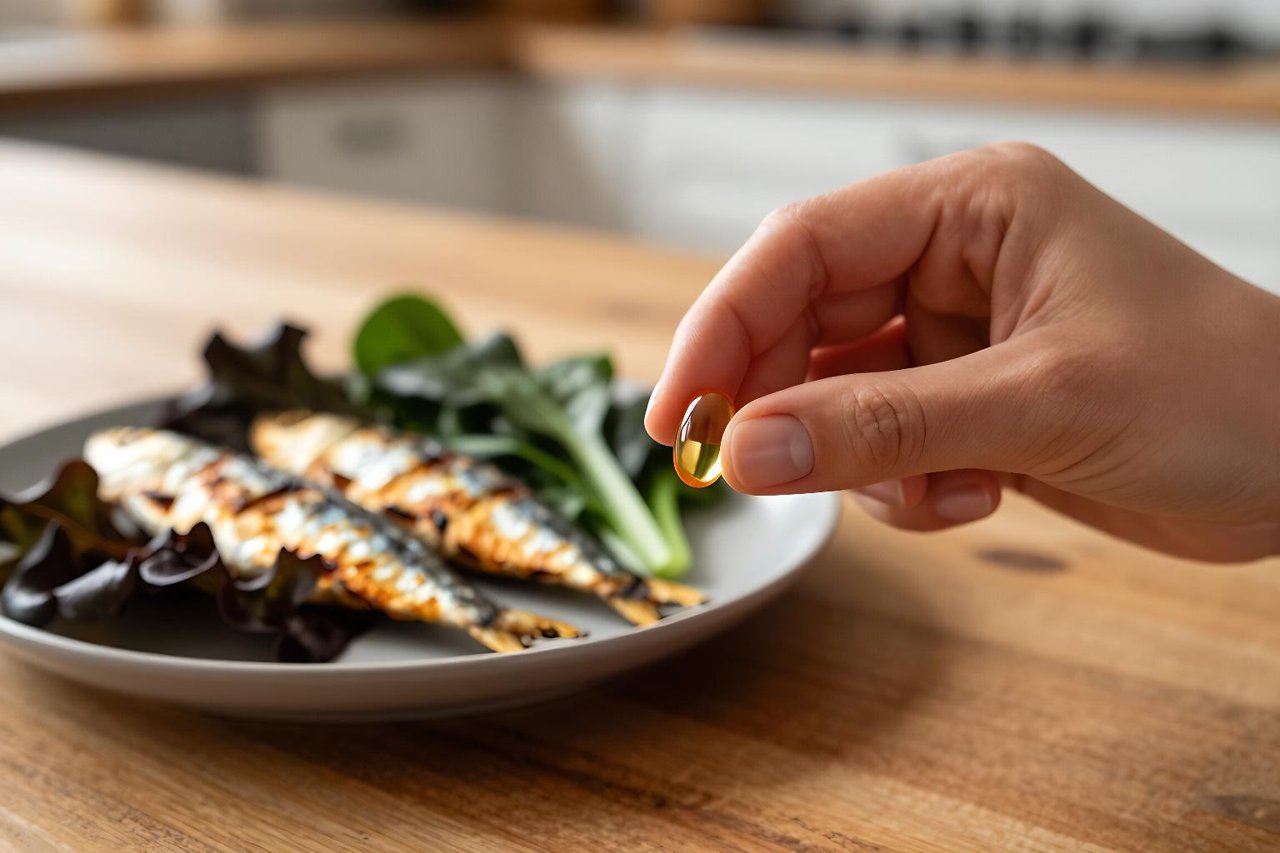
- Sardines and mackerel — roughly 5 to 6 mg per 100 g
- Chicken thigh — around 2 mg per 100 g
- Broccoli and spinach — under 1 mg per 100 g
- Eggs and nuts — small amounts, easily lost to cooking
You can hit 20 to 30 mg a day with a seafood-heavy diet. Reaching therapeutic territory through food alone would mean eating sardines at every meal, which is not a plan most people stick to.
Why swallowing a capsule doesn’t guarantee absorption
CoQ10 is fat-soluble, bulky at the molecular level, and poorly absorbed. A dry powder tablet taken on an empty stomach might deliver a small fraction of what the label claims. Fat helps, so does a softgel suspended in oil, and so does splitting the dose across the day rather than taking it all at once. Several of the most common slip-ups, from timing to storage, are covered in this breakdown of everyday mistakes that cancel out CoQ10 benefits.
Ubiquinol versus ubiquinone: does the form matter?
Ubiquinone is the oxidised form found in most cheap supplements. Ubiquinol is the reduced, antioxidant-ready version, and it costs noticeably more. The theory is that older adults convert ubiquinone to ubiquinol less efficiently, so buying the pre-converted form makes sense past a certain age. Some trials support the idea, others show plain ubiquinone working fine at adequate doses. If you’re weighing the price gap, this comparison of ubiquinol, ubiquinone and the cheaper options lays out where the extra money buys something real.
Who’s most likely to notice a difference
Not everyone responds the same way, and pretending otherwise is how people end up disappointed.
- People over 60, whose natural production has declined
- Anyone taking a statin, especially with muscle complaints
- People with diagnosed heart failure, under medical supervision
- Frequent migraine sufferers willing to give it eight to twelve weeks
- Those with low dietary intake of the B vitamins needed to make it
Healthy, well-fed 25-year-olds with normal lab work are the least likely to feel anything. That group also happens to be the biggest buyer of supplements, which tells you something about marketing.
Starting sensibly rather than randomly
The usual mistake is buying the cheapest bottle, taking it inconsistently with breakfast and coffee, and concluding after nine days that it doesn’t work. CoQ10 needs a fat-containing meal, a realistic dose (100 to 200 mg is a common starting point, higher for specific conditions under guidance), and a fair trial of at least eight weeks. If you’d rather not guess, this step-by-step approach to getting real CoQ10 benefits removes most of the trial and error.
Worth knowing too: CoQ10 plays well with others. It’s often paired with a basic multivitamin because the same B vitamins needed to manufacture it are the ones most commonly under-supplied in a typical diet, which is roughly the argument made in weighing multivitamin benefits against the alternatives. It also interacts with warfarin, so anyone on blood thinners should talk to their doctor before starting.
How to tell within two months whether it’s working
Vague promises deserve vague results, so pick something measurable before you open the bottle. Migraine sufferers can count headache days per month. Statin users can rate muscle discomfort on a simple 1-to-10 scale each evening. Anyone taking it for blood pressure can log readings twice a week at the same time of day.
Write the baseline down first, run the trial for eight weeks at a consistent dose taken with food, then compare. If nothing moved, you’ve got a clear answer and a few hundred dollars back in your pocket each year. If something did move, you also have a reason to keep going that isn’t just a label on a bottle.


