
Table of Contents
A reader emailed me last spring. She’d taken 200mg of CoQ10 every morning for eleven months, spent roughly £340 on it, and felt exactly the same. Same afternoon slump. Same aching legs on the hills near her house. Same sleep.
Her story isn’t unusual. CoQ10 has real evidence behind it, and it’s also one of the easiest supplements to take in a way that quietly erases most of the upside. These are the mistakes I see most often, roughly in order of how much they cost people.
Mistake one: swallowing it with water on an empty stomach
CoQ10 is fat-soluble and crystalline, which means your gut handles it badly. Absorption from a standard capsule is often quoted at somewhere between 2% and 5%. You can improve or wreck that number based on what’s on the plate next to it.
In one often-cited crossover study, taking CoQ10 with a fatty meal raised absorption roughly threefold compared with taking it fasted. Threefold. That’s the difference between 100mg doing something and 100mg doing very little.

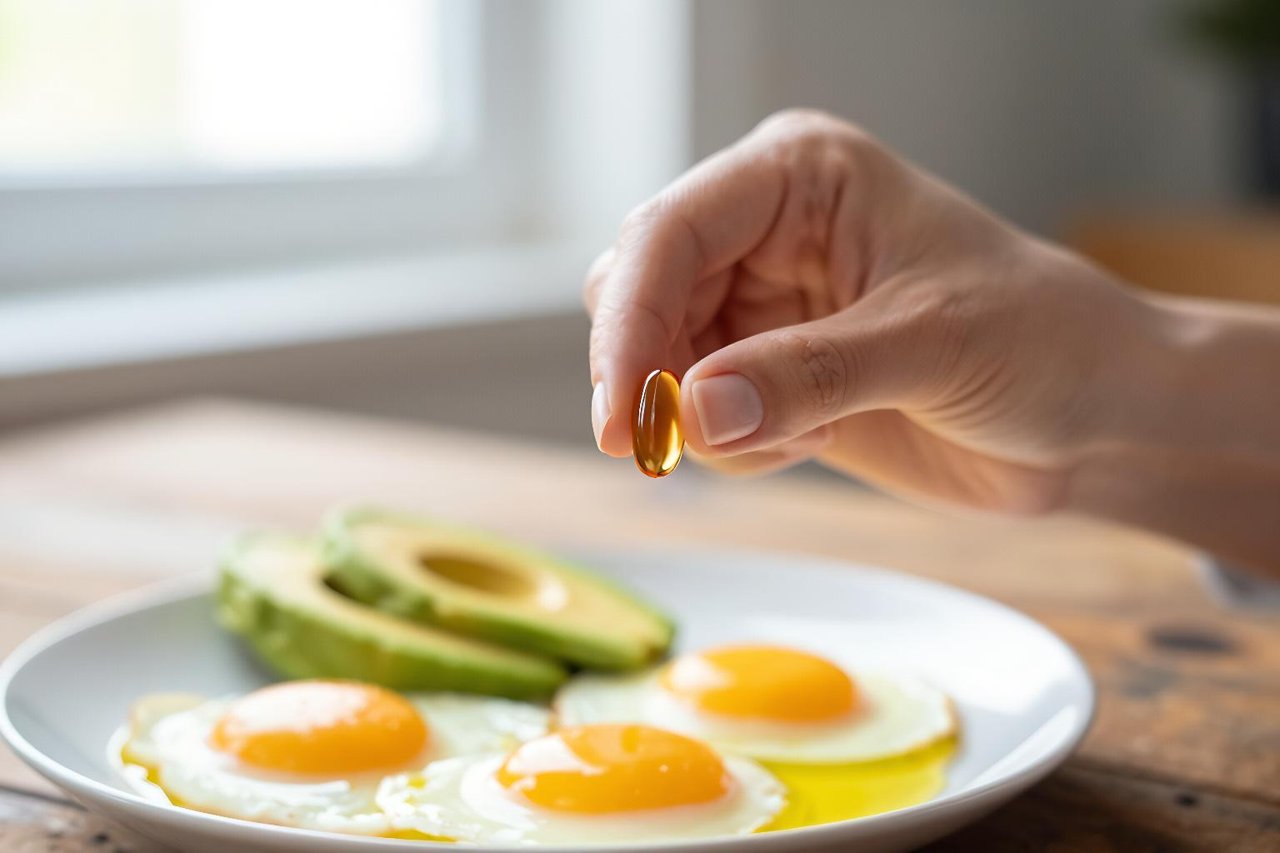
Practical version: take it with a meal that contains real fat. Eggs, full-fat yogurt, olive oil, avocado, oily fish, a knob of butter on toast. If you train fasted at 6am and pop the capsule with a glass of water before you leave, you’ve picked the single worst moment of your day. Move it to the meal afterwards. This one change costs nothing and is the most common reason people notice a difference after switching nothing else.
Mistake two: assuming ubiquinol is a stronger dose
Ubiquinol and ubiquinone are the same molecule in different oxidation states. Ubiquinol is the reduced form, the one your body actually uses in the mitochondrial membrane, and your body converts ubiquinone into it. That conversion gets less efficient with age and varies a lot between individuals.
What ubiquinol is not, however, is a double-strength version. 100mg of ubiquinol is not 200mg of ubiquinone. Some trials in older adults show higher plasma levels from ubiquinol at the same milligram dose, and some show barely any difference. Meanwhile the price gap is often two to three times.
My rule of thumb: under 40 and generally healthy, plain ubiquinone taken with fat is a sensible starting point. Over 60, or already taking a statin, or someone who tried ubiquinone for three months and noticed nothing, ubiquinol is worth the extra. If you want the detail on how the forms compare and where the cheap options genuinely hold up, there’s a fuller breakdown of ubiquinol versus ubiquinone and the cheaper alternatives.
Mistake three: judging it after ten days
CoQ10 is not caffeine
People expect a lift within a week. What they get, if anything, is a slow shift over two to three months as tissue levels build. Clinical trials almost always run 8 to 12 weeks before measuring anything, and that’s not arbitrary.
It’s also worth knowing what researchers actually measure. Not a buzz. Usually fatigue scores, perceived exertion, walking distance, or markers like blood pressure and inflammatory markers. The benefits of CoQ10 in the literature tend to be modest and cumulative rather than dramatic and immediate.
The failure mode is predictable. Two weeks in, nothing happens, so you either quit or double the dose. Both are worse than simply giving it twelve weeks at a steady dose.
The statin myth that refuses to die
Statins block the mevalonate pathway, which is the same pathway your body uses to make CoQ10. So yes, statins lower circulating CoQ10. That part is true, and it’s why the supplement gets recommended so often alongside them.
Where the story falls apart is the leap from blood levels to symptoms. Plasma CoQ10 is a poor proxy for what’s happening inside muscle tissue, and when researchers have tested CoQ10 against placebo for statin-associated muscle pain, the results have been largely disappointing, with most larger trials finding little or no difference in pain scores.
None of that means it’s pointless. It means it’s not a fix for statin muscle pain, and it is absolutely not a reason to stop or skip a statin. If you want to try 100–200mg for three months alongside your prescription, that’s a low-risk experiment worth running with your GP informed.
Mistake four: assuming more is better
Absorption is saturable. Going from 100mg to 300mg does not reliably triple your plasma level, and going to 600mg mostly triples your spending. For general use, most of the research sits in the 100–200mg range, with 300mg appearing in some heart failure and blood pressure work.
Higher doses do have their place, but usually under medical supervision for specific conditions, not as a personal upgrade because 100mg felt like nothing after a fortnight.
Mistake five: not checking what it does to your medication
This is the one that actually matters for safety. CoQ10 is not inert, and it has a few documented interactions worth knowing before you add it to a stack.
- Warfarin. CoQ10 is structurally similar to vitamin K and has been reported to reduce INR in people on warfarin. If you’re anticoagulated, this needs a conversation and probably closer monitoring, not a DIY trial.
- Blood pressure medication. CoQ10 has a modest blood-pressure-lowering effect of its own. Stacked on top of two or three antihypertensives, that can tip into lightheadedness when you stand up.
- Chemotherapy and radiotherapy. CoQ10 is an antioxidant, and the timing question around antioxidant supplements during treatment is genuinely unresolved. Ask your oncologist rather than guessing.
- Thyroid medication and diabetes drugs. Less dramatic, but worth flagging to your pharmacist alongside everything else you take.
Mistake six: shopping by bottle price instead of dose
A £9 bottle that contains twelve 400mg capsules is not cheaper than a £24 bottle of 120 x 100mg softgels. Work out price per 100mg and the illusion collapses immediately.
Three things are worth checking on the label. First, milligrams of actual CoQ10 per capsule, not the weight of the “proprietary blend”. Second, whether the product has been third-party tested by USP or NSF, which is your only real assurance of what’s in the pill. Third, the format: softgels suspended in an oil base generally absorb better than dry powder tablets, and CoQ10 degrades with light, so a dark or opaque bottle is a good sign rather than a marketing quirk. If you’d rather skip the label-reading, this roundup of CoQ10 supplements for heart health and energy covers the formats and doses that hold up.
Mistake seven: treating it as a substitute for the boring stuff
CoQ10 is a small lever. Diet supplies somewhere around 3–6mg a day from organ meats, oily fish and beef, which is why supplementing at 100mg+ is a completely different order of magnitude from food. But a capsule cannot outrun seven hours of sleep, no resistance training, and an untreated iron or B12 deficiency.
If fatigue is the problem you’re trying to solve, get the basics sorted first. Sleep, protein, some form of strength work twice a week, and a blood test. A cheap multivitamin compared against the alternatives often covers more ground for less money than an expensive single-ingredient supplement taken in isolation. CoQ10 earns its place on top of that foundation, not instead of it, which is exactly the logic behind this step-by-step approach to getting real CoQ10 benefits.
How to run a fair test on yourself
Most people who “tried CoQ10 and it did nothing” never actually tested it. They took it inconsistently, changed three other things at once, and judged the result on a vague feeling. Here’s a cleaner version.
- Pick one outcome. Time to walk a familiar hill. Number of stairs before your legs complain. A 1–10 fatigue score logged every Sunday. Grip strength. Anything that produces a number.
- Record a baseline for two weeks before you start. Without this, you have nothing to compare against and your memory will lie to you.
- Take 100–200mg with a fat-containing meal, same time daily, for twelve weeks. No dose changes mid-run.
- Change nothing else. No new gym programme, no new sleep supplement, no cutting out coffee. One variable.
- Decide at week twelve. If your number hasn’t moved, you’ve learned something useful and you can stop spending the money.
The reader from the start of this piece did eventually get an answer. She moved her capsule from a fasted 6am to breakfast with eggs, switched to 100mg of ubiquinol, and at week twelve told me the hill felt easier. She’d also started walking with a neighbour twice a week, which is precisely why you track a single number and change one thing at a time. Her honest conclusion was that she couldn’t fully separate the two. That’s fine. At least now she knows what she’s paying for.


