
Table of Contents
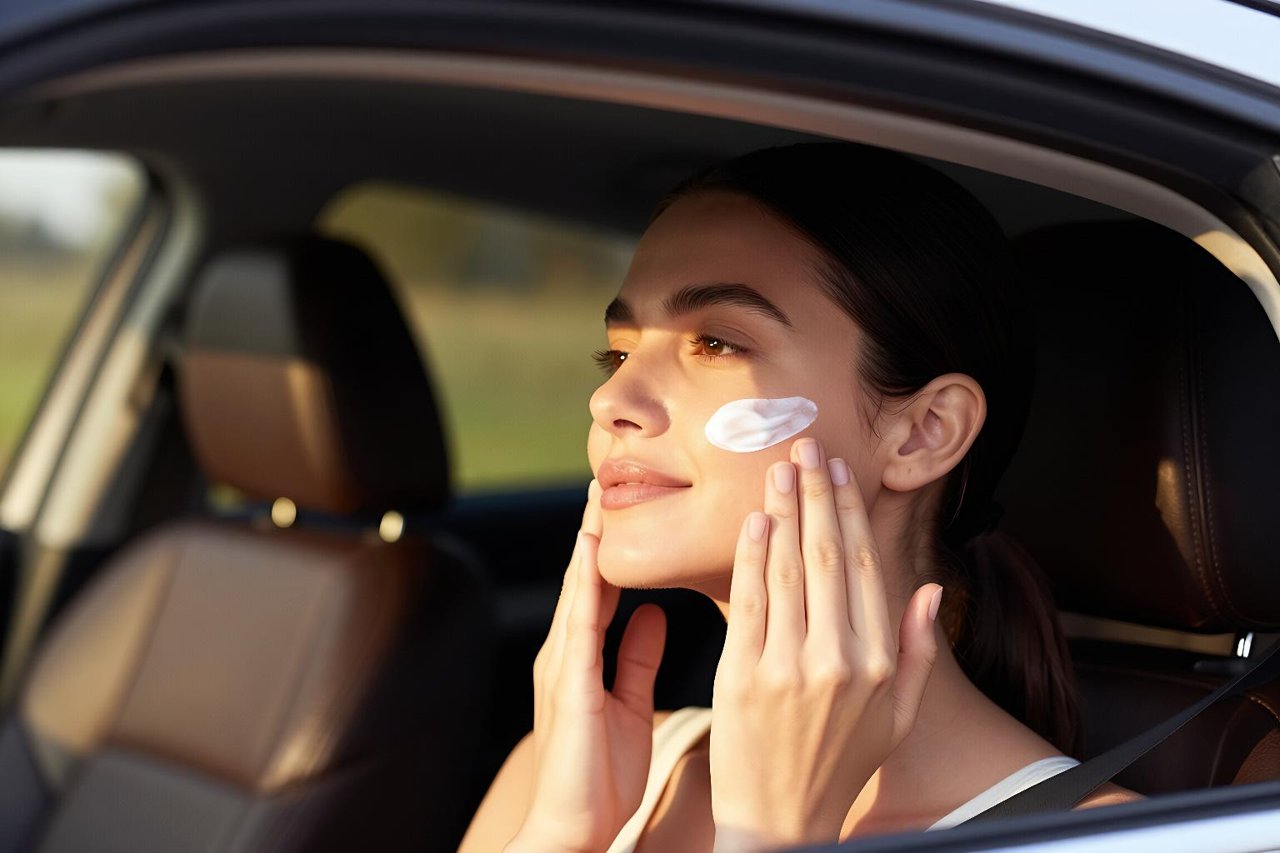
Park somewhere with even light and look closely at both sides of your face in the mirror. For most people who drive regularly, the left side has more freckles, a few extra lines around the eye, and often a sunspot near the temple. That asymmetry shows up in dermatology clinics constantly. A 2007 study in the Journal of the American Academy of Dermatology looked at 898 US adults and found significantly more left-sided facial aging and more left-sided skin cancers among people who spent a lot of time behind the wheel. Truckers, delivery drivers, sales reps on the interstate: same pattern.
The cause is straightforward. Your car blocks the part of sunlight that burns you and lets through the part that ages you.
Why Car Windows Don’t Protect You
Windshields are laminated glass and absorb nearly all UVB, which is why you can drive four hours and not come out looking like a lobster. Side and rear windows are usually tempered instead, and they let a much bigger share of UVA through.
UVA is the one that reaches the dermis. It doesn’t sting, doesn’t turn skin pink in the moment, and doesn’t feel like anything at all. What it does over years is break down collagen, drive up pigmentation, and add to skin cancer risk. Cloud cover doesn’t stop it. Air conditioning doesn’t stop it. Sitting in the shade of the roof doesn’t help when the sun is coming in at an angle through the driver’s door.

If you commute 40 minutes each way, that’s roughly six and a half hours of cumulative sun exposure per week aimed at one side of your body. Ten years of that adds up.
Start With Sunscreen, Applied Properly
Broad-spectrum SPF 30 or higher, every morning, whether it’s sunny or grey. The trick is using enough. Most people dab on maybe a quarter of the amount used in lab testing, which downgrades an SPF 50 to something closer to SPF 12 in practice. For the face and neck you want roughly the length of two fingers of product, and it’s worth reading up on how much sunscreen you actually need on your face because the real number surprises almost everyone.
Cover the ears, the back of the neck, the part line in your hair, and the tops of your hands. Those are the spots that get missed every single morning.
Make It Automatic, Not a Decision
The habit that survives busy mornings is the one that requires no thought. Keep a sunscreen stick in the driver’s door pocket and a small tube in the centre console. Apply before you pull out of the driveway, and touch up at fuel stops on longer trips. A stick is easier than a cream for the ears, nose, and hands because you can apply it one-handed in about 20 seconds.
Window Tint and UV Film Do the Heavy Lifting
This is the single highest-impact change you can make to the car itself. Quality ceramic window film rejects up to 99% of UV radiation and cuts heat at the same time, which means less glare and a cooler cabin. You can also get clear, nearly invisible UV film for the windshield in many markets.
Check your local rules first. Most US states restrict how dark the front side windows can be, measured as visible light transmission, but clear UV film usually falls outside those limits since it doesn’t darken the glass. Worth a five-minute search before you book the installer.
Cover the Parts You Always Forget
Clothing beats reapplication when you’re driving for hours. A lightweight UPF 50 sleeve or a thin long-sleeve layer on the sun-facing arm solves the problem completely, and it won’t make you overheat with the AC running.
- UPF-rated driving gloves or arm sleeves for long trips
- Wraparound sunglasses rated UV400, ideally with side coverage
- A cap or wide-brim hat to shade the face and scalp
- SPF 30 lip balm, reapplied at every stop
- A spare long-sleeve shirt kept in the car for unexpected sunny drives
Sunglasses matter more than people realise. The skin on your eyelids is the thinnest on your body and a common site for skin cancers, and good lenses also reduce the squinting that deepens crow’s feet over time.
Your Hands Are Taking the Worst of It
Think about it: your hands sit on the wheel, angled toward the window, for the entire drive. The back of the hand gets years of cumulative exposure, and it’s one of the first places to show age spots and thinning skin. Most people never put sunscreen there.
Add a hand cream with SPF to the console and use it before you set off. At rest stops, skip the harsh industrial soap in the restroom dispensers where you can, since stripping your skin barrier before another hour of dry cabin air is a bad combination. A gentle moisturizing hand soap in your own car kit is a small upgrade that pays off if you’re on the road daily.
Air Conditioning Is Quietly Drying You Out
Cabin air conditioning pulls moisture out of the air, and after an hour your skin barrier feels it: tightness across the cheeks, flaking around the nose, lips that crack by the time you arrive. Dehydrated skin also repairs UV damage less efficiently, so this isn’t purely cosmetic.
Layer a hydrating formula under your sunscreen in the morning. If you like a multi-step approach, the Korean skincare routine principles of thin hydrating layers work well here, since several light layers hold moisture better than one heavy cream under makeup. Point the vents away from your face and toward the windscreen or your chest instead.
Post-Drive Repair That Actually Helps
After a long drive, especially in summer, your skin is warm, dehydrated, and carrying a fresh dose of oxidative stress. Rinse with cool water rather than hot. Apply an antioxidant serum such as vitamin C in the evening to help mop up free radicals. Aloe or a soothing gel with panthenol calms any redness around the window-facing cheek.
Once or twice a week, a hydrating mask helps restore what the cabin air pulled out. A good collagen mask used consistently is a reasonable addition to that routine, mostly for the hydration and plumping rather than any magic. Skip harsh scrubs on pigmented areas, since aggressive exfoliation can make sun-driven dark patches worse.
Free Wins: Timing, Parking, and Glare
None of this costs anything. Check the UV index before a long drive and, in summer, aim to travel before 10am or after 4pm when the sun sits lower. Park with the driver’s side facing away from the afternoon sun where you can. A reflective windscreen shade keeps the cabin cooler, which means less heat stress on your skin and less squinting when you get back in.
Dashboard glare is another one people underestimate. Light bouncing off a pale dash or a glossy phone mount adds indirect UV to your face. A matte dash cover solves it in about ten seconds.
If You Drive for a Living
Professional drivers need a routine that runs on autopilot. Treat it like a checklist: sunscreen stick on face, ears, neck, and hands before the first mile; UPF sleeve on the window-side arm; sunglasses on; tint booked; water bottle within reach. Reapply at every second stop. Book a annual skin check with a dermatologist and specifically ask them to compare the left and right sides of your face and hands, because that comparison tells a story your own eyes tend to miss. For anything that looks new, changing, or unevenly pigmented, get it looked at rather than waiting for next year’s appointment.


