
Table of Contents
A 7 a.m. trail run in July. Four hours of snorkelling off Cozumel. A bluebird ski day at 2,700 metres. Three completely different days in the sun, and the same quiet failure point: the bottle sitting in your bathroom cabinet, chosen for a commute rather than for any of this.
Outdoor sunscreen has a harder job than daily sunscreen. It has to survive sweat, water, wind, grit, a towel, and your own hands rubbing your face. It has to be pleasant enough that you’ll actually reapply at hour three, when you’re tired and halfway up a ridge. Choosing well takes about ten minutes of clear thinking.
Start With How You’ll Sweat, Not the SPF Number
SPF measures protection against UVB, the burning rays. The maths is unforgiving in a useful way. SPF 30 filters roughly 96.7% of UVB, SPF 50 about 98%, and SPF 100 around 99%. That gap sounds trivial until you remember the leftover percentage is what reaches your skin across a five-hour hike.
Two things most people don’t know:

- Lab SPF is measured at 2 mg per square centimetre. Real-world application usually lands between 0.5 and 1 mg. Halve your dose of an SPF 30 and you’re effectively wearing something closer to SPF 8.
- Higher SPF formulas cushion sloppy application, which is why dermatologists tend to recommend SPF 50 for long days outside.
For a 30-minute dog walk, SPF 30 is fine. For a full day of climbing, sailing or beach volleyball, go 50 and reapply on schedule.
Broad Spectrum Is a Lab Test, Not a Marketing Word
UVB burns you. UVA ages you, and it’s the wavelength that pushes through cloud, glass and the top layer of water. UVA is also steady through the day; it doesn’t peak at noon the way UVB does, so a late-afternoon session still delivers a full dose.
Look for one of these on the label:
- Broad spectrum on a US product, meaning it passed the FDA’s critical wavelength test.
- PA++++ on Asian and European formulas, the top UVA rating in that system.
- A Boots star rating of four or five on UK formulas.
Mineral filters such as zinc oxide at 15–20% cover both ranges on their own. Chemical formulas usually pair two or more UVA filters, avobenzone with octocrylene for example, or rely on newer filters like Tinosorb S.
Water Resistance Has Two Numbers, and Neither Means Waterproof
Water resistance is tested at either 40 or 80 minutes of immersion. That’s the entire scale. Since 2011, US labels have been barred from claiming waterproof or sweatproof status, because no formula survives indefinite exposure.
If your activity involves repeated immersion, paddling, surfing or open-water swimming, buy the 80-minute version and mentally treat it as a 60-minute product. For dry activities with heavy sweating, water resistance still helps, because sweat dissolves sunscreen the same way water does. A water-resistant SPF 50 will outlast a cosmetically elegant daily moisturiser with SPF by a wide margin on a hot climb.
Match the Formula to the Activity
Lotion
The reliable default. Best coverage per gram, easiest to measure, simple to apply to a full body before you leave the car. Slightly heavier on the skin, which is the price of staying put.
Stick
Excellent for the face, ears and hairline while moving, and it won’t run into your eyes when you sweat. The catch is under-application. Four passes back and forth over a cheek, not one quick swipe.
Gel and fluid
The right call for humid heat, heavy sweating, and anyone prone to breakouts across the shoulders and back. Check that a gel is water-resistant; plenty of them aren’t.
Spray
Useful for topping up hairy legs or a squirmy child, but a poor primary application. Wind carries a good share of the mist away and most people never rub it in. Never spray directly onto your face; spray into your hands first.
If your skin reacts to everything you’ve tried, this guide to the best sunscreen for face and sensitive skin narrows the field considerably.
Application Is Where Most People Lose
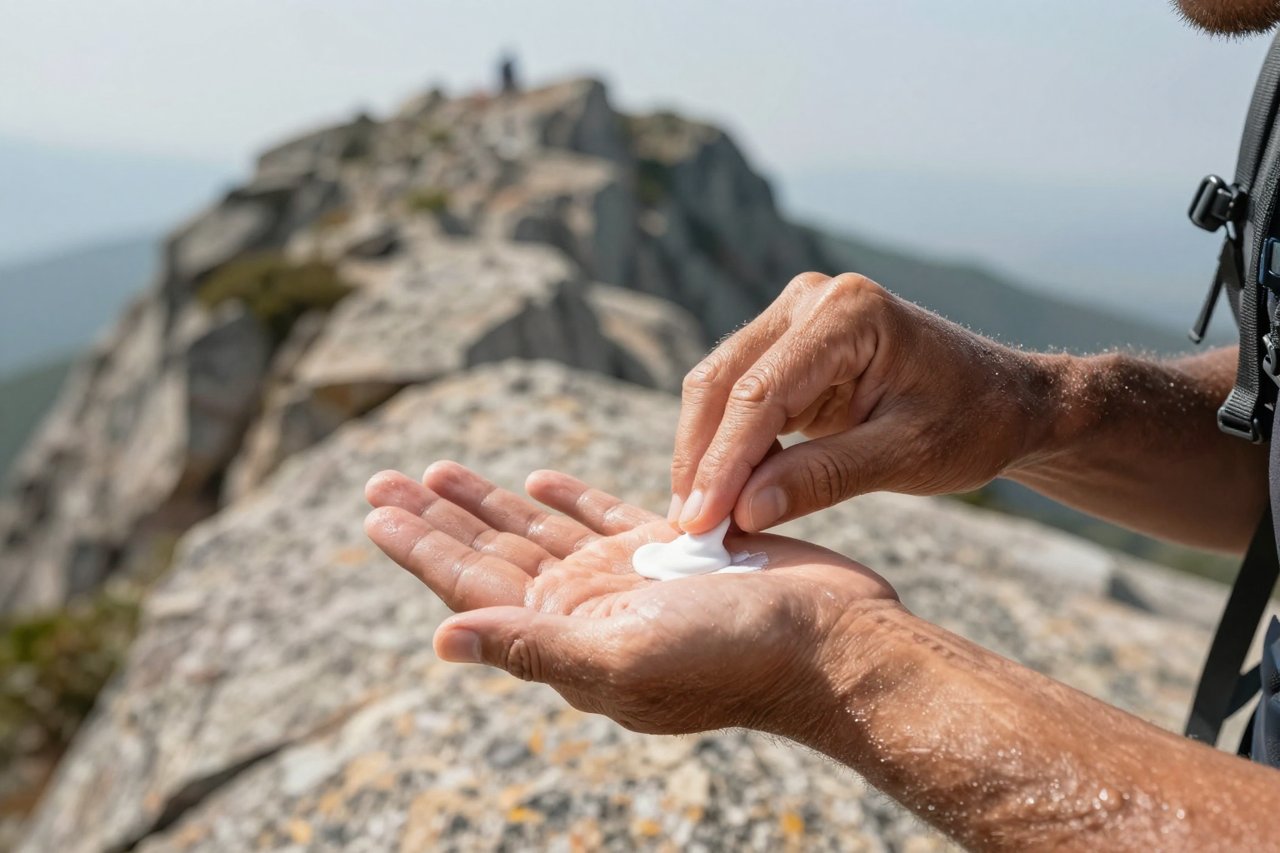
Here’s the number that surprises people: a full body needs about 30 ml per application, roughly a shot glass. Most of us use a quarter of that. For the face and neck alone, the two-finger rule is a decent measure, a line of product running the length of your index and middle fingers.
Everything else is technique:
- Apply 15–20 minutes before heading out so it binds to skin instead of sweating straight off.
- Reapply every two hours of exposure, and immediately after swimming, heavy sweating or towelling off.
- Check the expiry date. Sunscreen degrades, and a bottle that has baked in a car for two summers is not delivering what the label promises.
- Don’t skip the back of the neck, the tops of the ears, the part in your hair, the backs of your hands, and the tops of your feet in sandals.
Lips burn too. A dedicated SPF 30+ lip balm earns its pocket space, and it’s the most-forgotten item on every packing list.
The Conditions That Quietly Double Your Dose
UV intensity climbs roughly 10–12% for every 1,000 metres of elevation, so an alpine start at 3,000 metres puts you in levels you’d normally associate with the tropics. Snow is worse: fresh snow reflects 80–90% of UV, which is why skiers and mountaineers burn under the chin and around the nostrils.
Water reflects 10–25%, sand around 15%, and cloud is a weak filter, with thin overcast still transmitting 70–80% of UV. Foggy coastal hikes catch people out for exactly that reason, and anyone who has walked routes like these things to do in Nova Scotia knows how fast a grey sky becomes a pink nose.
Some medications raise photosensitivity, including certain antibiotics, retinoids, diuretics and NSAIDs. If you take any of them, treat SPF 50 as non-negotiable. UV also matters in winter, which makes getting enough sunlight in the winter a genuine balancing act between exposure and protection.
Salt Water, Reefs and the Environmental Question
If you swim in the ocean, especially around coral, skip oxybenzone and octinoxate. Hawaii and several other destinations restrict them, and reef-safe labelling has become meaningful rather than decorative. Mineral formulas built on non-nano zinc oxide are the safest bet. On a snorkelling trip like these things to do in Cozumel, a reef-safe 80-minute formula is the practical choice for both you and the water.
Skin Type Changes the Answer
Oily and acne-prone skin does better with gels, fluids and non-comedogenic labels. Dry skin wants cream formulas with glycerin or ceramides. Anyone dealing with melasma, rosacea or a personal history of skin cancer should be on a tinted mineral formula with iron oxides, which block visible light as well as UV. There’s a fuller breakdown in this guide to the best sunscreen for every skin type if you’d rather match formula to skin than to activity.
Test It Before the Big Day
Buy your outdoor sunscreen two weeks before the trip, not the night before. Wear it on an ordinary day first and check three things: whether it stings your eyes when you sweat, whether it pills under a hat brim or a pack strap, and whether your skin reacts at all. A formula that fails any of those tests is a formula you’ll quietly abandon by day two.
Then buy two. One full-size bottle for the pack, one small stick for a pocket. The sunscreen you actually reapply is the sunscreen that works, and convenience is the single variable that reliably predicts whether you’ll bother.


