
Table of Contents
A bottle of sunscreen can print SPF 50 across the front in confident gold letters and still let you burn during a hazy afternoon walk. That gap is exactly what the broad-spectrum claim exists to close.
So what does broad-spectrum sunscreen mean, in plain terms? It means the formula has been tested to filter both UVB radiation, the kind that turns your shoulders pink, and UVA radiation, the quieter kind responsible for most visible ageing and a meaningful share of skin cancer risk. A product that only handles UVB can legitimately call itself sunscreen. It just can’t call itself broad-spectrum.
That’s the definition. The more useful question is how a brand earns the claim, and what the label still leaves out.
UVB and UVA don’t damage skin the same way
UVB rays are short. Most of them are stopped in the epidermis, and they peak between roughly 10am and 4pm. They weaken in winter, weaken further behind glass, and they’re why skin turns red four to six hours after a long lunch outdoors.

UVA rays are longer. They reach the dermis, where collagen and elastin sit, and they pass straight through window glass and light cloud. Their intensity stays fairly flat from morning to late afternoon. A twenty-minute commute at 8am in November still adds up across a decade.
Why the second letter gets ignored
Sunburn is immediate and visible, so UVB grabs all the attention at the shelf. Photoageing (wrinkles, dark patches, leathery texture) unfolds over twenty or thirty years, which makes it very easy to deprioritise while standing in an aisle with a basket in one hand.
How a formula actually earns the broad-spectrum claim
It isn’t a marketing opinion. In the United States, the FDA’s 2011 labelling rule introduced a lab test called critical wavelength, which measures how far a sunscreen’s protection curve reaches into the UVA part of the spectrum. Products that push past 370 nanometres across the 290–400nm range may print “broad spectrum.” Those that fall short can’t.
Europe takes a different route. The UVA-in-a-circle logo means the UVA protection is at least one third of the advertised SPF. Australia works to its own standard, AS/NZS 2604, and caps labels at SPF 50+. Different tests, same underlying idea: broad-spectrum is a floor, not a flourish.
The SPF number only describes half the light
SPF measures UVB performance and nothing else. SPF 30 filters around 96.7% of UVB; SPF 50 filters about 98%. That 1.3 percentage point gap is why SPF 100 isn’t twice as protective as SPF 50, however much the packaging implies otherwise.
A high SPF paired with weak UVA coverage creates a specific problem. You don’t burn, so you stay out longer, and your dermis collects more UVA than it would have from a lower, better-balanced formula. Dermatologists have a name for it: false security.
Reading a label in ten seconds
- “Broad spectrum” on the front, plus a UVA indicator. That’s the words themselves or the circled UVA mark. If only an SPF appears, assume UVB coverage.
- SPF 30 minimum for daily wear, SPF 50 for long days outside. Lower than 30 is fine for a quick walk to the shop, not for a beach.
- Water resistance of 40 or 80 minutes if you swim or sweat. “Waterproof” and “sweatproof” were banned as claims by the FDA in 2011 because no formula survives immersion indefinitely.
- Texture you’ll tolerate. A greasy face sunscreen you avoid is worth less than an SPF 30 you actually reapply.
- An expiry date or the little open-jar symbol. Most formulas are good for 12 months after opening, less if they’ve been baking in a car.
What’s usually inside a broad-spectrum formula
Zinc oxide covers the full UVA and UVB range and is the workhorse of mineral sunscreens. Titanium dioxide is strong on UVB and short-wave UVA but weaker in long-wave UVA, so a titanium-only product often needs a partner filter to justify the claim honestly.
On the organic filter side, avobenzone is the classic UVA absorber, and it’s also notoriously unstable. Left unstabilised, it degrades in sunlight within about an hour. Look for it paired with octocrylene, bemotrizinol (Tinosorb S) or Mexoryl SX, all of which keep it photostable.
Filters aren’t the only thing that can irritate skin. Fragrance, drying alcohol and some preservatives cause more reactions than zinc ever does. If your skin runs reactive, there’s a useful walkthrough on choosing sunscreen for sensitive skin without the trial and error that covers patch testing and ingredient red flags.
Where broad-spectrum protection quietly fails
Almost all of it comes down to application, not chemistry. Lab testing uses 2mg per square centimetre. Real-world studies put most people at somewhere between a quarter and a half of that, which drags an SPF 50 down to the effective protection of an SPF 12 or so.
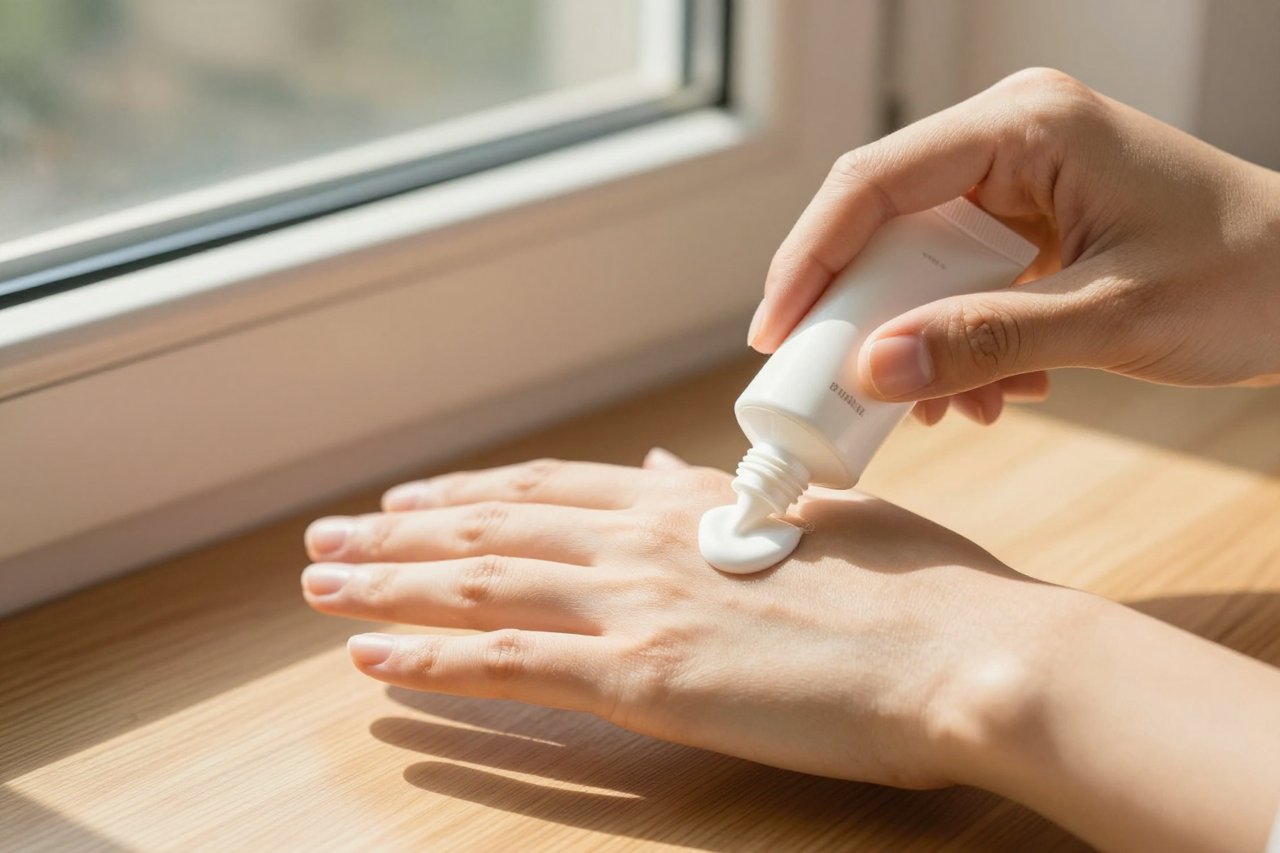
The working rule: a teaspoon for face and neck, and roughly a shot glass for an adult body in swimwear. On a bright day outdoors, reapply every two hours, and sooner if you’ve been swimming or sweating heavily.
Coverage also fails at the edges. Ears, the back of the neck, the tops of feet, the parting in your hair, and the strip of forehead just below a cap brim all get missed with startling consistency.
Things broad-spectrum does not mean
The claim gets stretched in marketing far beyond what the test covers.
- It doesn’t mean reef-safe. That phrase has no legal definition. Hawaii banned oxybenzone and octinoxate from 2021, which is a specific chemical rule, not a certification.
- It doesn’t mean chemical-free. Zinc oxide is a chemical. Every filter is.
- It doesn’t cover visible light. Standard broad-spectrum testing stops at 400nm. Tinted formulas containing iron oxides are the ones with evidence for blocking high-energy visible light, which matters for melasma and post-inflammatory pigmentation.
- It doesn’t mean all-day. No filter survives eight hours of daylight on skin, regardless of the number on the bottle.
A quick audit of whatever is in your bathroom cabinet
Pick up the bottle and check three things. Does it say broad spectrum with an SPF of 30 or above? Is it less than a year old and still the right consistency? Would you genuinely wear it tomorrow morning without negotiating with yourself?
If any answer is no, that’s your answer. The tube that spent last summer in a hot car is worth replacing, because heat accelerates the breakdown of avobenzone and other organic filters, and a separated or shrunken formula has usually lost its ability to spread evenly. Sunscreen only performs at its labelled rating when roughly a quarter-teaspoon goes onto the face and a full shot glass covers the body. A product you’ll use generously and reapply on a Tuesday afternoon in March beats a superior one sitting unopened on a shelf.


