
Table of Contents
The first time I tried to set up a home gym, I bought a $30 ab roller, a resistance band set from a discount site, and a folding bench that wobbled if you looked at it wrong. Total spend: about $120. Total workouts completed: four.
The second attempt cost roughly the same and has survived six years of use. The difference wasn’t money. It was knowing which five or six pieces of equipment do 90% of the work, and where the cheap version is genuinely fine.
Here’s how to build a simple home gym on a budget without filling your spare room with regret.
Start With the Space, Not the Shopping List
Measure the floor you can actually dedicate before you open a single product page. A 6-by-8-foot patch of carpet is plenty for dumbbells, a mat, and bodyweight work. If you have a 4-by-4-foot corner, you’re still in business, but you should skip anything long, like a barbell or a flat bench.

Two things trip people up here. The first is ceiling height: a doorway pull-up bar needs clearance, and basement gyms with low joists can rule out overhead pressing entirely. The second is flooring. A single 6mm mat over hardwood protects your knees and keeps you from sliding mid-lunge. Over concrete, add a cheap interlocking foam tile layer underneath. It costs about $30 and makes the space feel like a room instead of a garage.
Think about noise and neighbours
If you live in an apartment, dropped dumbbells are the fastest way to meet your downstairs neighbour. Rubber-coated weights and a mat solve most of it. Skip anything you’d need to slam.
The Gear That’s Worth Real Money
Three purchases justify spending a bit more. Everything else can be cheap.
Adjustable dumbbells
A pair of adjustable dumbbells replaces an entire rack. A used set of spin-lock dumbbells with 50 pounds of plates runs $60 to $90 on marketplace listings; new dial-style sets run $200 and up. If you only buy one thing, buy this. You can squat, press, row, hinge, and curl with a single pair, which means one purchase covers your whole body.
A mat that doesn’t slide
A $12 yoga mat from a discount store will bunch up under your hands during push-ups and drive you mad. Spend $25 to $35 on a 6mm mat with a textured underside and it’ll last years. This is the single most-used item in most home gyms.
A doorway pull-up bar
Twenty to thirty dollars, installs in about four minutes with no drilling, and gives you the one movement that’s genuinely hard to replicate with free weights. Check the doorframe width before ordering; a bar that doesn’t fit is just a metal stick.
Where Cheap Is Genuinely Good Enough
Resistance bands, jump ropes, foam rollers, and sliders all perform fine at low price points. A $15 set of loop bands does almost everything a $60 set does. The only thing to watch is the resistance rating: buy a set with three levels rather than three bands of the same tension.
Bands are also the best answer if you’re short on space or travelling. There’s a solid range of movements you can do with nothing else, and you can follow a complete resistance band workout for full-body strength without owning a single weight.
A short list of things you can safely buy cheap:
- Resistance bands and loop sets ($12 to $20)
- Jump rope ($8 to $15)
- Foam roller ($15)
- Sliders or furniture-mover discs for lunges ($10)
- Door anchors and handles for bands ($10)
Buying Secondhand Without Getting Burned
Home gym equipment is one of the best categories for secondhand buying, because most of it gets bought in January and sold in March. A few rules keep you safe.
Check dumbbells for bent handles and rust at the seams. Weigh plates if you can, since some cheap sets are under weight. For benches, sit on it and push sideways, because a wobble you feel in a stranger’s garage will drive you crazy at home. Avoid anything with fabric, foam padding, or electronics that can’t be inspected properly, and always ask why they’re selling. “I’m moving” is a good answer. “It’s been in the shed for three years” is not.
Facebook Marketplace and local auction sites beat eBay on price because nobody wants to pay shipping on 50 pounds of iron. Set a saved search for “dumbbells” and check it every few days for two weeks. Deals show up.
A Realistic Starter Setup for Under $200
Here’s a build that covers strength, cardio, and mobility without a single wasted purchase:
- Used adjustable dumbbells, 2 x 25 lb: $60 to $80
- 6mm exercise mat: $30
- Doorway pull-up bar: $25
- Three-band loop set: $15
- Jump rope: $10
- Foam roller: $15
That’s $155 to $175 depending on the dumbbell find. It fits in a corner, covers every major movement pattern, and doesn’t need a single upgrade to be useful for a year or more.
Make the Room Somewhere You Want to Train
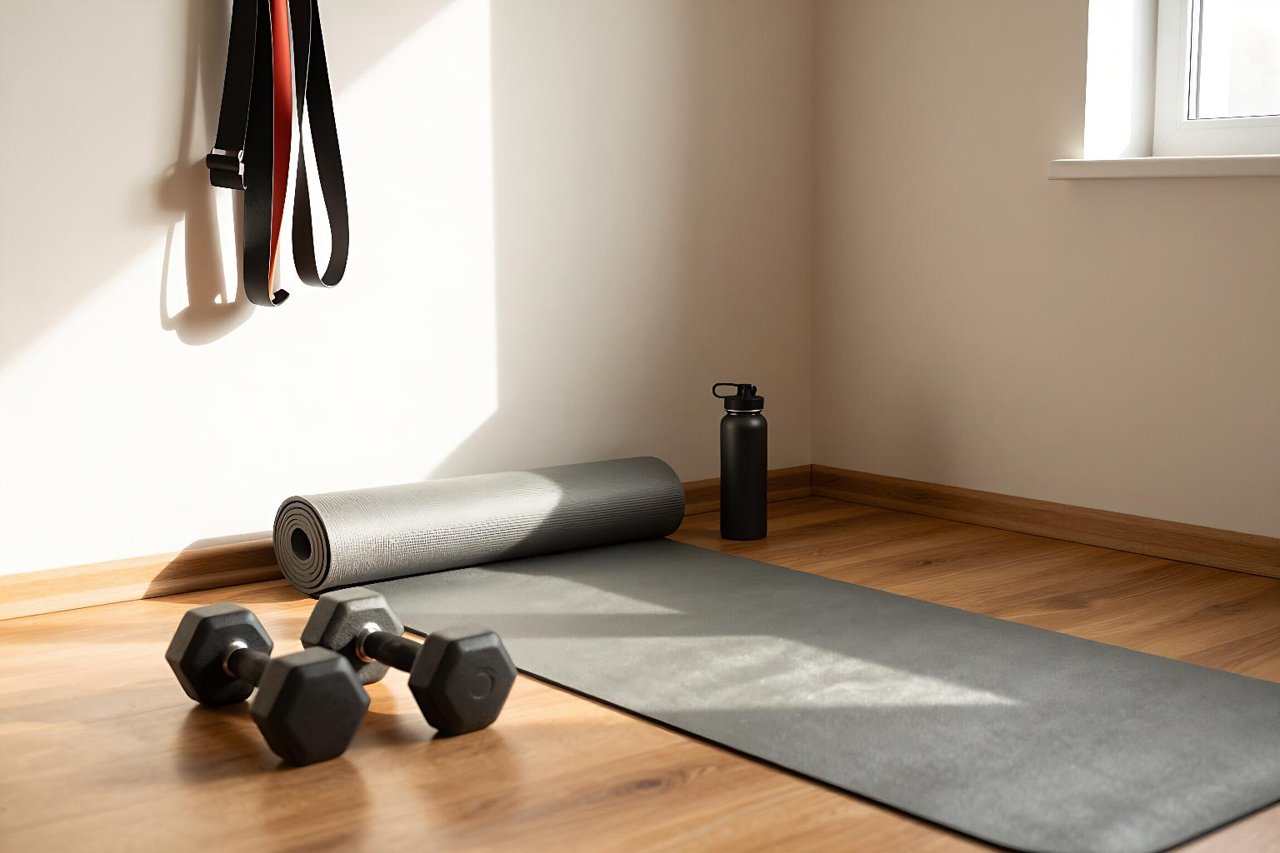
A mat rolled into a cupboard is a mat you’ll forget about. Leave the equipment out and visible. Hang the bands on a hook instead of burying them in a drawer, and keep the dumbbells on a cheap $20 rack or a sturdy shelf so you’re not dragging them across the floor every session.
Light matters more than people expect. A $15 clip lamp pointed at a blank wall beats flickering fluorescent tubes. A small Bluetooth speaker is worth it too, if only because silence makes every workout feel longer.
All of that is decoration compared to the real hurdle, which is showing up when you’d rather not. There are practical ways to stay motivated to work out when you’d rather do anything else, and most of them involve lowering the friction between you and the first rep. A gym you can walk into in ten seconds is already a big advantage.
Add Gear Slowly, and Only When Something Breaks
The temptation after month two is to buy more. Resist it. A kettlebell, a bench, a barbell set and a cable tower will not make you fitter than a consistent dumbbell routine, and each one adds clutter that makes the room less appealing.
A better rule: upgrade when a specific goal demands it. Want to deadlift 200 pounds? Then you need a bar and plates. Want to train for a half marathon? Then you need shoes and a plan, not a rowing machine.
The same logic applies at the household level. Rather than buying everything at once, fold fitness into a broader budget you can actually sustain, the way you’d plan any other recurring expense in a wellness routine that fits your budget. And if someone asks what to get you for a birthday or the holidays, a kettlebell or a decent mat is a far better answer than another candle. Our 2025 ultimate holiday gift guide has a few ideas in that vein if you need to drop a hint.
Six years in, my setup is a used dumbbell set, a mat, a pull-up bar and three bands. It still fits in a corner of the living room. The ab roller went to a charity shop in year one, and I have not missed it once.


