
Table of Contents
The itch usually starts small. A band of redness under a watch strap. A line of tiny blisters across the forearm two days after pulling weeds. A welt on the neck that disappears by lunch and is replaced by three more by dinner. Skin allergies are strange that way — the same immune mistake can look completely different depending on which trigger set it off and where on the body it landed.
Knowing which of the top 7 types of skin allergies you’re dealing with changes everything about how you treat it. A barrier cream won’t fix hives. An antihistamine won’t fix a chemical burn disguised as an allergy. Here’s how to read the clues.
1. Allergic Contact Dermatitis: The Rash That Leaves a Trace
This is the classic case of skin touching something it has decided to fight. Nickel in earrings, belt buckles, and jeans buttons is the most common culprit worldwide, followed by fragrance mixes, preservatives in cream, hair dye, and the urushiol oil in poison ivy and oak.
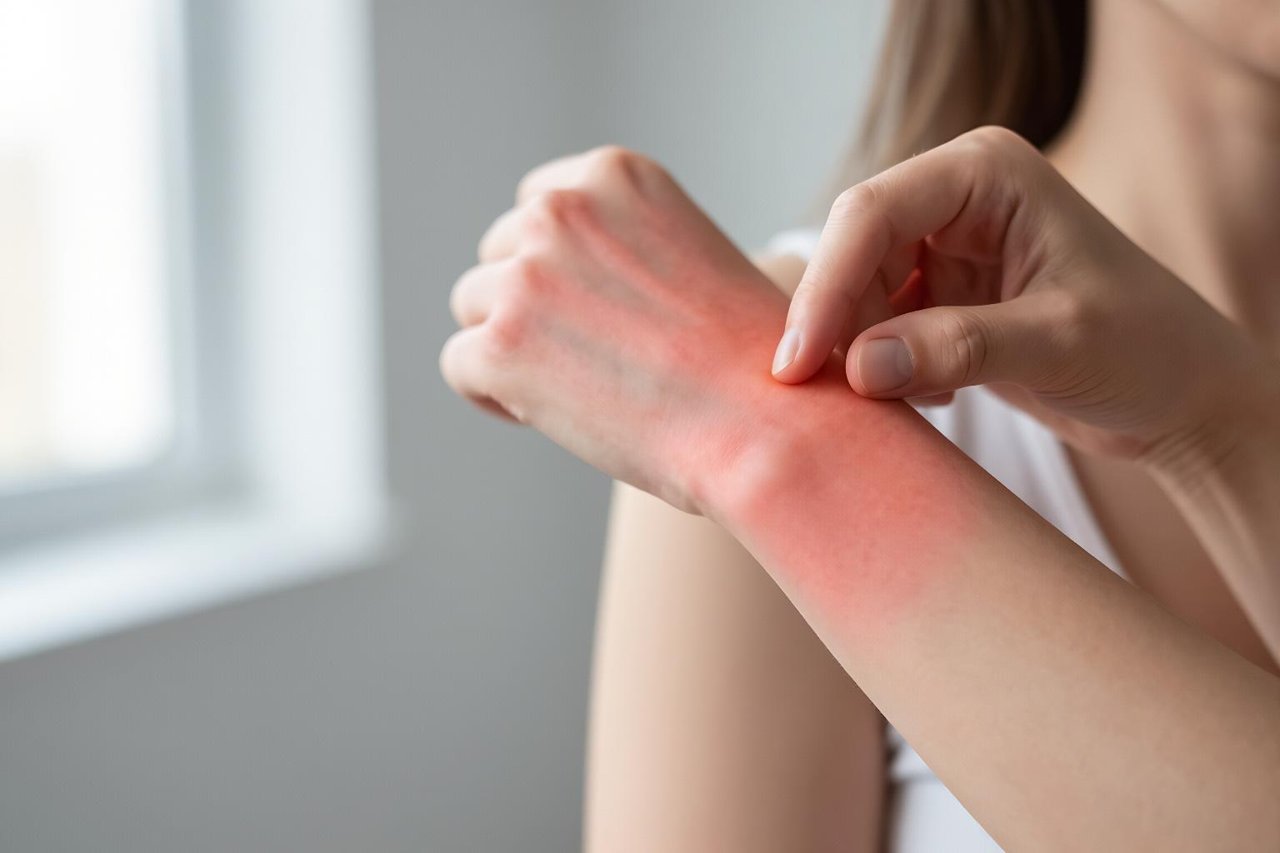
The tell is geometry. The rash appears only where the substance touched skin — a circle under a watch face, a streak up the leg where a plant brushed past, an earlobe but not the cheek. It rarely shows up instantly. In someone already sensitised, redness and blisters typically develop 12 to 72 hours after exposure, which is why people so often blame the wrong product.

Dermatologists confirm it with patch testing: small chambers taped to the back, read at 48 and 96 hours. It’s tedious and oddly satisfying when the answer finally appears.
2. Hives (Urticaria): Welts That Move Around
Hives are raised, pink or skin-coloured swellings with a paler centre that blanch when you press them. They itch, sometimes intensely, and they have a signature behaviour: any single welt lasts less than 24 hours before fading, while new ones keep arriving elsewhere. If a mark is still in the same spot three days later, it probably isn’t a hive.
Acute cases often follow a food, a new medication, or a viral infection, and clear within six weeks. Chronic urticaria — hives most days for longer than six weeks — is found in roughly 1% of people and in most cases no external trigger is ever found; the immune system is simply misfiring against the skin’s own mast cells.
Swelling of the lips, tongue, or throat alongside hives is a different matter entirely and needs emergency care. People with skin allergies often have sensitive airways too, which is why a lingering tickle in the throat deserves attention — these causes of a chronic cough are worth reading if the irritation won’t quit.
3. Atopic Dermatitis (Eczema)
Eczema isn’t strictly an allergy, but it belongs on the list because allergic triggers make it flare and because it so often travels with hay fever and asthma. The underlying problem is a leaky skin barrier — many people with eczema carry a faulty filaggrin gene — which lets irritants and allergens slip past the surface and set off inflammation.
Look for dry, scaly patches in the elbow creases and behind the knees in children, and on the hands, eyelids, and neck in adults. Itching comes before the rash, not after, and scratching deepens it. Roughly one in five children develops it, and a good proportion carry it into adulthood.
One easy mistake: assuming every flaky ring-shaped patch is eczema. A persistent ring with a raised, scaly edge is often fungal instead, and steroid cream makes it worse. If that sounds familiar, this guide to fungal infection treatment will help you sort out what actually works.
4. Drug Eruptions: Rashes From Medication
Almost any drug can trigger a skin reaction. The most common pattern is a morbilliform eruption — a measles-like spread of flat red blotches starting on the trunk and moving outward, usually 5 to 14 days after starting a new medicine. Penicillins, sulfa antibiotics, and anticonvulsants are frequent offenders.
Some reactions are more serious. A rash that peels, blisters, or involves the eyes, mouth, or genitals can signal a severe reaction such as Stevens-Johnson syndrome, and that is a hospital problem, not a wait-and-see problem. Certain chemotherapy agents, including carboplatin, are also known to set off hypersensitivity reactions in some patients, which is one reason infusions are monitored so closely.
5. Photoallergic Reactions: When Sunlight Joins the Fight
Some substances only become allergenic after ultraviolet light hits them. Sunscreen filters, fragrance ingredients, the anti-inflammatory gel you rubbed on a sore knee, and even the lime juice from a cocktail on a beach day can all set this off.
The pattern gives it away: the rash appears only on skin that saw both the chemical and the sun, so a swimsuit line or the shape of a shirt collar becomes visible. It typically develops 24 to 72 hours after sun exposure rather than the few minutes you’d expect from a sunburn, and it can sting or burn rather than itch.
6. Latex Allergy Rash
Latex reactions range from a local itchy rash to full anaphylaxis. The classic skin signs are hives appearing within 15 to 30 minutes on the hands or face after contact with gloves, balloons, or condoms — an immediate, IgE-driven reaction rather than the slower response of contact dermatitis.
Healthcare workers, cleaners, and people who’ve had many surgeries are at higher risk, and roughly half of those affected react to certain foods by cross-reactivity. Banana, avocado, kiwi, and chestnut are the usual suspects; itching or swelling in the mouth after eating them is a hint worth mentioning to a doctor.
7. Food-Related Skin Reactions
Food allergies rarely stop at the skin, but the skin often speaks first. Hives, flushing, and swelling around the mouth show up within minutes to two hours of eating the trigger food — milk, egg, peanut, tree nuts, shellfish, and wheat cover most cases in children.
A subtler version is pollen-food syndrome, where raw apple, carrot, or hazelnut causes an itchy mouth and mild rash in people allergic to birch pollen. Cooked versions often cause no trouble at all. Meanwhile, some food reactions are delayed and show up as an eczema flare a day or two later, making the cause-and-effect link hard to spot without a food diary.
Practical Steps That Actually Calm an Allergic Rash
- Stop the exposure first. No cream will outrun a trigger that’s still in contact with the skin — that means removing the new detergent, the earrings, the gloves, or the scented lotion.
- Cool, not hot. A lukewarm shower and a cool compress cut itching faster than any ointment. Hot water feels wonderful for 30 seconds and then makes everything worse.
- Plain emollient, applied generously. Fragrance-free creams restore the barrier; a thick layer beats a thin one by a wide margin.
- Oral antihistamines for hives. Non-sedating options work best for daytime; sedating ones are useful at night when itching peaks.
- Skip the herbal miracle creams. Multiple-ingredient natural remedies are among the most common causes of allergic contact dermatitis on the face.
Red Flags That Need a Same-Day Call
Most allergic rashes are uncomfortable but manageable. A few patterns are not. Get medical help quickly if the rash comes with a fever, spreads fast, or starts to blister and peel. Swelling of the lips, tongue, or throat, difficulty breathing, or feeling faint after a new food or medication means emergency services, not a call-back tomorrow.
Also worth a prompt appointment: a rash that hasn’t improved after two weeks of sensible home care, any reaction that involves the eyes, or a pattern that keeps returning in the same place without an obvious cause. Photograph it on your phone at its worst — rashes fade and shift, and a clear picture taken at 11pm is worth more in the consulting room than a vague memory three weeks later. A short course of topical steroids, the right antihistamine, or a patch test series can end months of guessing, and once you know your specific trigger, avoiding it is far simpler than treating the fallout.


