
Table of Contents
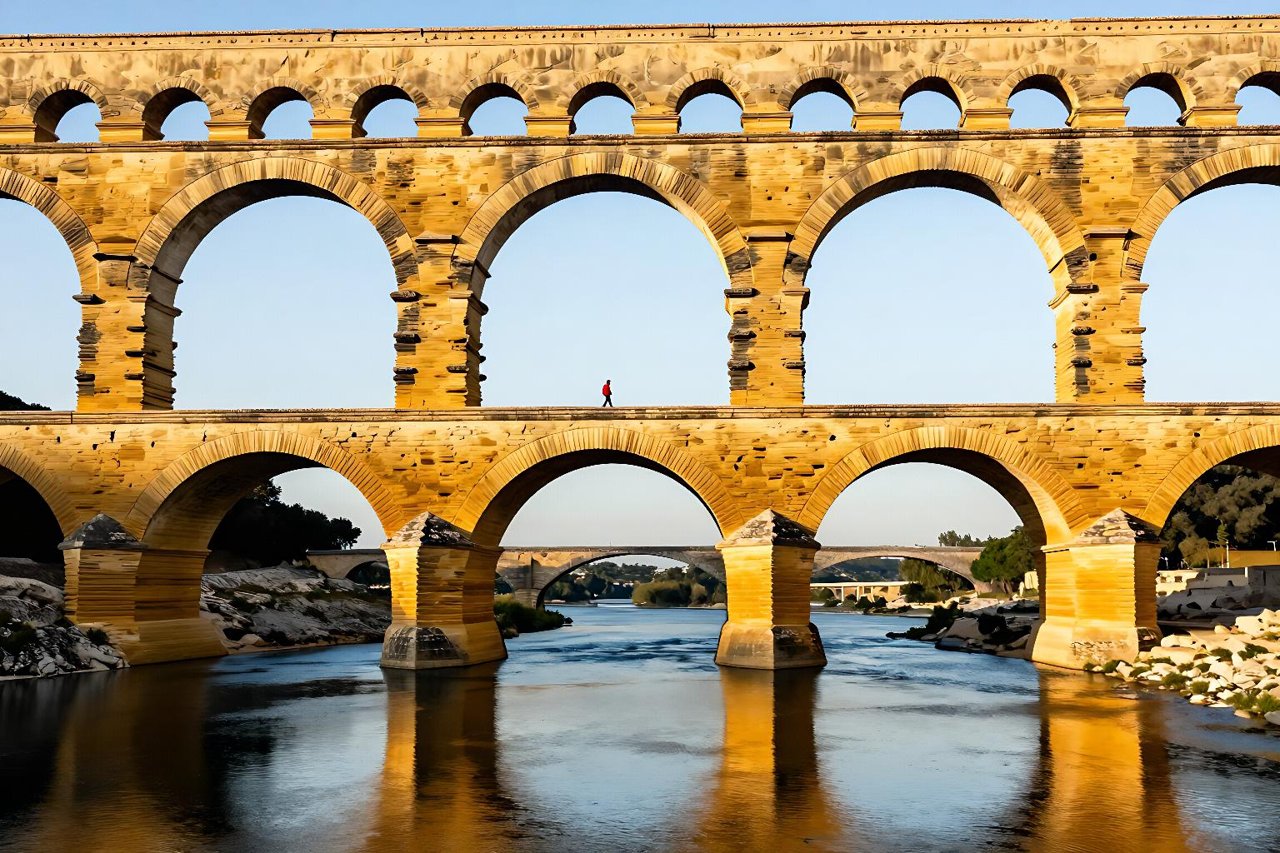
The Pont du Gard carried water to the Roman city of Nîmes for roughly 400 years. Along the full 50-kilometre aqueduct, the channel dropped just 17 metres, a gradient of about 1 in 3,000, and the Romans set that line using a water level and a sighting instrument called a chorobates, without sinking a single shaft to check their work. Get the slope slightly wrong over that distance and the water simply stops flowing.
It didn’t stop. That single fact is why the study of ancient civilizations with advanced engineering is not a hobby for romantics. It is a field of practical, humbling information for anyone who has ever poured concrete or laid a drain.
Roman Concrete Gets Stronger as It Ages
Rome ran eleven aqueducts into the city, close to 500 kilometres of channel, and the engineers who maintained them wrote the whole system down. Frontinus, appointed water commissioner in 97 AD, produced a report listing every pipe, every branch, and every landowner illegally tapping the supply. Auditing, in other words, not just building.
The material underneath that system has aged better than anything we make today. Roman marine concrete mixed volcanic ash from the Pozzuoli fields with lime and seawater. In 2017, a team led by Marie Jackson at the University of Utah found crystals of aluminium-tobermorite growing inside samples from Roman harbours, a mineral that strengthens the concrete over time as seawater dissolves the ash.

Modern Portland cement concrete is typically designed for a service life of 50 to 100 years. Roman harbour concrete has been pounded by Mediterranean waves for 2,000.
Giza: The Miracle Was Logistics, Not Magic
The Great Pyramid contains about 2.3 million blocks, roughly 6.5 million tonnes of stone, stacked to a height of 146.6 metres. It is aligned to the cardinal points within about three arcminutes, a fraction of a degree, which is tighter than many modern buildings manage.
The part that genuinely unsettles engineers is the supply chain. In 2013, papyrus fragments found at Wadi al-Jarf on the Red Sea coast turned out to be the logbook of an official named Merer, recording crews of about 40 men ferrying Tura limestone down the Nile to the pyramid site in two to three days per trip. The documents name the crews, the shifts, and the food allocations.
So the pyramids were not built by an unexplained force. They were built by an organisation that could move thousands of tonnes of stone, house and feed perhaps 20,000 workers, and keep accounts. The engineering feat is the bureaucracy as much as the masonry.
The Indus Valley Had Better Plumbing Than Most Modern Cities
At Mohenjo-daro, around 2500 BC, almost every house had a bathing platform with a sloping floor, a chute leading to a covered drain in the street, and a soak pit outside to take the waste. Drains were laid in brick with removable cover slabs so they could be cleaned. The Great Bath, a 12 by 7 metre tank about 2.4 metres deep, was sealed with a layer of bitumen to keep water in.
Bricks across a territory of roughly a million square kilometres were fired to a single 1:2:4 proportion of thickness, width and length. Nobody enforced that with an army, which makes it one of the more interesting puzzles in Bronze Age archaeology. The full story of those cities, and why they were laid out around sanitation rather than palaces, is worth reading in this piece on the Indus Valley civilization and its drain-first urban planning.
Greek Gearing That Shouldn’t Exist Yet
In 1901, sponge divers pulled a corroded lump from a shipwreck near Antikythera. It took most of the twentieth century to understand what it was: a bronze gear train of at least thirty interlocking wheels, cut by hand, built around 2,100 years ago. The device tracked the Metonic calendar, predicted solar and lunar eclipses, and followed the four-year cycle of the Olympic Games.
Nothing of comparable mechanical complexity appears in Europe again until the astronomical clocks of the fourteenth century. Greek engineering tends to get filed under temples and columns, but the machine tradition behind the Antikythera mechanism ran alongside it, as this account of how small Greek city-states punched above their weight makes clear.
Inca Stonework Was Designed to Move
Machu Picchu sits at 2,430 metres on a granite ridge between two fault lines. The Inca built it anyway, and the walls are still standing because they were built to fail slightly and recover.
Inca masons cut blocks to fit without mortar, sometimes to tolerances where a knife blade will not enter the joint. The walls lean inward a few degrees and sit in courses that can shift during a quake and settle back. At Sacsayhuamán near Cusco, individual limestone blocks weigh well over 100 tonnes and were fitted with the same precision.
Underneath the terraces, crews packed layers of gravel, sand and topsoil to drain the monsoon away from the foundations. Almost half the engineering effort at Machu Picchu is invisible, buried in drainage. Several sites in the Andes belong on any list of ruins that keep rewriting what we think ancient people could do.
China’s Canal and the Bronze Seismoscope
The Grand Canal eventually ran about 1,776 kilometres from Beijing to Hangzhou. Chinese engineers solved the problem of rivers at different heights with pound locks, a chamber that raises or lowers a boat between water levels, roughly four centuries before the same design appears in Europe.
In 132 AD, the astronomer Zhang Heng presented a bronze vessel about two metres across, with eight dragons around the rim, each holding a ball. A pendulum inside released a ball into the mouth of a toad below when the ground shook. Courtiers reportedly laughed when a ball dropped with no tremor felt in the capital, then stopped laughing when a messenger arrived days later reporting a quake several hundred kilometres away.
What Modern Engineers Quietly Copy
The techniques are not lost, they are being reverse-engineered. A short list of the borrowings:
- Self-healing concrete. Lime capsules and crystalline additives in modern mixes are a direct attempt to reproduce what Roman ash concrete does on its own.
- Seismic dry-stone. Engineers studying Inca joints have tested scaled walls on shake tables to model how segmented masonry dissipates energy.
- Passive cooling. Persian windcatchers and qanats, the underground channels that carried water for tens of kilometres without evaporating, inform desert architecture today.
- Standardisation. Indus brick ratios and Roman pipe sizes are the ancestors of every modular building code in existence.
Much of this overlapping ground, from Damascus steel to precision drilling, is covered in this survey of ancient civilizations and the technologies they got to first.
The Part That Never Makes the Postcard: Maintenance
Here is the detail that matters most, and it rarely gets mentioned. The Roman aqueducts did not survive because Roman concrete was magic. They survived because Rome employed people to walk the lines, clear the calcium carbonate buildup, and repair the leaks, and because Frontinus wrote down what the system was supposed to look like so that his successors could tell when it wasn’t.
When the maintenance stopped, the channels silted up within a generation or two. The engineering held. The institution didn’t.
That is the real lesson from the ancient world. Anyone can admire a block that weighs 200 tonnes. The harder discipline, and the one that actually determines whether infrastructure lasts two decades or two millennia, is the unglamorous one: knowing exactly what you built, writing it down, and paying someone to check it every year.


