
Table of Contents
In 1901 a Greek sponge diver named Elias Stadiatis surfaced from a wreck off the island of Antikythera convinced he had found a shipment of dead bodies. What he had actually found was cargo from a ship that sank around 70 BC: bronze and marble statues, packed in crates. Among it all was a corroded lump of metal about the size of a shoebox, which sat ignored in a museum in Athens for fifty years.
Then someone spotted a gear tooth.
That lump turned out to be a geared astronomical calculator built more than 2,000 years ago. It tracked the sun and moon, modelled the moon’s uneven speed across the sky, and predicted eclipses. Nothing of comparable mechanical complexity survives from anywhere in the world until the clockwork of medieval Europe, roughly 1,400 years later.
It has plenty of company. Across a dozen civilisations there are objects and techniques that look like they wandered in from the wrong century. Some are genuine marvels. A few are wishful thinking. All of them are worth a closer look.

The Antikythera Mechanism: A Computer Made of Bronze
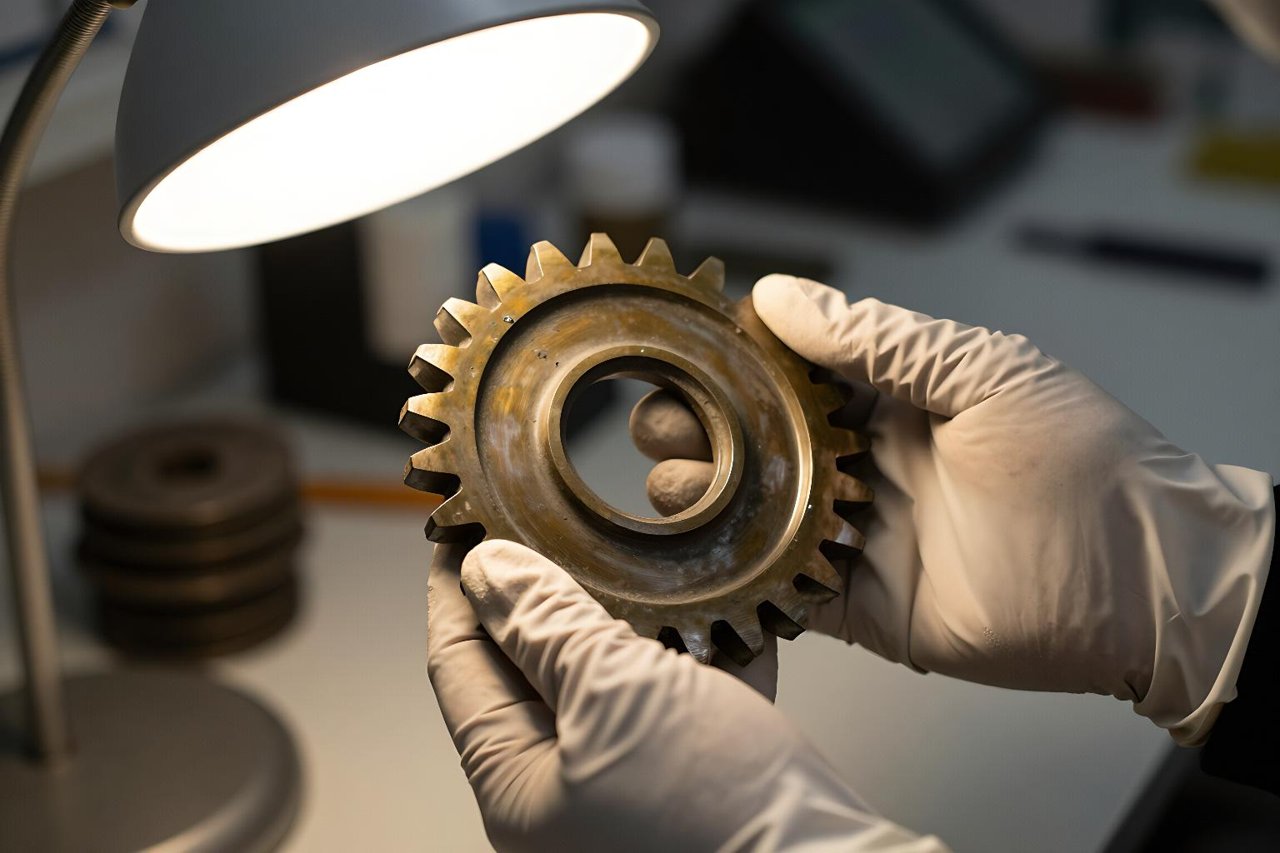
At least 30 bronze gears survive, and reconstructions suggest there were once several dozen, cut by hand with teeth barely a millimetre apart. The cleverest part is a pin-and-slot arrangement that reproduces the moon’s varying orbital speed. Instead of calculating that wobble, the maker built the irregularity physically into the gearing. Any modern mechanisms designer would recognise the trick instantly.
The dials also tracked a four-year cycle of athletic games, which tells you the machine was as much a status object as a scientific instrument. CT scans in 2006 read more than 2,000 characters of tiny Greek text hidden inside the fragments, including what appears to be a user manual. Someone built this thing and then wrote instructions for it.
Roman Concrete That Gets Stronger With Age
Harbour piers poured by Roman engineers around 2,000 years ago are still standing in Italy, while modern marine concrete often gives out in fifty. For decades the explanation was luck and volcanic ash from the Bay of Naples.
Then researchers looked closer at the lumps of lime scattered through Roman mixes. A 2023 MIT study argued those lumps are not sloppy mixing but a deliberate feature. When a crack reaches a lime clast, the clast reacts with water and calcium carbonate crystallises into the gap. The concrete heals itself. Earlier work on seawater concrete found rare minerals growing inside it as ash and saltwater reacted over centuries, making the structure tougher with time.
Portland cement, the stuff in almost everything we build, produces around 8% of global carbon emissions and is designed to be inert. Rome’s recipe improves as it soaks. We are only now working out how to copy it.
The Lycurgus Cup and Accidental Nanotechnology
Made in the 4th century AD and now in the British Museum, this glass vessel is one of the strangest objects to survive antiquity. Lit from the front it looks jade green. Lit from within, it glows a deep blood red.
The effect comes from gold and silver particles roughly 50 nanometres across, suspended in the glass. The Roman glassmakers almost certainly had no idea why the brew worked. They found a recipe that produced the colour and copied it. Reproducing that effect reliably took until the late 20th century, when scientists with electron microscopes finally worked out what the craftsmen had stumbled into.
China’s Earthquake Detector and the Paper Revolution
In 132 AD the astronomer Zhang Heng presented the court with a bronze vessel ringed by eight dragons, each holding a ball above the open mouth of a toad. When the ground shook, the mechanism dropped a ball with a clang, pointing toward the direction of the tremor. In 138 AD a single ball fell and nobody in the capital had felt a thing. Officials doubted the device until a messenger arrived days later reporting a quake several hundred kilometres away.
China’s record of firsts runs far past seismographs. Many of ancient China’s greatest inventions reached Europe only centuries after they were in daily use in Asia, carried along trade routes that moved objects faster than explanations.
Paper mattered most. Cai Lun’s refinement of papermaking around 105 AD gave scholars something cheaper than silk and lighter than bamboo. Every technology on this list depended on somebody writing down how it worked.
Surgery Before Anyone Knew What Germs Were
Sushruta’s operating theatre
The Sushruta Samhita, compiled in India around the 6th century BC, describes more than 300 surgical procedures and 120 instruments. The rhinoplasty technique recorded there, rebuilding a nose from a flap of cheek skin, reached Europe via Italian surgeons in the 15th century and is still recognisable in modern reconstructive work. Sushruta also told his students to clean their instruments with fire and wash before operating, some 2,300 years before germ theory gave anyone a reason.
Inca skull surgery
Peruvian skulls bearing neatly cut holes tell a similar story. A 2018 analysis of more than 800 craniotomies found survival rates climbing over the centuries, from roughly 40% in early cultures to as high as 75-80% under Inca surgeons. Bone regrowth around the openings proves many patients lived for years afterwards. The Inca had no iron tools and no writing, but they had practised hands and a clear sense of which cuts killed people.
Hero of Alexandria’s Coin-Operated Vending Machine
In the 1st century AD, Hero of Alexandria described a device for dispensing holy water in temples. A worshipper dropped a coin through a slot. The coin landed on a small pan, its weight tripped a lever, a valve opened, and a measured pour of water came out. The coin slid off, the lever reset, and the machine waited for the next customer.
That is the operating principle of every mechanical vending machine since. Hero also built a sphere that spun on steam and wrote about automata that staged miniature plays. None of it started an industrial revolution. When labour is cheap and slaves are plentiful, a steam engine is a curiosity rather than a business.
Persian Water Tunnels That Still Run
Iran’s qanats, some dating to around 700 BC, are gently sloping tunnels that carry water from the water table at the foot of mountains to villages and fields many kilometres away, with vertical shafts every 20 or 30 metres for access and ventilation. More than 20,000 kilometres of them were dug, and plenty still supply cities like Yazd. The engineering is impressive. The maintenance is the real achievement: those channels have been cleaned by hand, generation after generation, for nearly three thousand years.
Why “Ahead of Their Time” Is Only Half the Story
Not every odd artefact deserves the label. The so-called Baghdad Battery is the classic cautionary tale. The jar, found near the Iraqi capital in 1936, contains a rolled copper sheet and an iron rod, and will produce a small voltage if you fill it with vinegar. Popular books have called it proof of ancient electricity. No wires were found, no electroplated objects from the period exist, and the residue inside is more consistent with a rolled-up scroll. It is probably not a battery.
The genuinely extraordinary cases point at something more interesting than lost genius. The Antikythera mechanism needed a patron rich enough to fund precision bronze work. Roman concrete needed the specific ash of Pozzuoli. Damascus steel depended on trace elements in Indian wootz ore, and when the supply chain shifted, the technique died within a generation. A technology outlives its inventor only when four conditions line up:
- It can be taught. Written instructions travel; a master’s muscle memory does not.
- It can be repaired. Anything needing a specialist who no longer exists is already gone.
- Someone profits from keeping it alive. Qanats survive because cleaning them is somebody’s paid job.
- The supply chain holds. Exotic ingredients make beautiful objects and fragile traditions.
The Chinese inventions that did spread worldwide, paper, printing, the compass, gunpowder, are exactly the ones that passed all four tests. They were cheap to copy, useful to everyone from monks to generals, and worth building industries around. The Antikythera mechanism failed every single one, and its knowledge died with the workshop that made it.
That is the uncomfortable lesson hiding inside these objects. A brilliant idea is the easy part. Surviving requires customers, spare parts, teachers, and enough boring repetition to make the whole thing ordinary. The real marvel is not that someone built a computer out of bronze two thousand years ago. It is that anything at all made it across the gap.


