
Table of Contents
Stand outside the cathedral in Valencia at noon on a Thursday and you’ll see something odd: a row of men in black robes sitting in a circle on the pavement, settling arguments about irrigation water. The Tribunal de las Aguas has been hearing these cases for around a thousand years. No lawyers, no paperwork, no appeals. Farmers from eight canals state their case, the tribunal rules on the spot, and everyone goes back to the fields. It’s the oldest continuously operating court in Europe, and it exists for one reason: in a dry country, water has never been just water.
That instinct runs through every ancient society that lasted. Managing water, meaning finding it, moving it, storing it, sharing it and then getting rid of the surplus, was the hardest engineering problem most civilisations ever tackled. There were no pumps, no electricity, no steel. There was gravity, mud, stone, rope, human backs and a very sharp eye for the shape of the land.
Reading the Ground Before Digging It
Long before anyone built an aqueduct, people worked out that water hides. Damp patches, lines of green plants on a hillside, a seam of gravel in a cliff face: all of it pointed to water moving underground, and somebody had to learn to read the signs.
The oldest known wells are roughly 8,000 years old, sunk through soft rock at Atlit Yam off the coast of Israel and at Jericho in the Jordan Valley. Cutting one by hand through several metres of gravel is slow, filthy and dangerous work. Nobody did it for fun. They did it because the river was a day’s walk away and the settlement was staying put. The same stubborn logic shaped the first cities, which had to solve water and waste before anything else worked.

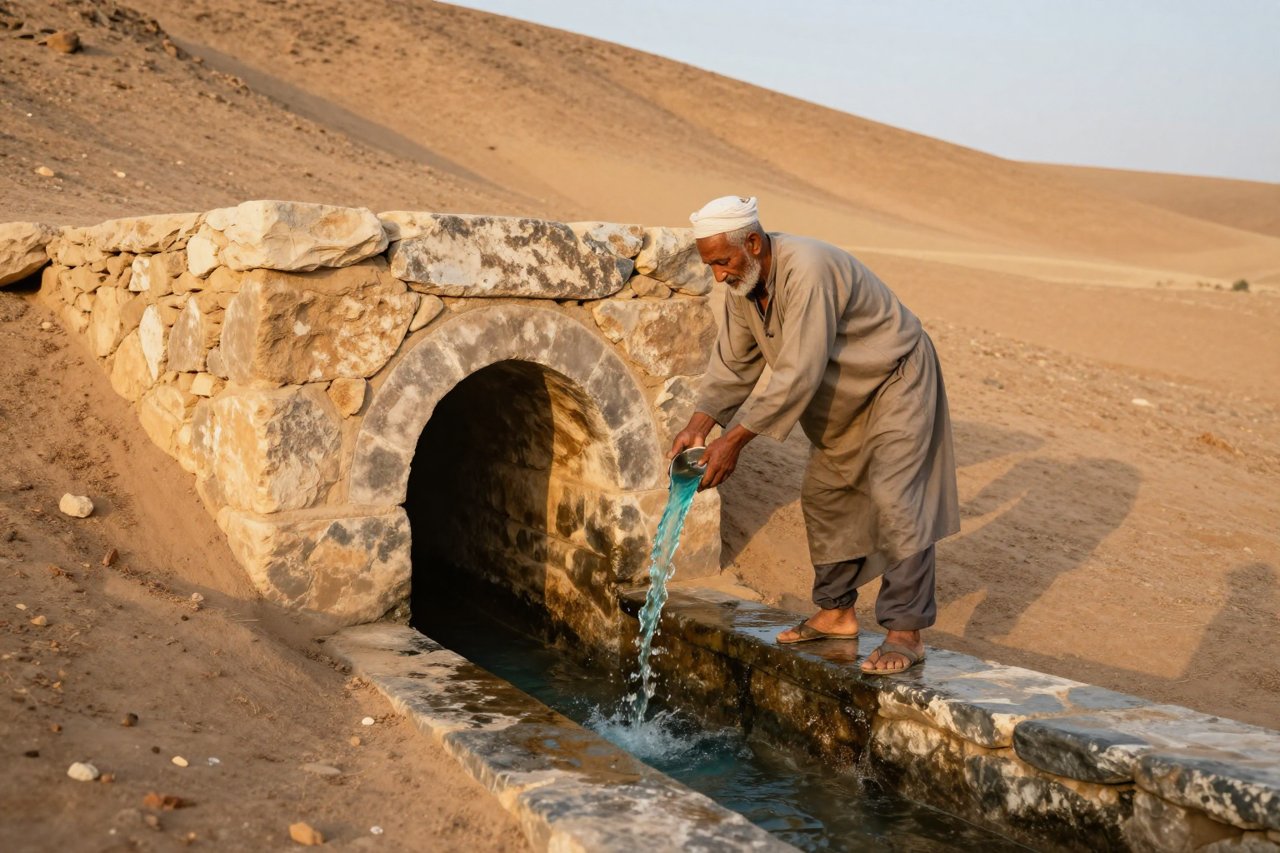
The Persians pushed the idea much further around 700 BC with the qanat, also called a kariz in Afghanistan, a khettara in Morocco and a foggara in Algeria. Same tool, a dozen names.
What’s inside a qanat
- The mother well: a deep shaft dug at the foot of a hillside until it hits the water table, sometimes 100 metres or more down.
- The tunnel: a gently sloping channel carrying water out to the fields, falling just enough to keep it moving without scouring the walls.
- Access shafts: vertical holes every 20 to 30 metres so workers can climb down and clear silt, which is a job that never stops.
- The outlet: where the water finally surfaces, cool, clean and free of evaporation losses.
The qanat at Gonabad in Iran runs about 33 km and has been delivering water for roughly 2,700 years. Its mother well is close to 400 metres deep. Around 22,000 qanats still operate in Iran today, which tells you something about how well the design works.
Rome’s Water Machine
Rome did water on a scale nobody had attempted before. Eleven aqueducts eventually fed the city, delivering something close to a million cubic metres a day at the peak: baths, fountains, public latrines, private villas and the fire brigades. The engineering was mostly about slopes. The Pont du Gard in southern France carries a channel 50 metres above the river on a gradient of about 34 cm per kilometre, which means the surveyors got their levels right without a laser or a spirit level. Everything relied on gravity, so every metre of fall had to be earned.
Water commissioners like Frontinus, who ran the system around AD 97, spent their days chasing leaks, illegal taps and fraud among the pipe crews. He wrote a whole book complaining about it. The system that made all of this possible is worth reading in its own right, along with the politics and scale of the empire that grew up around it.
Canals and the First Water Bureaucrats
In southern Iraq, the Tigris and Euphrates flooded at the wrong times and changed course whenever they felt like it. Farmers responded by digging. Irrigation canals were running across Sumerian land by 3000 BC, some of them tens of kilometres long, with sluice gates, dredging crews and inspectors.
All that shared infrastructure created the world’s first water laws. Hammurabi’s code, carved around 1754 BC, sets out what happens if you let your canal flood your neighbour’s field: you pay him back in grain, and if you can’t pay, your goods get sold. Egypt ran on a similar rhythm, tracking the Nile flood with nilometers so officials could set tax rates before the water arrived. A short flood meant a thin harvest, and everyone from the pharaoh down needed to know in advance.
The Monsoon Problem
Monsoon Asia faced the opposite challenge: months of deluge, months of nothing. The Khmer Empire answered it with enormous reservoirs called barays. The West Baray at Angkor is about 8 km by 2 km and held something like 50 million cubic metres of water, dug and dammed by hand and elephant over decades. From there, a web of canals and channels spread water to rice fields, filled the moats and kept the city alive through the dry season. The scale and planning behind it is why the Khmer capital became the biggest pre-industrial city on Earth.
Sri Lanka pulled off a similar trick with tanks linked in cascades, where the overflow from one reservoir fed the next. Some of those systems are still irrigating fields eight centuries later.
Catching Rain Before It Runs Away
Not everyone had a river. Cities with none learned to harvest the sky. Constantinople’s Basilica Cistern, built in the 6th century, sits underground on 336 columns and holds roughly 80,000 cubic metres of water piped in from the surrounding hills. Petra, carved into a desert canyon, ran on more than 200 cisterns and a system of channels and clay pipes that collected flash floods and steered them into storage. Machu Picchu has around 129 drainage channels, most of them buried beneath the terraces, and it is still standing on a wet mountainside because of them.
On the dry south coast of Peru, the Nazca people built puquios: spiral-shaped openings down to underground channels that tapped aquifers and fed them out to fields. Several still work. They’re one of the genuinely puzzling water systems that still puzzle archaeologists today, partly because nobody is quite sure how the tunnels were engineered.
Lifting Water Without Engines
Gravity gets water downhill. Getting it uphill took invention. The shaduf, a counterweighted bucket on a pole, has been in use in Egypt and Iraq for at least 5,000 years and can lift water two or three metres. The Archimedes screw, a spiral inside a tilted tube, lifts water steadily with nothing but a turning handle. The norias of Hama in Syria reached 20 metres in diameter and groaned water up from the Orontes for centuries.
King Sennacherib of Assyria went further around 700 BC, building an 80 km canal and aqueduct to bring water into Nineveh, including a stretch sealed with waterproof cement that still holds after 2,700 years.
Who Gets the Water, and When
Shared water always needs rules, and ancient societies wrote theirs down. Qanat water in Iran was owned in time units, sold and inherited in 15-minute slices. Omani falaj shares were auctioned by the minute during dry spells. In Athens, access to a public fountain was bound up with citizenship, and the city’s piped supply was watched over by officials with the power to fine anyone who drilled into it illegally.
Greek city-states treated water as public infrastructure and civic pride at the same time, which fits neatly with the way Greek ideas about law and shared civic life ended up shaping so much else. The practical lesson carried straight through to Valencia’s Thursday morning tribunal.
Why the Systems Broke, and Why We’re Copying Them Again
Almost none of these systems failed because the engineering was wrong. They failed when the maintenance stopped. Angkor’s reservoirs silted up as the Khmer state fragmented. When the Ostrogoths cut Rome’s aqueducts during a siege in AD 537, the city’s population collapsed back onto wells and the polluted Tiber within a generation.
That is the part modern engineers keep relearning. In Rajasthan, Rajendra Singh and a network of villagers revived thousands of traditional johads, small earthen check dams, and brought dry rivers back to flow. Tucson and other desert cities now mandate rainwater harvesting. Chinese cities are designing sponge districts that mimic the old baray-and-canal logic. Iran’s qanats survive because someone’s grandfather dug them and someone’s grandson still climbs down a shaft with a rope and a lamp to clear the silt.
The lesson is not that ancient people were wiser. It’s that every water system is a promise to keep looking after it, whether it runs on Roman concrete, mudbrick or a billing department. The ones that last are the ones where the maintenance never quietly stops.


