
Table of Contents
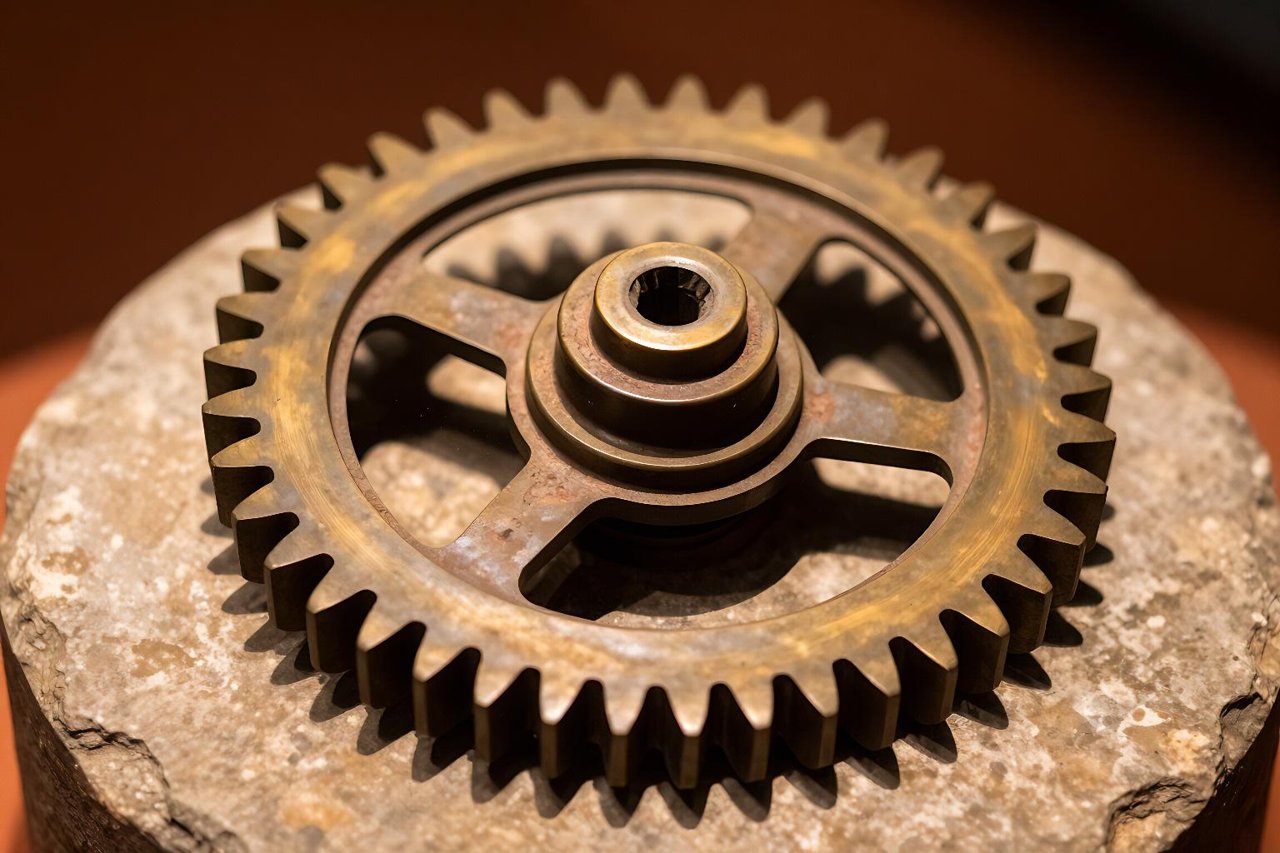
In 1901, Greek sponge divers sheltering from a storm off the island of Antikythera hauled a lump of corroded bronze out of a Roman shipwreck. It sat in a museum in Athens for decades until an archaeologist named Valerios Stais noticed a gear wheel embedded in the corrosion. Another century of X-ray imaging and CT scanning followed before anyone could say what he was looking at: a hand-cranked astronomical calculator, built between roughly 150 and 100 BCE, with at least thirty interlocking bronze gears.
Nothing of comparable mechanical complexity turns up again for well over a thousand years. That is the pattern with the best ancient engineering. We can usually describe what a device did and measure how well it worked. Explaining how it was made, or building a working copy from the same materials, is a different problem entirely.
The Antikythera Mechanism: A Computer Made of Bronze
Eighty-two fragments survive, and the largest gear carries 223 teeth, a number that matches the saros cycle of 223 lunar months. The front dial tracked the zodiac and the Egyptian calendar. The back carried spiral dials for the nineteen-year Metonic cycle and for predicting eclipses, plus a small rotating ball for the phase of the moon. A team at University College London built a functioning replica in 2021, so the gearing itself is no longer a secret.
The knowledge chain is. Cicero, writing in the first century BCE, mentions bronze spheres made by Archimedes that reproduced the motions of the sun, moon and planets. If devices like that existed, where are the workshops, the drawings, the apprentices, the clumsy early versions? The Antikythera mechanism looks like the last survivor of a tradition that left almost no other trace, which puts it in the same company as other ancient mysteries that still baffle scientists and historians.

Roman Concrete That Gets Stronger as It Ages
Stand under the dome of the Pantheon in Rome and look up. It spans 43.3 metres, it has been holding since about 126 CE, and it remains the largest unreinforced concrete dome on Earth. Modern engineers would find it difficult to pour an equivalent today without steel reinforcement.
The Romans were not simply lucky with their aggregate. They mixed lime with volcanic ash from the fields around Pozzuoli, and in seawater the chemistry kept working long after the builders died. A 2017 study led by Marie Jackson at the University of Utah found crystals of aluminous tobermorite and phillipsite growing inside cracks in the concrete, effectively healing damage and blocking saltwater intrusion. Roman harbour piers have taken two thousand years of wave action. Modern marine concrete is typically designed to last fifty to a hundred.
Then there is the mixing question. In 2023, researchers at MIT argued that the lumps of lime found in Roman concrete were not sloppy workmanship but a deliberate hot-mixing technique, leaving reactive calcium pockets that seal cracks when water reaches them. The lab results look convincing. Field trials take years, and until they report back, the argument stays open.
Damascus Steel: The Blades Nobody Can Fully Reproduce
Crucible steel from India, known as wootz, travelled west and produced blades with a watery, rippling surface and a reputation that outlived the technology that made them. Carbon content ran somewhere between 1.5 and 2 percent, and the blades held an edge while staying flexible enough to survive combat.
By around 1750 the supply had dried up. The specific ores and the long, tightly controlled forging cycle were gone, and nobody could make the real thing again. Modern analysis added a twist. A 2006 electron microscopy study of a genuine Damascus blade by Peter Paufler’s group in Dresden found cementite nanowires and carbon nanotubes inside the steel matrix, structures you would normally associate with advanced materials science rather than an eighteenth-century forge.
Smiths today produce pattern-welded steel that photographs convincingly. Metallurgists can explain carbide banding in general terms. Neither amounts to a full reconstruction, because the starting ore, the trace elements and the exact thermal cycles are lost.
Greek Fire: A Weapon That Burned on Water
In 678 CE, an Arab fleet besieging Constantinople was destroyed by a substance that burned on the surface of the sea and could not be quenched with water. The Byzantines mounted it on siphons in their bows and, according to contemporary accounts, threw it roughly thirty metres. It saved the city more than once.
Nobody knows the recipe. The most plausible reconstructions combine distilled petroleum, pine resin, sulphur and quicklime, but no complete formula survives and the secret died when the city finally fell in 1453. Every modern demonstration is an educated guess with a flame thrower attached.
The Lycurgus Cup and Nanotechnology in the Fourth Century
The Lycurgus Cup, a Roman glass vessel made in the fourth century CE, changes colour depending on how you light it. Shine light through it and it glows translucent red. View it under reflected light and it turns opaque jade green.
Scientists only worked out why in the 1950s. Particles of gold and silver around fifty nanometres across are suspended in the glass. Producing that effect means grinding precious metal into a colloidal suspension with tight control over particle size, and the craftsmen responsible had no concept of atoms, let alone nanometres. No second ancient example has ever been found. The cup is a one-off.
Stonework That Shouldn’t Fit Together
Sacsayhuamán, on the hill above Cusco in Peru, is assembled from limestone blocks weighing up to about 125 tonnes, cut and fitted so closely that a knife blade will not slide between two of them. There is no mortar anywhere in the walls. The quarry sat roughly twenty kilometres away, and the site itself is at 3,700 metres.
The unfinished obelisk at Aswan
Cut into the granite bedrock of a quarry in southern Egypt lies a single block around 42 metres long and close to 1,000 tonnes. It was abandoned after a crack appeared, which is why we can still see the trench the workers carved around it. What we cannot see is how they intended to lift it out, or how they moved the obelisks that did make it to Rome and Istanbul.
The methods on the table
- Timber rollers and sledges on prepared tracks, which works on flat ground and badly on slopes.
- Earthen ramps, which in some cases would have consumed more material than the monument itself.
- Levers and counterweights applied in small increments, demonstrated at scale in experiments but never at a hundred tonnes.
- Water-assisted transport on rafts or lubricated mud tracks, plausible in some locations and impossible in others.
The honest position is that several of these probably worked in different places, and the builders wrote no manual.
Small Objects, Bigger Question Marks
Some of the strangest finds fit in the palm of your hand. Because they are small, they are easy to dismiss, and because they are small, there is nowhere to hide the evidence.
- The Nimrud lens. A 3,000-year-old piece of rock crystal, about 38 mm across and ground as a plano-convex disc, found at Nimrud in Iraq in 1850. Magnifying glass, burning glass, or decorative inlay? The argument has run for more than a century without resolution.
- The Baghdad jar. Excavated in 1936 at Khujut Rabu, a clay pot holding a copper cylinder wrapped around an iron rod. Filled with vinegar it generates a volt or two, which is why it is often called a battery. Most archaeologists think it stored scrolls. No electroplated object from the period has ever turned up.
- The Inca quipu. Bundles of knotted cotton cord, some with more than a thousand individual strings, used by officials to record numbers and possibly narratives. The number system is largely decoded. The rest is contested.
- Zhang Heng’s seismoscope. A bronze vessel built in 132 CE with eight dragon heads that dropped balls into the mouths of bronze toads to indicate the direction of an earthquake. The internal mechanism has never been reconstructed convincingly.
Objects like these sit in the same territory as the scientific mysteries that still baffle researchers today: small, physical, well documented, and stubbornly resistant to a tidy answer.
Why the Gaps Remain
Almost none of these puzzles involve a missing physical law. They involve missing people. Wootz steel needed specific ores and a smith whose hands knew when to stop the heat. Greek fire needed a family of specialists with a state monopoly and a reason to keep quiet. Roman concrete needed a particular ash and a crew culture that went out with the empire. Knowledge that lives in a workshop rather than a text has a habit of vanishing in a single generation, and war, plague and economic collapse do this often enough that the survival of any of it is the surprising part.
The phrase we still don’t understand also tends to be looser than it sounds. Usually it means we have three or four plausible explanations and no way to choose between them. Replication experiments can help: if a method cannot produce the artefact to the tolerances observed, it drops out of the running. That is slow, unglamorous work, and it is exactly what is chipping away at the list of unsolved puzzles from the ancient world.
What makes this field worth following is the way each answer rearranges your assumptions about progress. A ship’s cargo in the first century BCE carried an analogue computer. Roman harbour walls outlast the ones we pour. A fourth-century glassmaker stumbled into nanotechnology without a word for an atom. The past was not a slow warm-up to the present. It was full of solutions that worked, travelled, and then got dropped.


