
Table of Contents
Ask ten people over 70 what “exercise” means and you’ll get ten answers. One pictures a gym full of chrome and mirrors. Another thinks of an aerobics class from 1987. A third assumes it’s off-limits because of a knee, a heart stent, or a fear of falling.
Here’s the useful version: exercise is any planned movement you repeat on purpose, and almost all of it counts. Lifting a tin of tomatoes eight times is exercise. Standing on one leg while the kettle boils is exercise. This article covers the fundamentals from zero, without assuming you own a gym membership or know what a “rep” is.
What movement actually does to an older body
Muscle mass starts slipping at roughly 3–8% per decade from about 30, and the slide accelerates after 60. Bone density follows a similar curve, particularly in women after menopause. Reaction time slows, the tiny sensors in your ankles and inner ear get less reliable, and the result is a body that can still do most things but has less margin for error.
The encouraging part is how quickly the trend reverses. One well-known study of people aged 86 to 96, living in a nursing home, put them on a resistance programme for eight weeks. Their leg strength more than doubled. They were not athletes. They were people who had been sitting down for years.

Strength is only half the story. Balance training cuts fall risk, and roughly one in four adults over 65 falls each year. Cardiovascular work keeps the heart and lungs efficient enough to climb stairs while holding a conversation. None of this requires anything more exotic than a chair, a wall, and a pair of shoes with grip.
The four kinds of movement you need, in plain terms
Most beginner programmes fail because they only include one type. You want a bit of all four, even if the amounts are small.
1. Strength work
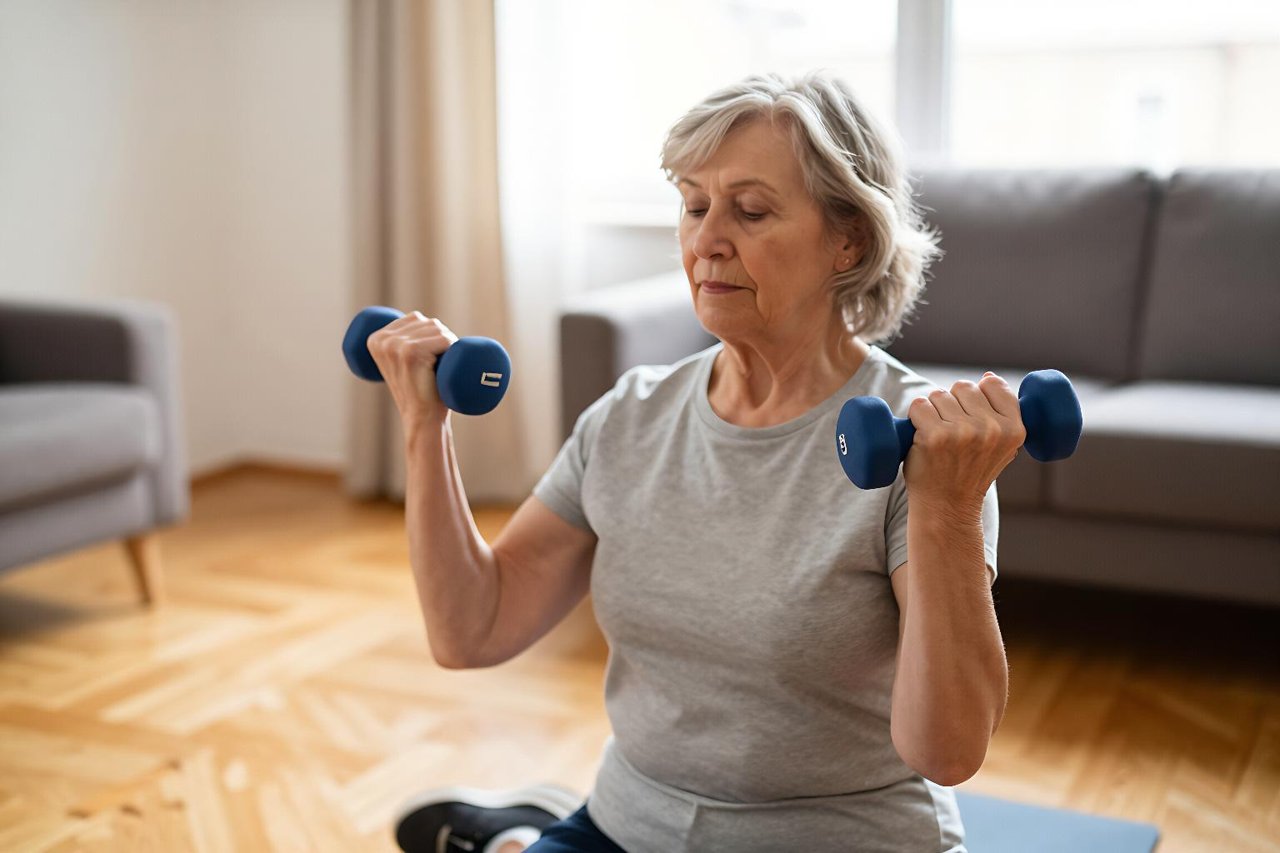
Anything that makes a muscle push or pull against resistance: standing up from a chair, wall push-ups, resistance bands, dumbbells, water bottles. Two sessions a week is enough to start, and each session can be 15 minutes. Do 8–12 repetitions of each movement, rest, then repeat once or twice.
If standing is difficult or you tire quickly, seated work is a genuine option rather than a consolation prize. These chair exercises for seniors cover the major muscle groups without requiring you to get down to the floor.
2. Balance work
Balance is a skill, not a gift, and it responds to practice within weeks. Start holding the kitchen counter and stand on one foot for ten seconds. Progress to holding on with one fingertip, then not at all. Heel-to-toe walking along a corridor and standing on a folded towel add difficulty without danger.
3. Aerobic movement
Walking counts. So does swimming, cycling, dancing, pushing a mower, or a shuffle around the block in bad weather. The target is 150 minutes a week of moderate effort, which sounds intimidating until you realise it splits into five 30-minute walks or ten 15-minute ones.
4. Flexibility and mobility
Five minutes of gentle stretching at the end of a session is plenty. Focus on hips, calves, chest and shoulders, the four areas that stiffen most with age and desk-sitting. Never bounce into a stretch and never push into pain.
How hard should it feel?
You do not need a smartwatch. Use the talk test: during aerobic work you should be able to speak in short sentences but not sing. If you’re gasping, ease off. If you could read a book aloud comfortably, pick up the pace.
For strength work, the final two repetitions of each set should feel genuinely difficult, with two or three more left in reserve. If you could do fifteen easily, the weight or the movement is too light. That single principle, gradually doing slightly more than last time, is what separates a programme that works from one that just makes you tired.
What a first month realistically looks like
Here’s a sample week for someone starting from very little. Adjust it to your own knees, hips and schedule.
- Monday: 20-minute walk plus five minutes of balance drills at the counter
- Tuesday: strength session, six movements, one or two sets each
- Wednesday: rest or ten minutes of gentle stretching
- Thursday: 20-minute walk
- Friday: strength session, same movements as Tuesday
- Saturday: something enjoyable, gardening, swimming, a longer walk with company
- Sunday: off
Keep the same six movements for the first few weeks. Adding variety feels productive but makes it harder to notice progress. If the real obstacle is not the squats but getting started at all, this guide to building healthy habits from zero deals with the habit side, which is usually the harder half.
Safety rules worth taking seriously
Discomfort in a muscle is normal. The following are not, and mean you stop and seek advice: chest pressure or pain, dizziness, unusual breathlessness, or joint pain that persists after you finish.
A few practical habits prevent most mishaps. Breathe out on the effort rather than holding your breath; counting out loud is a simple fix. Clear the floor of rugs and cables. Use a firm kitchen chair, never a wheeled office chair, if you’re holding on for support. Keep a phone within reach if you live alone. Anyone with a heart condition, a recent operation, or a fall in the past year should run the plan past a GP or physiotherapist first, not to be told no but to be told which movements to swap.
The mistakes that quietly cancel out effort
Two years of walking the same flat route at the same pace will keep you where you are, not make you stronger. The most common pattern is plenty of gentle activity and almost no strength or balance work, which is precisely backwards given what falls and frailty actually look like. There are also subtler traps: doing everything in one long Sunday session, giving up for a month after a twinge, using weights so light that nothing adapts. These exercise mistakes that quietly cancel out your effort are worth reading before week three, when enthusiasm usually dips.
Choose a format and stop deliberating
The best exercise is the one you will still be doing on a wet Tuesday in February. Walking suits people who like being outdoors and dislike equipment. Water workouts suit anyone with arthritic joints, because buoyancy takes load off knees and hips. Chair routines suit people managing fatigue or poor balance. Weights suit anyone who wants the fastest improvement in everyday strength, like carrying shopping or rising from a low sofa. If you’re torn, this comparison of walking, weights, water workouts and chair routines lays out the trade-offs honestly.
Your actual first session, spelled out
Start smaller than feels impressive. Tomorrow, do this: five sit-to-stands from a firm chair, five wall push-ups, a ten-second single-leg stand at the counter on each side, and a ten-minute walk. That’s it. Twelve minutes, no equipment, nothing that requires a change of clothes.
Repeat it three times this week, on non-consecutive days. Next week, add one repetition to each movement or one minute to the walk. In four weeks you’ll be doing roughly double, which is exactly how a body adapts. If you’d rather follow something written out day by day, this four-week starter plan for your living room removes the guesswork entirely.
The number that matters is not how much you lifted or how far you walked on day one. It’s how many weeks in a row you showed up. Someone who does twelve modest minutes three times a week for a year will be dramatically stronger and steadier on their feet than someone who attempted an hour, hurt something, and stopped in March. Pick the version you can repeat when you’re tired, and let the difficulty creep up slowly from there.


